
From The Institute For The Study of War:
Russian Offensive Campaign Assessment, March 22, 2023
Riley Bailey, George Barros, Grace Mappes, Kateryna Stepanenko, Nicole Wolkov, Layne Philipson, and Frederick W. Kagan
March 22, 8 pm ET
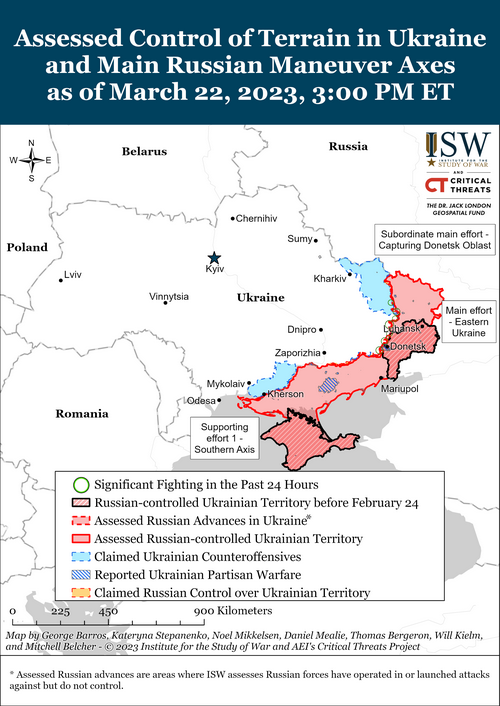
Click here to see ISW’s interactive map of the Russian invasion of Ukraine. This map is updated daily alongside the static maps present in this report.
Click here to access ISW’s archive of interactive time-lapse maps of the Russian invasion of Ukraine. These maps complement the static control-of-terrain maps that ISW produces daily by showing a dynamic frontline. ISW will update this time-lapse map archive monthly.
Russian forces conducted a limited drone and missile strike campaign in Ukraine overnight on March 21-22, indicating that Russian forces continue struggling with precision missile shortages. The Ukrainian General Staff reported that Russian forces conducted 21 drone strikes targeting residential and infrastructure areas in Kyiv, Zhytomyr, Zaporizhia, and Odesa oblasts, and Ukrainian forces shot down 16 of the drones.[1] Ukrainian officials stated that Russian forces struck two residential high-rise buildings in Zaporizhzhia City, killing at least one civilian and injuring 33.[2] Russian forces conducted more intensive and wider-ranging strikes during the fall 2022 air and missile campaign, suggesting that Russian forces may now be rationing their use of high-precision munitions for these strike campaigns or may simply lack the necessary munitions to sustain strike campaigns at their earlier pace and intensity. Head of the Ukrainian Joint Coordination Press Center of the Southern Forces Nataliya Humenyuk stated that the Russian missile strike threat remains high but that Russian forces would likely only conduct a limited campaign.[3]
Russian Defense Minister Sergey Shoigu announced that the Russian Ministry of Defense (MoD) intends to increase the size of Russia’s air defense forces at a Russian MoD collegium on March 22. Shoigu stated that one of the Russian Aerospace Forces’ (VKS) development priorities is to generate more air defense units with advanced air defense systems.[4] He noted that in 2023 Russian forces plan to form a new air defense division and brigade, form a special purpose air defense missile brigade, form a new anti-aircraft missile regiment with more advanced S-350 systems, form a military transport aviation regiment, and complete the modernization of Moscow City’s air defense systems.[5] Shoigu also commented on Russian combat experience in Ukraine, stating that Russian pilots conducted over 140,000 combat sorties since February 24, 2022, and that 90 percent of operational-tactical and army aviation, 60 percent of strategic long-range aviation, and 85 percent of UAV operators have combat experience.[6]
The Russian military is unlikely to generate such forces within several years, let alone by the end of 2023. Russia’s defense industrial base has historically experienced multi-year delays in developing advanced air defense systems, even before the strict sanctions and exacerbated resource constraints resulting from Russia’s invasion of Ukraine. Current Russian air defense brigades and regiments received their S-400 systems up to several years behind schedule.[7] The Russian military had only fielded the S-500 system, which was reportedly supposed to enter production in 2015, in one Russian air defense army by 2021.[8] Russia also delayed its planned delivery of a second S-400 battery to India in 2022 due to constraints caused by Russia’s invasion of Ukraine.[9] Russia may eventually grow its air defense forces as part of a larger effort to recreate a large conventional military in the long term, however. Shoigu’s announcement is similar to his previous announcement at an MoD collegium in December 2022 in which Shoigu stated that Russia seeks to form 17 new maneuver divisions over several years.[10]
The formation of new Russian air defense and airlift units will not increase Russian combat power in Ukraine this year. Shoigu’s statement is likely intended to reassure the Russian people that the Russian MoD is continuing to develop the Russian military as a world-class military power to offset perceptions about Russian military failures in Ukraine.
Shoigu likely signaled to Japan that it should not attempt to exploit Russia’s current military vulnerability in the Kuril Islands and to China that Russia remains a worthwhile military partner. Shoigu extolled the strength of Russia’s Eastern Military District (EMD) at length and announced that the EMD deployed a battery of Bastion coastal defense missile systems on Paramushir Island—an island in the northern portion of the Russian-occupied Japanese Kuril Islands. Shoigu’s statement was likely a warning signal to Japanese Prime Minister Fumio Kishida, who visited Kyiv and Bucha on March 21, about becoming too engaged in supporting Ukraine.[11] The Russian Eastern Military District is severely degraded. Significant Russian EMD elements deployed to Belarus and were badly damaged during the Battle of Kyiv in early 2022. Russian EMD elements of the 155th and 40th Naval Infantry Brigades recently fought and suffered heavy losses near Vuhledar in Donetsk Oblast in early 2023.[12] The 155th has been destroyed and reconstituted as many as eight times in the past year.[13] Shoigu’s statement was also likely a signal to Chinese President Xi Jinping that Russia supports Chinese security objectives in East Asia and remains a viable military partner despite the terrible damage Ukraine has inflicted on the Russian military.
Russian Defense Minister Sergey Shoigu walked away and refused to answer a question about how soon to expect peace in Ukraine. A journalist from the Russian Ministry of Defense-run media outlet TV Zvezda first asked Shoigu how the war will end, to which Shoigu responded, “any war ends in peace.”[14] The journalist then asked Shoigu how soon to expect peace in Ukraine. Shoigu did not answer the question and walked away. TV Zvezda originally aired the footage of Shoigu walking away but cut it in a later release. ISW previously reported that the Kremlin aims to set information conditions and prepare the Russian information space for a protracted war.[15]
The tempo of Russian operations around Bakhmut appears to be slowing amid Western reporting that Russian forces may be attempting to launch offensives in other directions. Russian forces made additional marginal advances in southern Bakhmut, and Ukrainian forces conducted counterattacks on the southwestern and northwestern outskirts of the city on March 21 and 22.[16] The Ukrainian General Staff reported on March 22 that Russian forces’ offensive potential in the Bakhmut area is declining, and Ukrainian officials have previously reported fewer combat clashes in the city itself in recent days.[17] US National Security Council Spokesperson John Kirby stated on March 21 that Russian and Ukrainian forces are continuing to prioritize operations around Bakhmut and that Russian forces might try to conduct another offensive, possibly in many different directions.[18] The United Kingdom Ministry of Defense (UK MoD) assessed that Russian forces may be losing momentum in the Bakhmut area because the Russian MoD is relocating units to other directions.[19] Russian forces are currently increasing the tempo of their offensive operations around Avdiivka aiming to encircle the settlement, and it is possible that Russian forces are doing so at the expense of their operations around Bakhmut and the stalled offensive around Vuhledar.
Russian personnel of the 136th Separate Guards Motorized Rifle Brigade (58th Combined Arms Army, Southern Military District) previously stated that they were deploying to the Vuhledar area to conduct assaults, but a Russian milblogger claimed on March 21 that elements of the 136th Motorized Rifle Brigade are operating in the Avdiivka direction.[20] This apparent deployment change—if it is not a result of Russian misreporting—possibly indicates that Russian forces prioritized the intensification of operations around Avdiivka over restarting the offensive on Vuhledar. Ukrainian Tavriisk Defense Forces Spokesperson Colonel Oleksiy Dmytrashkivyskyi stated on March 19 that Russian forces started increasing assaults in the Avdiivka area to set conditions for restarting offensive operations on Vuhledar, further suggesting that current Russian offensive operations around Avdiivka are preventing the potential resumption of offensive activities near Vuhledar.[21] Russian forces appear to be drawing more combat power to the Avdiivka area which may allow them to increase their rate of advance, although there were no confirmed Russian advances in the area on March 22. ISW continues to assess that Russian advances may prompt Ukrainian forces to withdraw from Bakhmut and/or Avdiivka although neither appears likely at this time. Russian forces may choose to launch or intensify offensive operations in new directions, but these operations would likely produce few tangible results as the overall Russian spring offensive continues to near culmination. ISW has still not observed evidence of the commitment of the Russian 2nd Motorized Rifle Division of the 1st Guards Tank Army (Western Military District) despite reports that it had reconstituted in Belarus and deployed to Luhansk. The Russians may commit this unit to one or more offensives already underway or to a new offensive undertaking. The commitment of this division’s two or three motorized rifle regiments is unlikely to achieve operationally decisive effects, however, given the failure of larger formations to do so.
Russian forces may be deploying T-54/55 tanks from long-term storage to Ukraine to compensate for significant armored vehicle losses. The Georgia-based open-source Conflict Intelligence Team research group reported on March 22 that Russian forces transported a train loaded with T-54/55 tanks from Primorsky Krai towards western Russia, and social media sources speculated that Russian forces may deploy them to Ukraine.[22] Dutch open-source group Oryx assessed as of March 22 that Russian forces have lost at least 57 T-90, 448 T-80, 1,025 T-72, 53 T-64, and 73 T-62 tanks in highly attritional fighting in Ukraine.[23] Russian armored vehicle losses are currently constraining the Russian military’s ability to conduct effective mechanized maneuver warfare in stalling offensives in Ukraine, and Russian forces may be deploying T-54/55 tanks from storage to Ukraine to augment these offensive operations and prepare for anticipated mechanized Ukrainian counteroffensives. The Soviet Union produced tens of thousands of T-54/55 tanks after the Second World War, and the Russian military may be turning to extensive Soviet reserves of these tanks to solve its significant armored vehicle shortages. The Russian military may also be deciding to field the tanks because parts to repair the T-54/55 tanks are abundantly available and substantially cheaper. T-54/55 tanks lack the armor capabilities of more modern armored equipment, however, and originally carried a smaller main gun, although the Russian military may have modernized some vehicles. The Russian military will likely experience greater numbers of casualties by fielding these older tank systems in Ukraine. The deployment of inferior equipment to replenish the Russian military’s ability to conduct mechanized maneuver warfare may prompt a further degradation of Russian manpower in Ukraine. Russian forces are unlikely to achieve preferable resource attrition rates on the grounds that T-54/55 are cheaper than anti-tank guided missile (ATGM) ammunition, as some have argued—each tank loss is the loss of a tank crew as well as the tank, after all, and it is not clear how effective these tanks will be against Ukrainian armored vehicles, whereas they are highly vulnerable to many anti-tank systems available to Ukraine, not all of which are expensive.
Russian authorities are cracking down against bars in urban areas, possibly to crack down against internal dissent among Russian social circles. St. Petersburg outlet Fontanka claimed on March 22 that St. Petersburg authorities shut down two dozen bars as part of a broader investigation into claims of involving minors in “anti-social acts,” including systematic drinking, drug use, and vagrancy.[24] This excuse is implausible given normal Russian attitudes toward “systematic drinking.” Russian Federal Security Service (FSB) personnel conducted recent raids against two popular bars and forced patrons to conduct pro-war activities, after which at least one Russian businessman stepped away from his role in managing the bars, as ISW has previously reported.[25] These raids may target rich Russian businessmen like Wagner financier Yevgeny Prigozhin, who failed to deny current ownership of a St. Petersburg bar in his response to a Russian journalist who alleged that Prigozhin owned the bar in June 2022.[26] These measures may also encourage self-censorship within these circles and among bar attendees by publicly displaying the consequences of speaking out of turn.
Key Takeaways
- Russian forces conducted a limited drone and missile strike campaign in Ukraine overnight on March 21-22, indicating that Russian forces continue struggling with precision missile shortages.
- Russian Defense Minister Sergey Shoigu announced that the Russian Ministry of Defense (MoD) intends to increase the size of Russia’s air defense forces at a Russian Ministry of Defense (MoD) collegium on March 22.
- Shoigu likely signaled to Japan that it should not become more engaged in supporting Ukraine by announcing the deployment of an anti-shipping missile system on one of the Kuril Islands.
- Russian Defense Minister Sergey Shoigu walked away and refused to answer a question about how soon to expect peace in Ukraine.
- The tempo of Russian operations around Bakhmut appears to be slowing amid Western reporting that Russian forces may be attempting to launch offensives in other directions.
- Russian forces may be deploying T-54/55 tanks from storage to Ukraine to compensate for significant armored vehicle losses.
- Russian forces conducted limited ground attacks along the Svatove-Kreminna line.
- Russian forces made marginal territorial gains within Bakhmut and continued offensive operations in and around Bakhmut and on the outskirts of Donetsk City.
- Ukrainian officials stated that Ukrainian forces continue to clear an area on the east (left) bank of the Dnipro River.
- The Kremlin continued hybrid reserve callup and crypto mobilization campaigns to recruit Russians for contract service.
- Russian officials and occupation authorities continued to advocate for legislative changes in an effort to further legitimize the deportation of Ukrainian children to Russia.
Go here to read the rest. We are now in calendar Spring. I would anticipate the next Ukrainian offensive will begin in the next 30 days.

