
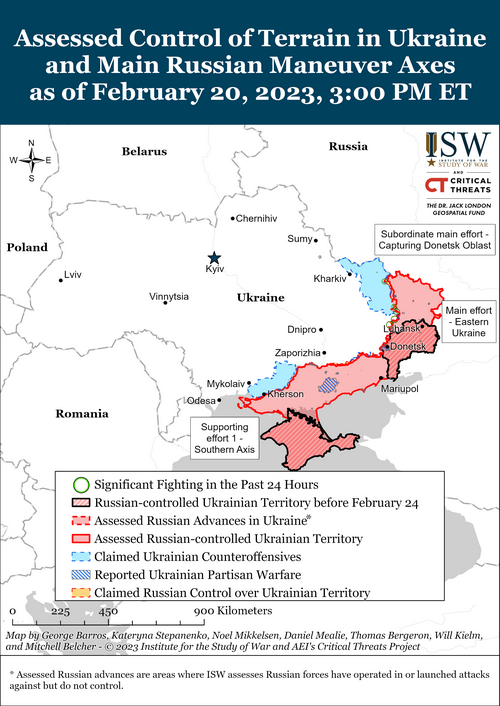
From the Institute For The Study of War:
Riley Bailey, Kateryna Stepanenko, Karolina Hird, Nicole Wolkov, Layne Philipson, and Frederick W. Kagan
February 20, 8:45 pm ET
Click here to see ISW’s interactive map of the Russian invasion of Ukraine. This map is updated daily alongside the static maps present in this report.
US President Joe Biden visited Kyiv on February 20 ahead of the first anniversary of Russia’s full-scale invasion of Ukraine. Biden met with Ukrainian President Volodymyr Zelensky and announced that the US will provide an additional $500 million in military assistance to Ukraine, including howitzer shells, anti-tank missiles, air surveillance radars, and other aid.[1] US National Security Advisor Jake Sullivan stated that the Biden administration notified Moscow of Biden’s visit shortly before his departure for Ukraine for “deconfliction purposes.”[2] Biden’s visit and the timing of his trip to Europe clearly signal continued Western support for Ukraine following concerted Russian efforts to deter Western military aid and political support.
Ukrainian officials continue to respond to statements made by unspecified US defense officials on the pace and prospects of the war as it approaches the one-year mark. Ukrainian President Volodymyr Zelensky stated on February 20 that Ukraine will continue to defend Bakhmut but “not at any cost.”[3] Zelensky and Ukrainian Defense Minister Oleksii Reznikov also emphasized that Ukrainian troops are continuing to prepare for counteroffensives in the near term.[4] Zelensky and Reznikov’s statements are likely direct responses to unspecified US defense officials, who reportedly told the Washington Post on February 14 that the United States is concerned about Ukraine’s ability to defend Bakhmut while also pursuing counteroffensive operations.[5] ISW continues to assess that Ukraine’s decision to defend Bakhmut is a strategically sound effort to pin Russian forces in a discrete area of the front and attrit them, and Zelensky likely tempered his administration’s stance on Bakhmut to make a limited rhetorical concession to US officials.[6] It has long been clear that Ukraine would not continue to defend Bakhmut at the risk of seeing large numbers of Ukrainian troops encircled in the city, so Zelensky’s comment is not likely a real change in Kyiv’s strategy.
Verkhovna Rada Committee on National Security, Defense, and Intelligence member Fedir Venislavskyi notably stated on February 19 that Russia has “all combat-ready units on the line of contact In Luhansk and Donetsk oblasts, and partly in Zaporizhia Oblast,” reaffirming the assessment that Russia does not have a large uncommitted combat ready reserves that can be deployed and change the course of operations.[7] These Ukrainian statements are consistent with ISW’s assessment that Ukraine has the capacity to regain the initiative in 2023 with sufficient and timely Western backing.[8]
The Russian Ministry of Defense (MoD) confirmed the formal integration of the Donetsk and Luhansk People’s Republics’ (DNR/LNR) militias into the Russian Armed Forces on February 19 in response to growing criticism about reported command changes within the proxy units. The Russian MoD denied reports about the alleged dismissal of officers of the integrated DNR and LNR’s 1st and 2nd Army Corps, likely in response to widespread milblogger and proxy criticisms about the reported dismissal of DNR Militia Spokesman Eduard Basurin on February 17.[9] Basurin discussed his dismissal in a publicized meeting with Wagner Group financier Yevgeny Prigozhin on February 19 in which he stated that such command changes will “harm” proxy commanders and servicemen.[10] Basurin noted that servicemen in occupied Donetsk Oblast trust their commanders and would be demoralized if those commanders were replaced by people they did not know. Basurin stated that it is important to warn about ongoing command changes and questioned who would be defending Russia if the newly integrated proxy units refuse to fight as a result of the Russian professionalization effort.
The decision to reorganize the DNR and LNR militias amid an ongoing offensive likely indicates that the Russian MoD does not fully grasp the scale of the underlying challenges of integrating irregular forces into the professional military, especially during a period of intense combat operations. The DNR and LNR forces are currently fighting in Donbas in support of Russia’s goal to reach the administrative borders of Donetsk and Luhansk oblasts and such untimely restructuring of the command structure may reduce cohesion within the proxy units and between them and Russian forces. Russian forces have suffered from their own shortcomings in unit cohesion and will likely face greater tensions with the proxy militias that were not trained to professional standards. Proxy elements have also repeatedly complained about receiving unequal treatment from the Kremlin, and Russian mobilized servicemen have recently accused the DNR and LNR formations of abuse and discrimination in turn.[11] This reorganization may upset and demoralize proxy elements that have enjoyed a great deal of independence as irregular militants for nine years and may risk alienating them amidst the offensive for Donbas. Russia needs DNR and LNR units—which have not been historically effective forces—to maintain positions in western Donetsk and Luhansk oblasts as conventional Russian troops pursue an offensive on select frontlines in eastern Ukraine.
The restructuring of proxy militias also suggests that the Russian military command is trying to achieve all desired reforms while the Russian MoD has the favor of Russian President Vladimir Putin. The Russian military command may recognize that Russia does not have the combat capability to reach the administrative borders of Donetsk and Luhansk oblasts in the short term and is likely trying to rush through some planned reforms before Putin again becomes disillusioned with the Russian MoD’s inability to secure meaningful advances. The Russian military command may alternatively be deluded about its ability to rapidly and seamlessly complete professionalization objectives to aid the ongoing offensive and may not perceive the problems inherent in conducting a significant military reform while pursuing difficult offensive operations. The Russian MoD has been trying to simultaneously professionalize different aspects of Russian forces by targeting Wagner’s influence, integrating mobilized servicemen into proxy and conventional formations, and introducing personal grooming standards and operational security procedures.[12] These efforts would be logical if Russia had initiated them during peacetime but are a bureaucratic burden that will likely generate further discontent toward the already heavily scrutinized Russian MoD. The Russian military command is embarking on too many drastic changes that will either require time or will cause significant tensions that will hinder their full execution even as it orders its forces to conduct extremely challenging military operations that are likely beyond their capabilities in any event.
The Russian military command has likely cut off Wagner Group financier Yevgeny Prigozhin’s independent access to artillery shells and heavy weaponry as part of the effort to professionalize Russian conventional forces. Prigozhin stated on February 20 that the Russian military command had stopped providing artillery shells to Wagner as a result of his “complicated relationships” with unspecified but likely Russian Ministry of Defense (MoD) officials.[13] Prigozhin claimed that Wagner has “complete shell hunger” as a result of Russian military officials ignoring his demands and introducing new limitations and restrictions on his ammunition procurement. Prigozhin claimed that Wagner servicemen are experiencing twice the number of casualties (without specifying the comparandum) because they are unable to suppress Ukrainian artillery fire and noted that Wagner had sufficient ammunition during the tenure of former Commander of the Russian Joint Grouping of Forces in Ukraine, Army General Sergey Surovikin. Prigozhin denied rumors of having a personal relationship with Surovikin, but noted that he used to meet up with and call Surovikin when he visited the frontlines. Prigozhin also noted that Wagner had been receiving some weapons from unnamed generals and officers who had violated the military code to help him. The Russian MoD has also reportedly cut off Prigozhin’s ability to recruit prisoners and train at select training grounds belonging to the Russian Armed Forces.[14] A milblogger observed that Prigozhin was repeating the experience of former Russian officer Igor Girkin, who led proxy units in Donbas in 2014, claiming that the Russian MoD had also cut off Girkin’s access to reinforcements and supplies while blaming him for losing ground in Slovyansk.[15]
Prigozhin’s appeal may have misrepresented the devastating impact of the lack of artillery ammunition on Wagner to mask his true frustrations with Wagner’s inability to have and operate its own artillery systems independent of conventional Russian units. Prigozhin demanded that the Russian military leadership set aside its principles and save Wagner servicemen by providing shells. It is unlikely that Wagner is operating in the Bakhmut direction completely without artillery support, however. Wagner is likely receiving artillery support from the conventional Russian forces that have been supporting Wagner operations in the area since the Wagner offensive culminated.[16] The Russian military command may have stripped Wagner’s privileges to independently use its own artillery systems, which Prigozhin sought to portray as disregard for Wagner servicemen’s lives. Prigozhin’s rhetoric was partially successful as some prominent milbloggers expressed solidarity with Wagner—even stating that those who boycott Prigozhin are boycotting Russian President Vladimir Putin.[17] Others complained that paramilitaries should not be allowed to replace conventional forces.[18] Prigozhin’s appeal further indicates that Wagner is dependent on the provision of heavy weapons and ammunition by the Russian MoD, and further confirms that Wagner is not the sole force operating around Bakhmut given the ongoing artillery fire in the area.
Chechen Republic Head Ramzan Kadyrov likely publicized a meeting he had with Prigozhin on an unspecified date in order to assuage Prigozhin’s possible anger at Kadyrov’s likely refusal to join Prigozhin’s informational campaign against the Russian MoD. Kadyrov posted a picture on February 19 showing him meeting with Prigozhin on an unspecified date and applauded the Wagner Group for its success and work in Ukraine.[19] Kadyrov’s endorsement of Prigozhin and the Wagner Group followed Kadyrov‘s equally effusive endorsement of the Russian MoD on February 18, suggesting that Kadyrov is likely trying to maintain his relationships with the MoD and the Kremlin without incurring Prigozhin’s criticism. [20] Kadyrov did not state that he intends to form a paramilitary company in an unspecified timeframe, as some Western reporting of his comments suggested. Kadyrov rhetorically commented that he might compete with Prigozhin’s Wagner Group one day following the completion of his work in the civil service as Chechen Republic head.[21] Kadyrov has governed the Chechen Republic as its dictator since 2007 and is unlikely to leave his position there any time soon unless he improbably receives a promotion of some sort—certainly not by choice. His observation about “competing” with Wagner was thus likely meant as a compliment to Prigozhin rather than a statement of Kadyrov’s own intentions. Kadyrov already effectively has his own paramilitary structure in the form of the Chechen combat units that he raises and over which he appears to retain some command and control.
US Secretary of State Antony Blinken said that the US government is concerned that China is considering providing lethal aid to Russia. Blinken stated in an interview with CBS News on February 19 that he told Chinese Foreign Minister Wang Yi at the Munich Security Conference that Chinese lethal support to Russia would have “serious consequences” for US-Chinese relations.[22] The US Treasury and State Department have sanctioned Chinese Changsha Tianyi Space Science and Technology Research Institute Company (Spacety China) for providing satellite imagery of Ukraine to Wagner.[23]
The Russian MoD likely responded to a call for the Russian military to systematically target electrical infrastructure supporting Ukrainian nuclear power plants (NPPs) by setting possible informational conditions for strikes aimed at forcing emergency shutdowns at these NPPs. The Russian MoD falsely claimed on February 19th that Ukrainian officials are planning false-flag attacks at hazardous radiation facilities in Ukraine to accuse Russian forces of conducting indiscriminate strikes on these facilities in violation of the Convention on Nuclear Safety ahead of the 11th emergency special session of the United Nations General Assembly on February 22.[24] A prominent Russian news aggregator recently called on the Russian military to systematically target electrical substations external to Ukrainian NPPs in order to force Ukrainian officials to conduct emergency shutdowns at the plants.[25] The Russian MoD may be starting an information operation aimed at setting informational conditions for conducting such strikes and the potential radiological incidents that could result from systematically depriving the facilities of energy. The attacks advocated by the Russian news aggregator would not likely generate radiological incidents, but attacking anywhere near nuclear power plants always carries some risk of such incidents. Previous Russian strikes against critical infrastructure facilities in Ukraine do not suggest that Russian forces are systematically targeting electrical infrastructure specifically associated with NPPs at this time, however. The Russian MoD’s statement may also be attempting to set informational conditions for a potential radiological incident at the Zaporizhzhia Nuclear Power Plant (ZNPP) in light of reports that Russia’s draining of the Kakhovka Reservoir may be putting the ZNPP’s cooling system in peril.[26]
Key Takeaways
- US President Joe Biden visited Kyiv on February 20 ahead of the first anniversary of Russia’s invasion of Ukraine signaling continued US commitment to supporting Ukraine in its efforts to liberate its territory.
- Ukrainian officials continue to respond to statements made by unspecified US defense officials on the pace and prospects of the war as it approaches the one-year mark.
- The Russian Ministry of Defense (MoD) announced the formal integration of the Donetsk and Luhansk People’s Republics’ (DNR/LNR) militias into the Russian Armed Forces on February 19 in response to growing criticism about reported command changes within the proxy units.
- The decision to reorganize the DNR and LNR militias amidst an ongoing offensive likely indicates that the Russian MoD does not understand the scale of the challenges of integrating irregular forces into a professional military during intensive combat operations.
- The restructuring of proxy militias suggests that the Russian military command is trying to achieve all its desired reforms while the Russian MoD has the favor of Russian President Vladimir Putin.
- The Russian military command has likely cut off Wagner Group financier Yevgeny Prigozhin’s independent access to artillery shells and heavy weaponry as part of the effort to professionalize the Russian conventional forces.
- Prigozhin may have misrepresented the devastating impact of the lack of artillery ammunition on Wagner to mask his true frustrations with Wagner’s inability to have and operate its own artillery systems.
- Chechen Republic head Kadyrov likely attempted to assuage Prigozhin’s possible anger at Kadyrov’s likely refusal to join Prigozhin’s informational campaign against the Russian MoD.
- US Secretary of State Antony Blinken stated that the US government is concerned about China’s possible consideration of sending lethal aid to Russia.
- The Russian MoD likely responded to a call for the Russian military to systematically target electrical infrastructure supporting Ukrainian nuclear power plants (NPPs) by setting possible informational conditions for strikes aimed at forcing emergency shutdowns at these NPPs.
- Russian forces continued ground assaults along the Svatove-Kreminna line.
- Russian forces continued offensive operations around Bakhmut as well as in the Avdiivka-Donetsk City area and western Donetsk Oblast.
- Ukrainian officials reported that Russian forces continue to militarize the Zaporizhzhia Nuclear Power Plant (ZNPP).
- Ukrainian officials reported that Russian forces may be struggling to repair air defense systems deployed in Ukraine.
- Russian occupation authorities are using an “anti-terrorist” commission to justify seizing and nationalizing assets in occupied Crimea for economic and military benefit.
Go here to read the rest. Biden’s visit underlines that the Puppetmaster’s of this administration do not intend to pull an Afghanistan in Ukraine. Well and good. Hopefully it does not signal a willingness to use US troops in the Ukraine as instructors and advisors.


“US Secretary of State Antony Blinken stated that the US government is concerned about China’s possible consideration of sending lethal aid to Russia.”
… This would be a very dangerous escalation.