
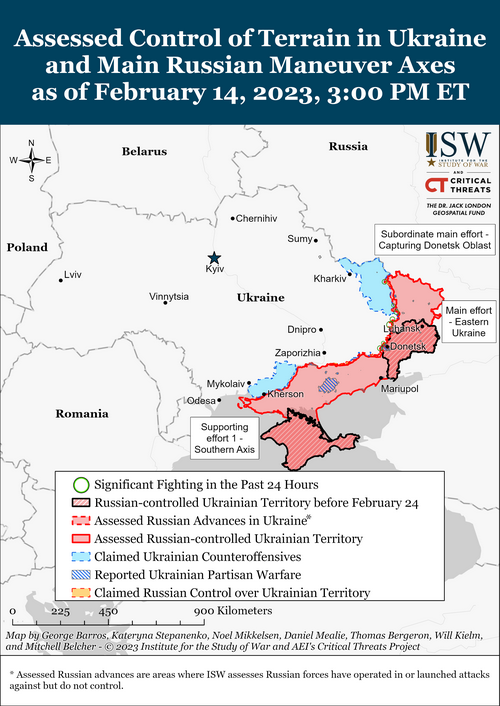
From The Institute For The Study of War:
Russian Offensive Campaign Assessment, February 14, 2023
George Barros, Kateryna Stepanenko, Karolina Hird, Angela Howard, Nicole Wolkov, and Frederick Kagan
February 14, 8:15 pm ET
Click here to see ISW’s interactive map of the Russian invasion of Ukraine. This map is updated daily alongside the static maps present in this report.
US Secretary of Defense Lloyd Austin signaled on February 14 that the Ukraine Defense Contact Group’s 54 member states will continue to support Ukraine in the long run. Austin stated that the Ukraine Defense Contact Group (a coalition of 54 states supporting Ukraine’s defense) will “support Ukraine’s fight for freedom over the long haul” and will support Ukraine during a spring counteroffensive.[1] The Washington Post reported on February 13 that the Biden administration will announce a new aid package for Ukraine “in the next week.”[2]
The Washington Post reported that US officials have privately signaled to Ukraine that Western security aid to Ukraine is finite, however. The Washington Post reported on February 13 that an anonymous US government official stated that US government officials are trying to “impress upon [Ukrainian officials] that [the US Government] can’t do anything and everything forever.”[3] The Washington Post also reported that US officials stated that recent Western aid packages for Ukraine “represent Kyiv’s best chance to decisively change the course of the war.“[4]
Western reporting indicates that there continue to be Western concerns about Ukraine’s determination to hold Bakhmut. The Washington Post also reported that US defense planners assess that Ukrainian forces are unable to simultaneously defend Bakhmut and launch a spring counteroffensive and have urged Ukraine to prioritize the spring counteroffensive over defending Bakhmut.[5] ISW continues to assess that Ukraine’s decision to defend Bakhmut is likely a strategically sound effort despite its costs for Ukraine.[6] Ukraine’s defense of Bakhmut has forced the Kremlin to expend much of the Wagner Group as a force and commit high-value Russian airborne forces to sustain attritional advances.[7] Ukrainian defense of Bakhmut has degraded significant Russian forces and will likely set favorable conditions for a future Ukrainian counteroffensive. Had Russian troops taken Bakhmut without significant Ukrainian resistance they could have hoped to expand operations in ways that could have forced Ukraine to construct hasty defensive positions in less favorable terrain. Therefore, Ukraine’s defense of Bakhmut and undertaking an effort to set conditions for a counteroffensive are likely complementary, not mutually exclusive, activities considering that Russian forces would have continued their offensive beyond Bakhmut had Ukraine yielded the city earlier.
The Russian Ministry of Defense (MoD) is reportedly recruiting convicts and mimicking the Wagner Group’s treatment of convicts as cannon fodder. CNN reported that the Russian MoD had been directly recruiting prisoners who deployed to Soledar, Donetsk Oblast, into formations of the Luhansk People’s Republic (LNR) 2nd Army Corps in October 2022.[8] Convicts complained to CNN about gruesome abuses and noted that they suffered heavy casualties after they were ordered to storm Ukrainian defensive positions. CNN also obtained a recording from a deceased convict who feared that the Russian MoD would execute him after he survived an assault on Soledar, though this soldier was killed in action days later anyway. These convicts specified that the Russian MoD recruited them after Wagner Group initially overlooked them, and even accused Russian forces of conducting deliberate friendly fire against the convicts.
The Russian MoD’s decision to recruit prisoners is an indicator that the Kremlin seeks to exploit convicts for future human wave attacks in a similar fashion as the Wagner Group despite convicts’ limited combat effectiveness. Representative of the Ukrainian Main Military Intelligence Directorate Andriy Usov stated that Russian Defense Minister Sergey Shoigu and Chief of the Russian General Staff Valery Gerasimov are creating a convict cannon fodder reserve that they could directly control through the MoD’s own private military companies.[9] Russian MoD’s integration of these convict forces into the LNR formations also may suggest that Russian military commanders are attempting to avoid the restructuring of some of their conventional units to fit underprepared convicts. ISW had previously observed instances of Russian proxy armed formations receiving poor treatment from Russian conventional forces, and the Russian command may have sought to not further disturb unit morale by integrating convicts.[10]
The Russian MoD’s recruitment of prisoners in fall 2022 may also coincide with the intensifying criticism from Wagner Group financier Yevgeny Prigozhin. Prigozhin began to publicly attack Russian military commanders in early October, and the Russian MoD’s intervention in his recruitment scheme may have ignited some of these grievances with the conventional Russian military and MoD bureaucracy.[11] A representative for the Russian prisoner group Gulagu.net also noted that many in Moscow began to fear Prigozhin and his unpredictable and ever-growing large “organized criminal group of mercenaries and killers.”[12] The Kremlin has since been distancing itself from Wagner—both rhetorically and by likely depriving Prigozhin of the ability to recruit and train convicts. The Ukrainian General Staff, for example, reported that Russian MoD began to use the Kadamovsky Training Ground in Rostov Oblast to train mobilized and volunteer personnel for a few weeks, while Wagner had not been able to train at the training ground since the beginning of 2023.[13]
Key Takeaways
- US Secretary of Defense Lloyd Austin signaled on February 14 that the Ukraine Defense Contact Group’s 54 member states will continue to support Ukraine in the long run. The Washington Post reported that US officials have privately signaled to Ukraine that Western security aid to Ukraine is finite, however.
- The Russian Ministry of Defense (MoD) is reportedly recruiting convicts and mimicking the Wagner Group’s treatment of convicts as cannon fodder.
- Russian forces continued offensive actions in the Kupyansk direction and along the Svatove-Kreminna line on February 14.
- Russian forces continued ground attacks around Bakhmut and along the western outskirts of Donetsk City on February 14.
- Russian forces did not conduct any confirmed ground attacks in western Donetsk Oblast or in Kherson, Mykolaiv, or western Zaporizhia oblasts on February 14.
- Russian ground forces on the Kola Peninsula in northwestern Russia have been reduced to one-fifth of their initial strength numbers before the invasion of Ukraine, supporting ISW’s longtime assessment that the Kremlin is not concerned about a NATO conventional military threat against Russia.
- A Ukrainian and Tatar partisan group reportedly conducted an improvised explosive device (IED) attack on a car carrying two Russian military personnel and two Russian special service representatives in Nova Kakhovka on February 10.
- Russian President Vladimir Putin and Belarusian President Alexander Lukashenko may meet on February 17.
Go here to read the rest.
From Strategy Page:
February 14, 2023: Russia has a problem with the growing number of Ukrainian spies and paramilitary partisan groups operating in Russian-occupied portions of Ukraine as well as pro-Ukraine or anti-Putin Russians inside Russia who provide Ukraine with targets and other information about Russian military activities. Ukraine abides by the American restrictions on using American supplied missiles on targets inside Russia. Instead, Ukraine uses improvised and Ukrainian-made long-range weapons to strike these targets. Ukrainian special operations forces have also operated inside Russia and carried out some spectacular attacks on Russian military bases and industrial sites. This damage, especially large explosions and fires, are hard to hide from commercial and military satellites overhead or curious Russians with cellphone cameras and access to the Internet outside Russia. Russian lack of adequate facility security or effective air defenses is embarrassing but no surprise to most Russians and Ukrainians.
Some information comes from Russians themselves as they complain about how their own government is treating them, especially government efforts to put more Russians into uniform and send them off to fight and die in Ukraine. This sort of thing is nothing new for Russians. They experienced it in 1994 when Russia sent untrained and poorly led troops to fight and die battling Chechens in the Caucasus. Nearly 3,000 Russian troops died and the rest withdrew and left the Chechens to run their own country. Before that there was the nine -year Afghanistan campaign that kept up to 115,000 Russian troops at a time in Afghanistan until 1989 and sent 14,500 of these soldiers home in coffins. No railroads and a few roads limited the number of troops Russia could support in Afghanistan. They also had some help from 55,000 pro-Russia Afghans. Russia used a lot of air force bombers stationed across the northern Afghan border in Russia to kill about a milli0n armed and mostly unarmed Afghans. Later, starting in 1999 another round of fighting in the Caucasus led to a victory but 0ver ten thousand Russians died in Chechnya this time in a victorious campaign that left Chechnya devastated by massive air strikes. Over 30,000 civilians died, along with 12,000 armed men.
So far in Ukraine over 150,000 Russians have died in less than a year. The Wagner Group recruitment of convicts with the promise of a pardon if they served six months backfired when it became known that only about 20 percent of the first convicts recruited survived their six months and received their pardons. Recent recruiting efforts show that far fewer convicts are willing to volunteer and, justifiably, feel safer serving out their sentences. Russia has now officially banned recruiting prison inmates. Efforts to recruit, conscript or otherwise mobilize a large new force of Russian troops is working on paper but not in reality. That is why so many of the newly formed Russian combat units are full of unwilling, unarmed, untrained and unsupported troops who can be coerced into starting an attack but any serious resistance causes the troops to flee, often abandoning undamaged armored vehicles as they head for safety. Some attacks do succeed, mainly because they advance in an area where there are few or no Ukrainian troops.
Russia still has a few real combat units that are composed of well trained and armed troops led by experienced officers. These units have to be used sparingly and carefully. Russia cannot afford to lose too many of these troops because they are difficult to replace. The presence of these reliable troops prevents the generally more professional Ukrainian forces from chasing the Russians forces out of Ukraine. Ukraine takes better care of their troops and will not get them killed on pointless frontal assaults that are exposed to Ukrainian artillery fire. While the Russian infantry is not very reliable, Russian artillery is dependable but the Ukrainians use their artillery more skillfully, especially against Russian artillery.
While Ukraine continues to catch, prosecute and punish corrupt officials, Russia is eliminating anti-corruption laws to enable corrupt officials to evade detection and continue to profit from corrupt practices. This encourages Ukrainians to keep fighting and Russians to resist getting mobilized into the military. It also encourages more Russians to sabotage the war effort via individual efforts. The Russian war effort is often disrupted by these individual actions against railroad signal systems. This is s=easy to do and difficult to prevent. Russian mothers organize effective protests against the war, as they have been doing in the 1980s. Russia is increasingly at war with itself as well as Ukraine.
Russian leader Vladimir Putin insists Russia will keep fighting no matter the casualties and setbacks his forces suffer in Ukraine. This will go on as long as he continues to have the support of provincial and municipal leaders and internal security forces. These local leaders are appointed by the central government and are expected to keep the peace in their areas and deliver quotas of new recruits when asked. That is increasingly a source of opposition to the local governments. Putin is also making it more difficult for military-age men to leave the country and is establishing a hopefully accurate database of men eligible for military service.
Russia has many other problems. Their latest military technology gets captured, scrutinized and countermeasures developed. This has been going on since the war began. Ukraine shares this captured gear with its NATO allies who receive a constant flow of Russian weapons sent to Poland and beyond for further examination and analysis. This has been particularly hard on Russian electronic systems, especially counter-measures that are supposed to reduce the effectiveness of Western weapons. Russia developed some interesting new tech which loses most of its effectiveness when the enemy knows how it works and how to remotely make it not work.
Russia has captured some Western systems but not to the extent that their systems have been captured and analyzed. These losses are common in any war and first became a major factor during World War II. This was especially true with the electronic warfare German and British engineers engaged in to keep their bombers operational over enemy territory. This established the model for tech warfare that persists to the present, especially in Ukraine and Russia. During World War II the Russians were allies of Britain and the United States and received a lot of impressive (to the Russians) Western tech. Russia found that even when they had this tech they had a hard time duplicating it. Throughout the Cold War Russia continued to fear the Western edge in tech and the Russian inability to manufacture it themselves. That changed after the Soviet Union disappeared in 1991 and a new democratic (for a decade or so) Russia had free access to Western manufacturing technology as well as the tech itself. During the last decade Russia has again gone to war with the West and no longer has all that access to Western tech and is feeling the widening gap between Russian and Western technical capabilities.
China has long learned from Soviet and Russian mistakes, is now nearly equal to the West in terms of tech, and a much more formidable foe for the West and, if need be, Russia. China is replacing Russia as the primary trade partner of the central Asian states that were more part of the Soviet Union and later post-Soviet Russia. The war in Ukraine has given China the opportunity to completely replace Russia in Central Asia, where Russia is facing growing Chinese activity. Russia long believed their eastern flank was secure but now there is a potential threat from China and a two-front war if Russia survives the current conflict with Ukraine and its NATO allies.
Russia also continues to commit a growing list of war crimes against Ukrainian civilians in Russian occupied areas. This means more Ukrainian partisans forming and operating against the Russian occupation officials and internal security forces. This is one reason why Ukraine is intent on driving all Russian forces out of Ukraine. Meanwhile they collect names and war-crimes activities by Russians in the occupied territories. That makes it more difficult for these killers to one day try to gain asylum in the West, as some known war criminals have done in the past and were eventually identified and prosecuted, and might make their hiding out in Russia more sporting. Russia considers these men, and some women, heroes for diligently carrying out crimes against Ukrainian civilians. This includes forcing Ukrainian civilians to behave by threatening to send their children to Russia where they are adopted by Russian families. The threats are often carried out and Ukrainian orphans are regularly shipped off to Russia for adoption and absorption into the Russian population. The Ukrainian government knows who many of these children are and will seek to get them back after Russian troops are driven out of Ukraine. This will produce some interesting post-war diplomacy and drama.


I just wanted to say thank you for continuing to follow the Ukraine story and to provide such solid information to us.
Where is our former Radio Free Europe and Radio Liberty in all of this? Seems our adversaries always seem to have the upper hand in the propaganda part of the war.