
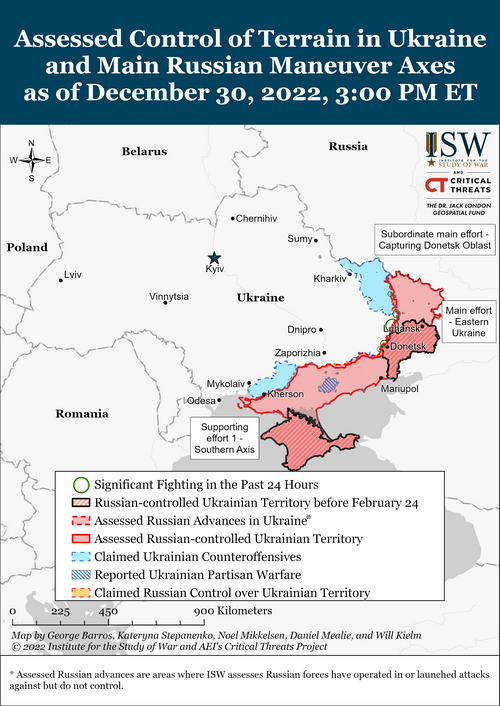
From The Institute For The Study of War:
Russian Offensive Campaign Assessment, December 30
Riley Bailey, Karolina Hird, Madison Williams, Layne Philipson, and Frederick W. Kagan
December 30, 5:30 pm ET
Click here to see ISW’s interactive map of the Russian invasion of Ukraine. This map is updated daily alongside the static maps present in this report.
Russian forces targeted Kyiv using Iranian-made drones on the night of December 29 to 30, a continuation of an increased pace of drone attacks in Ukraine. The Ukrainian Air Force Command stated that Russian forces launched 16 Shahed-131 and -136 drones at targets in Ukraine on the night of December 29 to 30 and that Ukrainian air defenses shot down all of them.[1] Ukrainian officials reported that Russian forces launched seven of the drones at targets in Kyiv and that Ukrainian air defenses shot down all of them, but one of the drones’ munitions hit an administrative building.[2] The Russian drone attacks follow a massive series of Russian missile and drone strikes against Ukrainian critical infrastructure on December 29 during which Russian forces launched 23 drones, the majority of which were Shaheds.[3] The Russian military’s use of 39 drones in the past two days, its use of 30 Shahed 131 and -136 drones on the night of December 18 and 19, and its use of 13 Shahed drones on December 14 represent a significant increase in its recent use of these systems in Ukraine.[4] ISW assessed on December 10 that an increased pace of Russian drone attacks may indicate that Russian forces accumulated more Iranian-made drones after a three-week period (November 17 to December 7) of not using them or that Russia received or expected to receive a new shipment of drones from Iran.[5] Russian forces have likely further increased their pace of drone attacks in an effort to sustain their campaign against Ukrainian critical infrastructure given their likely depleted stock of precision missiles.[6] Ukrainian air defenses have recently proven to be highly effective at shooting down Shahed drones and the Russian military’s use of these systems in attacks against civilian targets in rear areas is having diminishing impacts.[7] The Russian military will likely continue to commit an increased number of these systems to attacks on civilian targets in Ukraine in its misguided attempt to break the Ukrainian will to fight.
Russian President Vladimir Putin opened the door for further institutionalized corruption through the manipulation of the Russian domestic legal sphere. Putin approved a decree on December 29 that exempts all Russian officials, including members of the military and law enforcement services, from the requirement to make income declarations public.[8] The decree extends to military officials, employees of Russian internal affairs organs, those serving in Rosgvardia and law enforcement positions, employees of the Russian penitentiary system and Investigative System, and individuals seconded to positions in Luhansk, Donetsk, Kherson, and Zaporizhia oblasts.[9] The decree also notably lifts the ban on military officials receiving “charitable” gifts in connection with their participation in hostilities in Ukraine.[10] Russian independent newspaper The Insider noted that this decree could theoretically allow Russian officials involved in the war to seize the private property of Ukrainian residents of occupied areas because such property could be legally classed as “charitable gifts.”[11] ISW continues to report on Putin’s manipulations of domestic law to quash domestic opposition to the war and enable those who support it.[12]
Key Takeaways
- Russian forces targeted Kyiv using Iranian-made drones on the night of December 29 to 30.
- Russian President Vladimir Putin opened the door for further institutionalized corruption in the Russian Federation.
- Russian forces continued to conduct counterattacks along the Svatove-Kreminna line.
- Ukrainian forces struck Russian concentration areas in Luhansk Oblast.
- Russian forces continued offensive operations in the Avdiivka area as well as in Bakhmut, where the pace of Russian offensive operations may have slowed compared to previous days.
- A Russian source claimed that Russian forces conducted ground attacks in Zaporizhia Oblast.
- Russian and Ukrainian sources continued to discuss whether and when an imminent second wave of mobilization in Russia will occur.
- Russian officials continue to pursue the integration of occupied territories into the Russian Federation.
Go here to read the rest.
From Strategy Page:
December 30, 2022: Russia is desperate for some good news out of Ukraine, where Russian forces have suffered one failure after another. Sensing an opportunity, Russian forces have suffered heavy casualties trying to push Ukrainian forces out of a few key locations in the Donetsk province, which is part of Russian occupied Donbas. Russia has been using Wagner Group mercenaries for most of the attacks because these troops are more effectively led and willing to continue making seemingly suicidal attacks on Ukrainian forces. The Ukrainian defenders are special operations troops whose orders are to inflict maximum casualties on the attacker while minimizing enemy advances and Ukrainian casualties. In return the Russians can regularly issue press releases announcing continued advances by their troops without revealing that these advances often consist of a few meters in the general direction of the Ukrainian positions. The Russian attacks are supposed to tie down a lot of Ukrainian troops but that does not happen and it is Russia that is losing lots of its most effective troops every week without any useful gains. Some Russian pro-war Internet reporters can get away with mentioning how the “Donetsk Offensive” really works as long as they don’t it too vividly or frequently. Ukrainian leaders offer more effusive and frequent praise for the Ukrainian defenders.
December 29, 2022: Russia fired at least 120 ballistic and cruise missiles at Ukrainian towns and cities. Air defenses shot down 66 of the missiles, most of them the slower cruise missiles. This attack was directed mainly at electricity generation facilities. Most of the missiles used were obtained from Iran.
Iranian pilots and ground crews are in Russia to learn how to fly and maintain the 24 Russian Su-34 fighters that Iran is receiving from Russia. These aircraft were originally sold to Egypt but the Ukraine-related sanctions canceled that and when Russia began buying weapons from Iran they found that Iran would take modern jet fighters, like the Su-35 to pay for the weapons going to Russia.
December 28, 2022: Ukraine reported that at least 620 Russian soldiers were killed or wounded on the 25th. Many of the wounded have since died because Russia still lacks sufficient medical facilities inside Ukraine and lacks the transportation resources to fly casualties to better medical facilities in Russia. Since the invasion began, 102,000 Russian troops have been killed, wounded or reported missing. Ukraine reports a growing number of Russian soldiers surrendering or deserting. These are often returned in prisoner exchanges. A growing number of Russian prisoners of war resist being part of these exchanges because they deliberately deserted and face prosecution and prison if they return to Russia. Some of the Russian soldiers who were legitimate prisoners were prosecuted after being exchanged because the Russian government wanted more former prisoners jailed to discourage surrendering.
The official Russian policy is that they are willing to stop their Ukraine invasion but demand that Ukraine permanently cede territory to Russia. This includes the Crimean province and the portions of Luhansk, Donetsk, Zaporizhia and Kherson provinces they currently occupy. Ukraine is taking back more and more of that territory and wants Russia out of Ukraine completely. Russia implies that even if that happens, Russia will continue to consider Ukraine a lost part of Russia and not a sovereign country.
The current state of the Russian military cannot support any Russian military objectives in Ukraine, or anywhere else. What Russia lost in Ukraine will take years to replace. For example, most of the infantry officers the army had in 2021 have already been killed, captured or disabled in Ukraine. There were no replacements for the lost infantry officers so Russia tried calling up retired officers and transferring non-infantry officers to lead infantry units. That did not work. Another problem is the lack of NCOs. These have been a staple of Western armies for centuries and are often capable of replacing infantry officers lost in combat. Russia abolished NCOs a century ago and has not been able to rebuild that after more than a decade of trying.
Russia is currently crippled by severe economic sanctions imposed because of their Ukraine invasion. According to Ukraine and its NATO supporters, the Ukraine war won’t end until all Russian troops are gone. Any New Russian Army will take years to create and currently the loss of officers and experienced soldiers has Russia depending on Belarussian instructors to train new Russian troops. This is done in Belarus to the extent possible because Belarus’s tiny army has much smaller training capability than the pre-2022 Russian army. Almost all new troops in Russia get no training at all and are just given uniforms, assault rifles and transportation to Ukraine where they find few officers to lead them and not much in the way of supplies, especially food, to sustain them. Because of the dismal current situation, the announcement of a new Russian Army is seen as a morale building exercise for pro-war Russians and the few army personnel who still support the war.
Another myth is that Russia could eventually persuade Belarus to join Russian forces inside Ukraine. The main obstacle to that happening is that Russia wants to annex Belarus as well as Ukraine. Before 2022, Belarus was seen as the next former Soviet territory to be annexed by Russia. The response of Ukrainians to Russian invasion has changed attitudes towards annexation of Belorussia. This is despite the fact that the longtime (27 years so far) Belarus president-for-life Alexander Lukashenko has ruled Belarus as a loyal ally of Russia. That has not helped the Belarussian economy or improved the lives of Belarus voters. A new post-Soviet Union generation of voters has seen how life is better in democracies, especially other former victims of Russian rule like neighboring Poland, Lithuania, Latvia, Estonia, and Ukraine. They blame Lukashenko for the poverty and mismanaged economy in Belarus, as well as an incompetent response to covid19.
Since 2020 Lukashenko has faced growing popular protest against government incompetence and decades of rigged elections, corrupt rule, and inability to do much of anything effectively. Since the late 1990s Lukashenko has won reelection with 80-90 percent of the vote in visibly fraudulent elections. Lukashenko is a Soviet era official, who runs Belarus using the Soviet Union as a model. Belarus is a police state, where elections, and everything else, is manipulated to keep the same politicians in power. It’s a tricky business, but so far Lukashenko has kept the security forces up to snuff, and on his side. He bribes or bullies key officials to keep the country running. Lukashenko has maintained good relations with Russia, getting him cheap fuel supplies and other aid. Belarus is small (9.5 million people) compared to neighbors Russia (146 million) and Ukraine (42 million) and Russia wants to absorb Belarus and Ukraine to rebuild the centuries old Russian empire that the czars created and the communists lost. Lukashenko, like most Belarussians, opposes annexation by Russia. So far Russia is not actively seeking to annex Belarus or send in security forces to help suppress what has turned into a rebellion against Lukashenko.
Lukashenko is becoming more of a liability for Russia but is currently still a “favored ally.” Russia would like to be rid of Lukashenko but there is no one in Belarus with his skills, experience and pro-Russia attitude. Russia has created a major problem for itself in Belarus. Not as bad as the mess in Ukraine, but still another setback in the Russian effort to rebuild the Soviet-era Russian empire. Lukashenko noted what happened to pro-Russia Ukrainian politicians after the Russians invaded and most Ukrainians joined or supported the fight against Russian domination and any pro-Russia Ukrainians.
Go here to read the rest.
There are no signs of the Russian offensive rumored of earlier in this month. Putin is trying to use the winter as a period of respite for his forces. But what respite he is getting he is not making use of to strengthen the Russian forces in Ukraine. Putin embarked on this War with woefully inadequate forces and so his forces remain.


Only the Russians could start a war, fail to achieve any of their major objectives, yet nevertheless unilaterally declare the areas they invaded “Russian territory”, and then demand as a “settlement” that Ukraine voluntarily give up all of said territory. Sure, makes sense to me. /sarcasm off
In the meantime, Russia launches another Borei class fleet ballistic missile submarine, the Imperator Alexander III.
https://tass.com/defense/1557339
Such submarines are capable of carrying 16 inter-continental ballistic missiles called the Bulava. The Bulava has 6 to 10 thermonuclear warheads each having 100 to 150 kilotons of explosive yield. Operational range is 8K to 15k kilometers.
The submarine propulsion system is an OK-650 pressurized water reactor using 20-45% enriched uranium-235 to produce 190 MW of thermal power. This kind of reactor was designed to minimize accidents and malfunctions that had previously plagued the former Soviet submarine fleet during the Cold War. Monitoring subsystems, designed for rapid detection of leaks, have been included, along with newer-generation emergency cooling systems for the reactor core.