
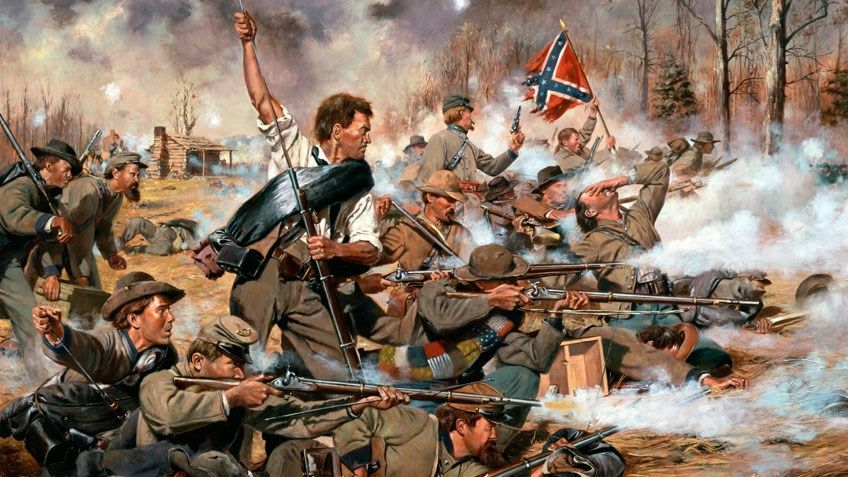
I believe that the world has never produced a body of men superior, in courage, patriotism, and endurance, to the private soldiers of the Confederate armies. I have repeatedly seen those soldiers submit, with cheerfulness, to privations and hardships which would appear to be almost incredible; and the wild cheers of our brave men, when their thin lines sent back opposing hosts of Federal troops, staggering, reeling and flying, have often thrilled every fibre in my heart. I have seen, with my own eyes, ragged, barefooted, and hungry Confederate soldiers perform deeds which, if performed in days of yore by mailed warriors in glittering armor, would have inspired the harp of the minstrel and the pen of the poet.
Jubal Early, Lieutenant General, Army of the Confederate States of America


I am rereading Scott’s “Waverly”, which describes the Highland troops following Bonnie Prince Charlie in similar terms. Like Johnny Reb, Hamish could win battles, but fell to superior logistics and resources.
https://www.youtube.com/watch?v=H8Iw-j217yk
The South could never defeat the North, but outlast the North, make the North decide that the War wasn’t worth it, they came close to doing.
Without the morale-raising victories of the summer of 1864–Mobile Bay, Atlanta and Cedar Creek–I think the Union throws up its hands and the South wins its independence.
And if the South had won a more complete victory a year earlier at Chickamauga, shattering the Army of the Cumberland entirely, you probably don’t see those victories. Two-to-three months to rebuild another army and retake Chattanooga is a best case scenario in winter (inevitable with Grant in command, but still), and that throws off the coordinated strategy Grant would use by those critical few months.
Johnny Reb came this close on a number of occasions, and it wasn’t for want of trying on his part.
As George Pickett said to an obnoxious Southern questioner pestering him about Gettysburg: “I think the Yankees had something to do with it.”
Dale:
And what if they had followed up vigorously after the First Battle of Bull Run and seized Washington? I have always wondered at that.
There was the Battle of the Monocacy, fought in Maryland northwest of Washington, which was a Confederate victory but not significant enough to allow the Confederates to march on Washington.
What if there had not been a Pickett’s Charge at Gettysburg, but some flanking maneuver that allowed the Confederates to march on Harrisburg?
We will never know.
At least the Confederates had a sense of honor, unlike today’s godless Democrats.
Thank you for your generosity in victory. I believe the actions of Lincoln would have been similarly motivated had it not been for his murder. Most men fought for their State (at the time the primary allegiance that most had). Honor is indeed a concept and virtue sorely lacking in our present society.
All of this suffering may be cured by making our Founding Principles the rule of the day.
It’s a good question. I think if Lincoln has to pull a Madison and high-tail it out of DC, it might be brutally demoralizing for the Union, but it also might prompt a Fort Sumter x100 response, too. You would lose eastern Maryland, but the Federal Government reforms in Philadelphia and gets a revenge mandate. The War was too fresh for a knockout blow for the Union. If it fails after Second Bull Run, different story and the South wins its independence.
I agree with you Dale, but I could also see the Rebs taking Washington inspiring quick European recognition of the Confederacy. Also, the really talented Union commanders were still in lower ranks, so a massive Union army might well have had the leadership problems that beset the Union in the east until Grant in 64. There is an epic alternate history novel waiting to be written on this theme!
The main philosophical reasoning of the Confederate leadership was that the war was purely defensive. This attitude prevailed until desperation set in as the war lingered on. This is exemplified in some of Lee’s Army most reluctantly crossing the Potomac in his invasion of Maryland. Nevertheless, it is still a
matter of interesting speculation as to the effect a more aggressive invasionary policy might have had on the final outcome.
https://www.youtube.com/watch?v=l-_rXKWLPtA
A good fictional look at the strategic dilemma confronting the Confederacy at the beginning of the War.