
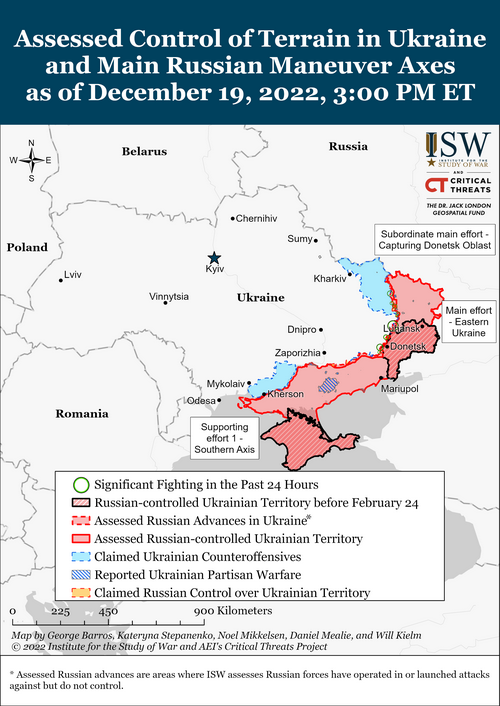
From The Institute For The Study of War:
Russian Offensive Campaign Assessment, December 19
Karolina Hird, Kateryna Stepanenko, Grace Mappes, Madison Williams, and Frederick W. Kagan
December 19, 9:30pm ET
Click here to see ISW’s interactive map of the Russian invasion of Ukraine. This map is updated daily alongside the static maps present in this report.
Belarusian President Alexander Lukashenko likely deflected Russian President Vladimir Putin’s efforts to coerce Belarus into further Russian-Belarusian integration concessions during a meeting in Minsk on December 19. Putin and Lukashenko refrained from publicly discussing the Russian invasion of Ukraine, with both leaders noting that Belarus still faces a Western threat.[1] Putin announced that he may consider training Belarusian combat aviation crews for the use of “munitions with special warheads” due to the “escalating” situation on the Union State’s external borders.[2] ISW has previously assessed that Lukashenko uses the rhetoric of defending Belarusian borders against the West and NATO in an effort to avoid participating in the Russian invasion of Ukraine.[3] Lukashenko had also used similar hints about the possible deployment of nuclear weapons in Belarus on February 17 in the context of claimed Western aggression.[4] Lukashenko noted that Russia will deliver S-400 air defense complexes and Iskander complexes, while Putin stated that both leaders discussed the formation of a united defense space.[5] ISW continues to assess that Belarus’ participation in Putin’s war against Ukraine remains unlikely. The fact that Putin appears to have accepted Lukashenko’s talking points without persuading Lukashenko to adjust them indirectly supports this assessment. Lukashenko would likely adjust his rhetoric to create some plausible explanation to his own people about why he was suddenly turning away from the fictitious NATO invasion threat he has manufactured to join Putin’s disastrous invasion of Ukraine.
The Kremlin has also attempted to conceal Putin’s likely original intentions to pressure Lukashenko into further concessions regarding integration with the Russian Federation. Putin notably stated that “Russia is not interested in absorbing anyone,” when referring to Belarus.[6] This statement followed Lukashenko’s reiteration of Belarusian independence and full sovereignty on December 16 and appears to be a defensive reaction to Lukashenko’s comments.[7] Kremlin Spokesperson Dmitry Peskov also stated that Putin did not go to Belarus to convince Lukashenko to join the war, noting that such speculations are unfounded and “foolish.”[8] Peskov had avidly denied Putin’s intention to invade Ukraine days before the start of offensive operation in a similar fashion, to be sure, but this denial is more likely an attempt to cover up Putin’s desperation to involve Lukashenko in the war and apparent failure—again—to do so.
Russian forces targeted Kyiv with Shahed-131 and -136 kamikaze drone strikes overnight on December 18–19. Ukrainian officials reported that Ukrainian forces shot down 30 Russian Shahed drones, including 10 over southern Ukraine and 18 over Kyiv.[9] Kyiv City Military Administration Head Serhiy Popko stated that Russian strikes did manage to hit an unspecified infrastructure object in Kyiv, and Russian milbloggers claimed that Russian strikes targeted energy infrastructure.[10] Ukrainian National Security and Defense Council Secretary Oleksiy Danilov assessed that Russian forces have enough missiles left to conduct three or four more rounds of strikes and then would have to acquire more missiles from Iran, which Ukraine would struggle to defend against; but he noted that Ukrainian forces know how to defend against Shahed kamikaze drones.[11] Russian milbloggers continued to criticize Russian forces for striking operationally insignificant targets that do not forward Russia’s military goals in Ukraine.[12]
Igor Girkin, a former Russian militant commander and prominent critical voice in the Russian milblogger information space, shared a Russian volunteer’s harsh critique of the Russian military’s overall performance in the war on December 19.[13] The volunteer framed his critique around Russian failures to defend against Ukrainian counteroffensives; the circumstances that led to those failures; and Russian leadership, media, and milbloggers’ failure to address the situations and decision to focus on false positivity.[14] Girkin himself has been a profound critic of the Kremlin and Russia’s military failures, especially following his claimed two-month stint fighting in Ukraine, as ISW has previously reported.[15] The volunteer forecasted that Russian forces will have to surrender more cities and even full oblasts to Ukraine as they will be unable to defend against a possible winter counteroffensive, and Girkin’s amplification of such a forecast suggests he may agree with it. Girkin’s own extremely pessimistic forecasts have been surprisingly accurate, including his critiques of the failure to effectively generate Russian military volunteers in May that has carried over to current mobilization efforts, of the disproportionately high Russian price paid for the limited gain of the capture of Lysychansk in July, and of Russian logistics lines’ continued vulnerability to HIMARS strikes across the theater.[16] Other prominent Russian milbloggers largely ignored the rant that Girkin amplified on December 19 (unlike Girkin’s own December 6 rant following his return to Russia and Telegram), instead continuing to report on Russian activity around Bakhmut in the same performative nature that portrays operationally insignificant gains as huge victories—a framing that the volunteer’s rant spent hundreds of words condemning.[17]
The Donetsk People’s Republic (DNR) is reportedly clashing with other pro-Russian authorities about basic administrative functions, suggesting a lack of cohesion between occupation administrations throughout various areas of occupied Ukraine. Russian-backed Crimean chairman of the Association of Freight Carriers and Freight Forwarders, Anatoly Tsurkin, posted a public appeal to DNR Head Denis Pushilin on December 18 calling for Pushilin to regulate the “illegal, groundless actions that are carried out on the territory of the DNR” by employees of various DNR military, administrative, law enforcement, and bureaucratic organs.[18] Tsurkin claimed that DNR employees in the areas of Nikolske and Manhush (transport hubs west of Mariupol that have access to the M14 Mariupol-Berdyansk-Melitopol highway that leads to the E105 Melitopol-Dzankoi highway that links occupied Zaporizhia Oblast with occupied Crimea) are detaining trucks traveling from Crimea for no special reason and with tenuous justifications in order to confiscate drivers’ personal documents and illegally confiscate cars.[19] Tsurkin’s complaints likely come partially as a result of increased pressure on Russian authorities to find alternative logistics routes from Russia to Crimea due to damage to the Kerch Strait Bridge. They are additionally emblematic of growing friction between the DNR and other Russian-affiliated factions, on which ISW has previously reported.[20] The lack of administrative cohesion in Pushilin’s regime is apparently being ill-received by other Russian and Russian-backed authorities, which broadly suggests that Pushilin is not communicating effectively with other occupation organs and therefore complicating logistics between the DNR and other occupied territories.
The Wagner Group has likely built its offensive model around tactical brutality in order to accommodate for and take advantage of its base of poorly trained and recently recruited convicts. The UK Ministry of Defense (UK MoD) reported on December 19 that the Wagner Group is continuing to play a major role in attritting Ukrainian forces around Bakhmut and that the group has developed its distinct set of tactics around the fact that its recruit base is primarily composed of former convicts with little to no training.[21] UK MoD noted that Wagner Group command takes advantage of the tendency of recruits to engage in brutal behavior because it protects high-value leadership assets at the expense of low-value recruits.[22] ISW has extensively reported on the fact that the Wagner Group uses convicts to build out its fighting force and that Wagner Group forces are serving a largely attritional role in operations near Bakhmut, failing to take significant ground but effectively pinning Ukrainian forces in the defense of surrounding territory.[23]
Key Takeaways
- Belarusian President Alexander Lukashenko likely deflected Russian President Vladimir Putin’s efforts to coerce Belarus into Russian-Belarusian integration concessions on December 19.
- Russian forces targeted Kyiv with Shahed-131 and 136 kamikaze drone strikes overnight on December 18-19.
- Igor Girkin, a former Russian militant commander and prominent critical voice in the Russian milblogger information space, wrote a harsh critique of the Russian military’s overall performance in the war.
- The Donetsk People’s Republic (DNR) reportedly clashed with other Russian occupation authorities regarding basic administration procedures, suggesting tensions between the various occupation administrations in Ukraine.
- The Wagner Group has likely built its offensive model around tactical brutality in order to accommodate for and take advantage of its base of poorly trained and recently recruited convicts.
- Russian forces continued limited counterattacks along the Svatove-Kreminna line as Russian sources claimed that Ukrainian forces targeted Russian rear positions in Luhansk Oblast.
- Russian forces reportedly lost positions south of Bakhmut on December 18 and continued ground attacks near Bakhmut and Donetsk City.
- Ukrainian officials reported that Russian forces are pulling back some elements from areas along the east (left) bank of the Dnipro River in Kherson Oblast.
- Wagner Group financier Yevgeniy Prigozhin continued efforts to establish the Wagner Group as a legitimate parastatal organization by petitioning notoriously nationalist elements in the Kremlin.
- Russian occupation authorities continued to restrict movement within occupied territories and employ societal intimidation tactics.
Go here to read the rest.
From Strategy Page:
December 19, 2022: In the last few months Ukrainian troops have noticed reduced use of artillery by the Russians. Better yet, more of the Russian shells and rockets are duds and don’t explode when they hit the ground. Ukrainian troops learned how to use their artillery ammo carefully because NATO nations did not have as much to provide as Russia already had. That’s because the Russians maintained larger stockpiles of munitions and had a lot older stuff that could be used somewhat safely by Russian artillerymen, but were more likely to fail to explode to land where aimed.
For the first six months of the war Russia was able to fire a lot more shells and rockets at the Ukrainians than the Ukrainian were capable of. That changed because Russia, like the NATO nations supplying Ukraine, is running out of artillery ammunition. Existing inventories are largely gone and munitions firms worldwide have all the business they can handle. Russia does not have as much capacity for manufacturing enough munitions to replace what has been expended or destroyed by the Ukrainians, who carefully attacked all Russian ammo stocks they could find and hit. Plus they captured a lot and promptly used those on the Russians, notably after their breakout from Kharkhiv this fall. Russia has few foreign sources of munitions and those sources have encountered problems. For example, North Korea sold Russia large quantities of shells, much of it near its “use by” date. These munitions were moved to Ukraine via the Trans-Siberian railroad. Russia has had problems lately with that rail line and that has delayed some of the North Korea munitions shipments. Another source was Iran, which didn’t have as much to spare as North Korea but was able to get it to the Russians quickly.
That left neighboring Belarus, which Russia has pressured to enter the war to assist Russian forces in Ukraine. The Belarussian leader is pro-Russia but most Belarussians are not and support Ukraine. Because of that, Belarus cannot send troops into Ukraine but Belarussian ammo stocks and manufacturing capabilities are available. As with Iran and North Korea, Belarus has to be paid
One of the problems Russia has is that the shelf life of most munitions varies from 5-20 years, depending on the component (shell, fuze, electronics, batteries or propellant.) Artillery shells and rockets use various types of explosives, notably as propellants, that degrade over time. Western nations spend a lot of money to remove elderly munitions by recycling them. This is expensive but it is a major reason why Western munitions are more reliable and less dangerous for users.
When the Cold War ended in 1991 Western nations were able to safely dispose of munitions that were too old to be safe and reliable. Russia had more of these munitions and little cash or sense of urgency in safely disposing of their elderly artillery shells and rockets. Storage facilities containing these expired munitions eventually began to randomly explode in a spectacular fashion. Russia then sought to dispose of the oldest and most unstable munitions in controlled explosions that did not destroy structures and kill or injure nearby military or civilian personnel. This disposal process is still underway and Russia keeps track of how old munitions are and knows which munitions recently passed their use-by date and can be safely delivered to artillery units for use. This is one reason why Ukrainians experience many Russian shells and rockets fired at them that are very inaccurate and often do not detonate when they land. For Russian artillerymen, a few of these shells and rockets explode when fired, often killing or injuring members of the gun crew.
Go here to read the rest. The Soviet style of war, of which the current Russian style of war is a pale imitation, required immense conscripted armies in the tens of millions, supported by a completely mobilized industrial sector, producing endless amounts of munitions and equipment. Russian tactics and strategy pretend that they still have immense armies and endless supplies of munitions and equipment. Little wonder that this War has been such a flat failure for Russia. Facts are stubborn things, and ignoring them, especially in wartime, is never wise nor safe.

