
From The Institute For The Study of War:
Russian Offensive Campaign Assessment, December 8
Kateryna Stepanenko, George Barros, Grace Mappes, Riley Bailey, Yekaterina Klepanchuk, Madison Williams, and Frederick W. Kagan
December 8, 6:40 PM ET
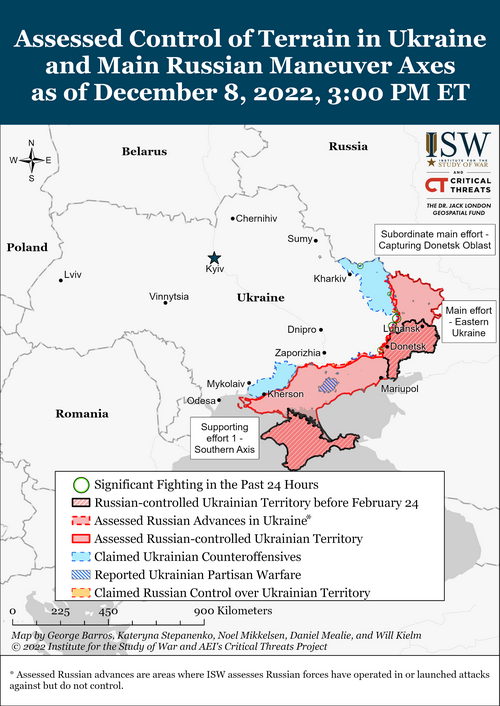
Click here to see ISW’s interactive map of the Russian invasion of Ukraine. This map is updated daily alongside the static maps present in this report.
German Chancellor Olaf Scholtz stated that the risk of Russian nuclear escalation is currently low, partially supporting ISW’s previous assessments. Scholtz stated that “Russia stopped threatening to use nuclear weapons” because an international “red line” contributed to “putting a stop” to Russian nuclear escalation threats on December 8.[1] ISW has always assessed that Russian nuclear escalation in Ukraine was unlikely.[2] Russian President Vladimir Putin reiterated Russia’s official position on nuclear weapons, including Russia’s non-first-use policy, on December 7.[3] Both Scholtz’s and Putin’s statements support ISW’s previous assessment that while Russian officials may engage in forms of nuclear saber-rattling as part of an information operation meant to undermine Western support for Ukraine, Russian officials have no intention of actually using them on the battlefield.[4]
The Kremlin likely has not abandoned its maximalist objectives in Ukraine despite Kremlin Spokesman Dmitry Peskov’s first-time acknowledgment that Moscow’s current territorial objective is to fully seize four partially occupied Ukrainian oblasts. Peskov took an opportunity to further capitalize on the Western desire for negotiations on December 8 when expanding upon Russian President Vladimir Putin’s December 7 remarks regarding the acquisition of “new Russian territories.”[5] Peskov stated that one of the main goals of the Russian “special military operation” in Ukraine was to “protect residents of southeastern Ukraine and Donbas” when responding to a journalist‘s question regarding the Kremlin’s original objectives for war.[6] Peskov also noted that there are no talks about annexing new territories that are currently not under Russian partial occupation as there is “still a lot of work to be done” to fully occupy Donetsk, Luhansk, Zaporizhia, and Kherson oblasts. Peskov, however, reiterated that the Kremlin is still pursuing its “demilitarization” and “denazification” objectives in Ukraine, which confirms that Russia is still pursuing regime change (“denazification”) and the elimination of Ukraine’s ability to resist future Russian attacks or pressure (“demilitarization”). The Kremlin’s objectives, in other words, continue to remain unchanged from those set following the Russian withdrawal from Kyiv. Peskov’s comments were not an inflection in Russian war aims or demands.
Putin’s invocation of Russian imperial history on December 7 and his recent remarks regarding Russia’s role as the only “guarantee of Ukrainian sovereignty” are further indicators that the Kremlin is setting conditions for a protracted war aimed at eradicating Ukrainian sovereignty.[7] The Kremlin’s deliberately inconsistent messaging is part of a persistent information operation intended to mislead the West into pushing Kyiv to negotiate and offer preemptive concessions.[8]
The Kremlin’s Western-oriented messaging is continuing to anger the pro-war milblogger community that is increasingly accusing the Kremlin of deviating from its original war goals in Ukraine, however. A prominent milblogger stated that “the annexation of Zaporizhia and Kherson oblasts was not among the declared goals of the special military operation on February 24.”[9] Less prominent milbloggers claimed that Putin does not have the capacity to continue pursuing his maximalist goals following numerous withdrawals and unsuccessful offensive campaigns, forcing the Kremlin to accept protracted war as the means to wear down Ukraine.[10] The Kremlin’s deliberately inconsistent rhetoric may have further ramifications on the appeal to Russians of Putin’s vision for the war in Ukraine.
Putin may be deliberately distancing his rhetoric from nationalists’ unrealistic demands for the Russian war efforts in Ukraine. Putin stated on December 8 that in order to help Russia complete its war goals Russians should stop engaging in confrontations on the information front and suppress their impulses to believe fake and leaked information.[11] Putin added that there is “a lot of noise” within the information space regarding Russia’s missile campaign against Ukrainian energy infrastructure and falsely implied that Russian strikes are retaliatory measures following the claimed Ukrainian attack on Kerch Strait Bridge, shelling of the Kursk Nuclear Power Plant, and Ukraine’s uninterest in providing water to Donetsk City. A prominent milblogger — who had been calling on Putin to retaliate for Ukraine’s liberation of Russian-occupied territories and claimed Ukrainian strikes against Russia — found Putin’s comments disappointing and angrily interpreted Putin’s statements to mean that the Kremlin had not planned to strike Ukrainian infrastructure if the attack against Kerch Strait Bridge did not occur.[12]
The Kremlin has been increasingly attempting to reorient public opinion to favor its official messaging, and Putin’s December 8 statement may aim to diminish or marginalize the milbloggers to re-establish the perception that the Kremlin maintains a “moderate” and authoritative position. Putin has previously publicly associated himself with nationalist milbloggers but still drawn criticism for failing to fully ideologize Russia.
Putin may be attempting to get the milblogger community under control by attacking its credibility and encouraging self-censorship. Kremlin Spokesperson Dmitry Peskov stated on November 6 that Russians must listen to information about mobilization from Putin and the Russian Ministry of Defense (MoD) when responding to a question regarding Telegram channels.[13] While Putin may also be considering actually censoring the milbloggers, such measures remain unlikely given Putin’s ongoing efforts to retain relations with select milbloggers. Putin’s December 8 statement may also be an example of poor messaging discipline that failed to account for Russian milbloggers’ growing complaints about Moscow’s failures to address the perceived Ukrainian threat against Russia.
On the other hand, a senior Kremlin official explained why the Kremlin tolerates criticism from the pro-war Russian milblogger community for the first time. Russian Foreign Ministry Spokesperson Maria Zakharova responded to a question concerning the discrepancies between the Kremlin’s and milbloggers’ coverage of the war at the “Voenkors [milbloggers] as a New Information Powerhouse” panel on December 7.[14] Zakharova implied that the Kremlin permits divergent coverage of the war in order to maintain a uniform political view — likely referring to the milbloggers’ ongoing support for Putin’s vision for seizing all of Ukraine. Zakharova also suggested that the Kremlin is not interested in enforcing “absolutist” information policies as the divergent voices allow the Kremlin to monitor different opinions and their influence in society. Zakharova hypothesized that if the Kremlin attempted to force scripted slogans upon shapers of the Russian information space it would not deprive them of their opinions or influence but only remove these figures from the Kremlin’s eye.
Zakharova’s statements are a candid acknowledgement of the Kremlin’s desire to appeal to the wider nationalist audiences at the expense of the Russian Ministry of Defense’s (MoD) credibility, as ISW has long assessed. The convening of the panel itself further confirms that the Kremlin is cognizant of its inability to strip the milbloggers of their influence at this stage of the war, granting milbloggers growing credibility in the Russian information space. The Kremlin, however, continues to intensify censorship against Russian opposition bloggers that criticize the Russian government, analyze combat footage, and voice concerns similar to those of nationalist milbloggers’ about mobilization and frontline problems. Russian officials have announced a search for famous Russian YouTube personality Dmitry Ivanov (1.7 million viewers) who had analyzed the ground situation during the siege of Mariupol and has criticized Zakharova, for example.[15]
Chairman of the US Joint Chiefs of Staff General Mark Milley stated that fighting in Ukraine may intensify this winter despite the recent fighting tempo decrease from autumn, partially supporting ISW’s assessments and forecasts.[16] Milley told the Wall Street Journal on December 7 that frontlines in Ukraine are currently “stabilizing[,] and as winter rolls in,” he acknowledged the “potential opportunity for offensive action” from either Russian or Ukrainian forces during “the depth of the winter because of the weather and the terrain.”[17] Milley’s assessment diverges from US Director for National Intelligence Avril Haines’ December 3 forecast that the pace of the war in Ukraine will slow over the winter so that fighting can resume in spring 2023.[18] Milley’s statement supports ISW’s assessment that Ukrainian forces will be able to exploit the weather conditions as the hard freeze approaches in late December since winter is conducive for mechanized warfare in Ukraine.[19] ISW assesses Ukrainian forces likely are preparing to take advantage of frozen terrain to move more easily than they could in the muddy autumn months and that Ukraine’s continued operational successes depend on Ukrainian forces’ ability to continue successive operations through the winter of 2022–2023 without interruption.[20]
Ukrainian officials stated on December 8 that Russian forces further militarized the Zaporizhzhia Nuclear Power Plant (ZNPP). Ukrainian state nuclear energy agency Energoatom reported on December 8 that Russian forces transferred several Grad MLRS systems near reactor number 6 and the dry storage fuel area at the ZNPP.[21] Energoatom stated that Russian forces most likely plan to use the Grad systems to strike Nikopol and Marhanets, Dnipropetrovsk Oblast – near daily targets of Russian shelling already.[22] ISW has reported on prior footage confirming that Russian forces have stored military equipment, including ammunition, armored personnel carriers, anti-aircraft guns, and other armaments on the ZNPP grounds.[23] New equipment deployments to the ZNPP may be an attempt to placate ongoing speculation among Russian nationalist milbloggers of a possible Russian withdrawal from the ZNPP, which the Kremlin has denied twice within the past 10 days.[24]
Key Takeaways
- German Chancellor Olaf Scholz stated that the risk of Russian nuclear escalation is low.
- Chairman of the Joint Chief of Staff General Mark Milley stated that fighting may intensify in Ukraine during the winter.
- The Kremlin has likely not abandoned its maximalist goals in Ukraine despite Dmitry Pskov’s comments on Russian territorial objectives.
- The Kremlin’s Western-orientated messaging continues to anger the pro-war milblogger community.
- Russian President Vladimir Putin may be distancing his rhetoric from nationalists’ unrealistic demands for the Russian war in Ukraine.
- A senior Kremlin official admitted that the Kremlin tolerates criticism from the pro-war milblogger community out of a desire to appeal to the wider nationalist community.
- Ukrainian officials stated that Russian forces further militarized the Zaporizhzhia Nuclear Power Plant (ZNPP).
- Russian forces reinforced positions near Svatove and conducted counterattacks near Kreminna amid continued Ukrainian counteroffensive operations in eastern Ukraine.
- Russian forces continued offensive operations in the Bakhmut and Avdiivka–Donetsk City areas.
- A Russian government official implied that Putin’s word is law when it comes to the military mobilization of Russian citizens.
- Russian occupation officials increased security measures in Russian-occupied territories in Ukraine.
Go here to read the rest. Citing Mark Milley as a military authority is amusing. He thought the Russians would win the War in few days. He also predicted that the Afghanistan government after our withdrawal might hold out for months. Milley does not give professional military opinions based upon military expertise. He gives guesses based upon what he has read in the mass media. Of all the appointments of President Trump, his appointment of Milley was his worst.


The Russians fought poorly during the 1939 Winter war with Finland because they were on the offence and had little motivation to put themselves in danger for a dubious cause. They fought well in 1942-43 Winter against the Germans because they were motivated (threatened by political officers?) to defend the Motherland. Seems, like the Bourbons, they learn nothing and forget nothing.