
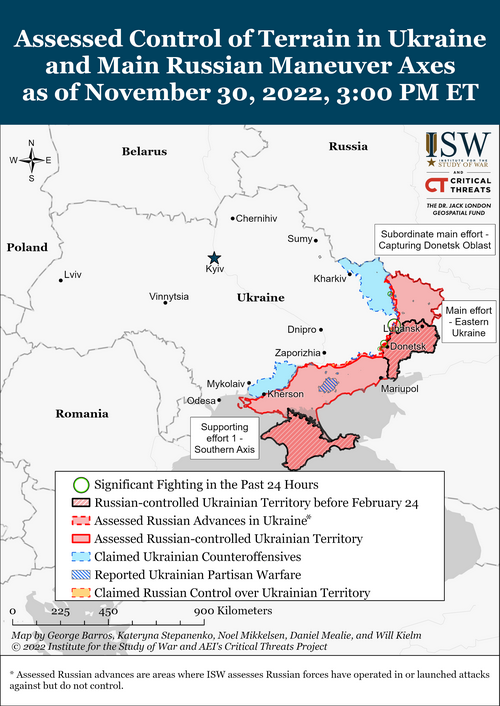
From The Institute For The Study of War:
Karolina Hird, Riley Bailey, Madison Williams, Yekaterina Klepanchuk, and Frederick W. Kagan
November 30, 8:00 pm ET
Click here to see ISW’s interactive map of the Russian invasion of Ukraine. This map is updated daily alongside the static maps present in this report.
Russian efforts around Bakhmut indicate that Russian forces have fundamentally failed to learn from previous high-casualty campaigns concentrated on objectives of limited operational or strategic significance. Russian forces have continually expended combat strength on small settlements around Bakhmut since the end of May; in the following six months, they have only secured gains on the order of a few kilometers at a time.[1] As ISW has previously observed, Russian efforts to advance on Bakhmut have resulted in the continued attrition of Russian manpower and equipment, pinning troops on relatively insignificant settlements for weeks and months at a time.[2] This pattern of operations closely resembles the previous Russian effort to take Severodonetsk and Lysychansk earlier in the war. As ISW assessed throughout June and July of this year, Ukrainian forces essentially allowed Russian troops to concentrate efforts on Severodonetsk and Lysychansk, two cities near the Luhansk Oblast border of limited operational and strategic significance, in order to capitalize on the continued degradation of Russian manpower and equipment over the course of months of grinding combat.[3] Russian troops eventually captured Lysychansk and Severodonetsk and reached the Luhansk Oblast border, but that tactical success translated to negligible operational benefit as the Russian offensive in the east then culminated. Russian efforts in this area have remained largely stalled along the lines that they reached in early July. Even if Russian troops continue to advance toward and within Bakhmut, and even if they force a controlled Ukrainian withdrawal from the city (as was the case in Lysychansk), Bakhmut itself offers them little operational benefit. The costs associated with six months of brutal, grinding, and attrition-based combat around Bakhmut far outweigh any operational advantage that the Russians can obtain from taking Bakhmut. Russian offensives around Bakhmut, on the other hand, are consuming a significant proportion of Russia’s available combat power, potentially facilitating continued Ukrainian counteroffensives elsewhere.
Russian state nuclear power company Rosatom stated that the former chief engineer of the Zaporizhzhia Nuclear Power Plant (ZNPP) has become the new director of the ZNPP. Rosatom advisor Renat Karchaa announced on November 30 that Yuriy Chernichuk has become the new ZNPP director and the first deputy general director of the Joint Stock Company “Operating Organization of the ZNPP,” which is the entity that Rosatom formed on October 3 to essentially replace Ukrainian company Energoatom as the plant’s operator and to oversee the “safe operation” of the ZNPP and manage personnel activities within the plant.[4] Karchaa also noted that the entire management company of the ZNPP is formed of existing members of ZNPP staff who have signed a new employment contract.[5] Rosatom‘s direct role in appointing and overseeing ZNPP management is consistent with previous efforts to install and maintain Russian control of the ZNPP in a way that is likely intended to force the International Atomic Energy Agency (IAEA) to de facto accept Russian claims over the plant by interacting with Russian-controlled ZNPP staff.[6]
The Kremlin continues efforts to stifle domestic dissent through legislation that broadens the definition of “foreign agents” and those amenable to foreign influence. Russian media began reporting on November 23 that the Russian government approved new restrictions on the ability of those deemed “foreign agents” to post materials created by foreign-influenced sources and conduct public activities, which will enter into effect on December 1.[7] The Russian Ministry of Justice expanded the list of “individual-foreign agents” on November 27 on the basis of those individuals conducting unspecified political activities.[8] The United Kingdom Ministry of Defense (UK MoD) also noted that Russian President Vladimir Putin has approved amendments to the 2012 ”Foreign Agents Law” that extends the original definition of ”foreign agents” to anyone who is under undefined ”influence or pressure” from foreign actors.[9] The amendments also afford the Russian Ministry of Justice the purview to publish the personal details of designated foreign agents, opening them up to public harassment.[10] These measures are likely intended to crack down on increasing instances of domestic dissent about the Kremlin’s conduct of the war. By broadening the definition of those classified as foreign agents, the Kremlin can expand its weaponization of this designation to ratchet up censorship measures and exert increased control over the information space.
The Belarusian Minster of Defense made comments likely in support of ongoing information operations, and some Russian sources reframed those comments so as to place further pressure on Belarusian officials to support Russia’s war in Ukraine. Belarusian Minister of Defense Lieutenant General Viktor Khrenin stated on November 30 that the actions of bordering NATO members suggest that preparations are underway to conduct military operations in the eastern direction (i.e., against Belarus).[11] While Khrenin’s comments incorporate several possible types of military operations, Russian media and a milblogger reported his comments as saying explicitly that NATO is preparing for offensive operations in the eastern direction (which is a nonsensical accusation).[12] Khrenin likely made the comments about NATO military activities on the borders with Belarus in support of what ISW has previously assessed is an ongoing information operation aimed at fixing Ukrainian forces on the border with Belarus in response to the threat of Belarus entering the war.[13] ISW has also previously assessed that Belarus is highly unlikely to enter the war.[14] Russian sources likely framed Khrenin’s comments to be more inflammatory in order to support the information operation about Belarus entering the war but also to set more escalatory information conditions that may place more pressure on Belarusian officials to further support the Russian offensive campaign in Ukraine.
Russian opinion polling suggests that the Russian public may be tiring of Russia’s war in Ukraine. Russian opposition media outlet Meduza reported on November 30 that it had gained access to the results of an opinion poll commissioned by the Kremlin for internal use that shows that 55 percent of Russians favor peace talks with Ukraine and 25 percent favor continuing the war.[15] Russian independent polling organization Levada’s October polling shows a similar breakdown with 34 percent favoring continuing military actions in Ukraine and 57 percent favoring negotiations.[16] Internal Kremlin polling reportedly placed the percentage of Russians supporting negotiations with Ukraine at 32 percent in July and the percentage favoring the continuation of the war at 57 percent.[17] Meduza reported that the director of the Levada Center Denis Volkov stated that the share of Russians likely to support peace talks with Ukraine began to grow rapidly following Russian President Vladimir Putin’s partial mobilization decree.[18] Disruptions associated with partial mobilization and Russian setbacks on the battlefield have likely contributed to an increasing war weariness among the Russian public, as reflected in the polling.
Key Takeaways
- The Russian military’s efforts around Bakhmut suggest that Russian forces failed to learn from previous costly campaigns focused on operationally insignificant settlements.
- Russian state nuclear company Rosenergoatom appointed a new director for the Zaporizhzhia Nuclear Power Plant.
- The Kremlin continues efforts to stifle domestic dissent through an expansion of measures ostensibly aimed against “foreign agents.”
- Russian opinion polling suggests that the Russian public may be growing tired of Russia’s war in Ukraine.
- Russian forces continued efforts to defend against Ukrainian counteroffensive operations along the Svatove-Kreminna line.
- Russia forces continued to make incremental gains around Bakhmut and to conduct offensive operations in the Avdiivka-Donetsk City area.
- A Ukrainian official acknowledged that Ukrainian forces are conducting an operation on the Kinburn Spit.
- Russian and Ukrainian sources indicated that Russian officials are continuing to conduct partial mobilization measures.
- Russian officials’ ongoing efforts to integrate illegally annexed territories into the Russian Federation are likely very disorganized.
Go here to read the rest.
From Strategy Page:
November 30, 2022: Putin says Russia may need to mobilize five million men in order to defeat Ukraine. That is considered impossible unless Russia can carry out a mobilization on the scale of the mobilization carried out after the Germans invaded in 1941. In 2022 it’s the Russians doing the invading and there is no foreign invader burning down Russia to justify a major mobilization to defend the motherland. Vladimir Putin is no Josef Stalin and the Putin government has a lot less control over the population than Stalin did. Russians can, more easily and at less risk, fight back against government injustice. Putin’s actions are seen as responsible for the economic depression Russia finds itself in and the growing number of men forced to fight, and die, in Ukraine against better motivated armed and effective locals. State controlled media has tried to put the blame on NATO, but that has not worked. More Russians are discovering that it’s Putin, not NATO, that is bringing all this misfortune into Russia. Stalin never had to deal with the Internet or a generation of Russians who have experienced democracy, can see the differences, and do something about it.
Over five million Russians have permanently left Russia since Vladimir Putin took power in 1999. The exodus accelerated when he made his rule legally permanent in 2020. In 2022 Putin ordered the invasion of Ukraine, the first of several conquests he proclaimed necessary for Russian survival. This is not working out because of disastrous mistakes at the top, while increased internal repression and external violence have crippled the economy (fewer jobs). That and forcing unwilling men into the army to fight in Ukraine have led to still more Russians leaving Russia. These departures are substantial and continually reduce the population and percentage of the population that is Russian. This is all about Putin seeking to increase Russia’s Slavic population and rely less on migrants from former Soviet states in Central Asia to make up the difference in numbers. This is worse because ethnic Russians have a much lower birth rate than new central Asian arrivals. This lower birth rate is similar to what is happening in most industrialized nations. When Putin became the Russian leader in 1999, there were 117 million ethnic Russians who formed 80 percent of the population. The other 20 percent were various “less reliable” minorities. That included Ukrainians. By 2020 there were 109 million ethnic Russians and 24 percent of the population was non-Russian. In 1999 the total population was 147 million while in 2020 it was 144 million. Russia added the population of Crimea (2.4 million) to the official total but that province belongs to Ukraine and the Ukrainians are poised to take it back.
In contrast, over half a million Ukrainians have volunteered or been conscripted to join the military since February. Ukrainian forces are composed of troops with more training as well as better equipment and leadership. In combat Ukrainian losses are less than half what Russia suffers. Training, leadership and better weapons and tactics make a big difference. Ukraine also assigns many of its troops to perform essential transportation, supply and other support functions that Russia neglects or puts less effort into. It should not be this way because Russia has over three times the population of Ukraine and an equal superiority in resources, but still does not acknowledge the importance of support services for the combat troops. As Ukraine turned to the West for new and more effective ways of doing things, they discovered, especially since 2014, that Western military practices were superior to what was still standard in Russia. For example, Ukrainians have, since the 1990s, sought to adopt a Western style of logistical support. Russian invasion plans depended on a quick victory because Russia did not have the logistical capabilities to handle a longer war. That turned out to be a major flaw in the Russian war plan and now they are feeling the impact of superior Ukrainian logistics support from NATO. For example, Russia has not been able to supply its troops with as much artillery ammunition as Ukraine is receiving. Ukraine and NATO nations have increased their artillery ammo production far above what Russia can produce. The Ukrainians also continue to use their artillery more effectively than the Russians. This sort of situation has long been expressed another way; “amateurs study tactics while professionals study logistics”.
Speaking of logistics, the United States has been the major supplier of weapons and other assistance since 2014 and most of the weapons shipped to Ukraine in the last year. That is costing the Americans less than six percent of their annual defense budget while Russia is seeing its military defeated and discredited while its economy suffers long-term damage. The war in Ukraine is diminishing the Russian threat to Europe. This is why many European NATO countries are spending even more (as a portion of their military budget) to support Ukraine. The main purpose of NATO has always been to protect Europe from Russian threats.
November 29, 2022: Russia has sent at least one of its Buk-M3 self-propelled anti-aircraft systems to Donbas. In 2014 it was an older Buk-M2 system that shot down a Malaysian Boeing-777 airliner enroute from the Netherlands. Russia tried to blame this on Ukrainian forces, but an extensive investigation proved that Russia was the culprit. That investigation finally wrapped up this year. Ukraine is receiving Patriot air defense systems and 250 heavy machine-guns with thermal sights to deal with the low and slow Shehed-136 cruise missiles.
November 28, 2022: Ukrainians were warned by their government that Russia would continue attacking the electricity generating and distribution system. Ukraine is more dependent on nuclear power for electricity than any other country in Europe and the Russians sought to take advantage of that. In response Ukraine has organized a large force of technicians to keep repairing damage to the electrical power facilities. Currently Ukraine believes that at least 20 percent of electricity will not be available because of continued Russian attacks. On the plus side, Russia is backing away from threats of a “nuclear disaster.” This is partly because the UN sponsored IAEA (International Atomic Energy Agency) nuclear risk inspectors made it clear to everyone that any catastrophe at a Ukrainian nuclear power plant would end up hurting at least as many Russians, and Belarussians, and other Europeans as Ukrainians.
Russians still remember the 1986 nuclear power plant disaster caused by the Soviets. This enabled the IAEA to get involved in demilitarizing the Zaporizhzhia nuclear power plant complex, the largest in Europe. The complex is on the Dnieper River in Zaporizhzhia province, which is adjacent to Donbas. Russia took control of the nuclear facility in February. Russia is using the threat of damage to the nuclear facility to force the advancing Ukrainian forces to retreat. Failure to comply will, the Russians imply, create another Chernobyl disaster and an even larger radioactive zone. A large region around the Chernobyl power plant is still highly radioactive because of the 1986 nuclear meltdown of one of the reactors. This nuclear disaster, which the Soviets tried to keep quiet, was quickly exposed as a major disaster and one of the reasons Ukrainians were so eager to leave the Soviet Union five years later. Most of the victims of the radioactivity were Ukrainian but there were plenty of victims in Russia and other nations.
On the second day of the invasion Russian troops arrived at Chernobyl and replaced the Ukrainian security guards keeping people out of the 2,600 square kilometers (thousand square miles) radioactive exclusion zone near the Belarus border. After 1986 about 250,000 people were moved from the zone and since then only tourists were allowed in, under escort, for short periods. About 5,000 people guard the security zone and monitor the enormous concrete and steel structure now surrounding the still highly radioactive power plant uranium core. Those monitors spend fifteen days at a time in the zone and then two weeks outside it, with their radioactivity levels carefully monitored. Those monitoring personnel remained, but under Russian control. While Ukrainians comprised most of those killed by the melt down, about 70 percent of the initial radiation fell on what is now Belarus. For that reason, it seems unlikely the Russians would not arrange for an accident at the entombed nuclear core. Most Belarussians oppose Russia and their own dictator, which is currently kept in power by Russian forces. The main reason for taking control of the exclusion zone was that it is a key element of one of the shortest routes to Kyiv. That offensive failed and Russian troops withdrew from Chernobyl at the end of March, as all Russian forces retreated from northern Ukraine.
The IAEA has no police powers and is autonomous, although it cooperates closely with UN agencies. Ukraine knows that but Ukraine allows foreign reporters to visit the front lines, something Russia prohibits in the name of “security”. IAEA inspectors can observe the Zaporizhzhia complex and confirm that the Ukrainians are not firing on it, while the Russians are, and claiming the Ukrainians are responsible for damage to the reactors. Russia is one of the five founding members of the UN with a veto over most UN efforts. But the IAEA is not part of the UN and can document who did what at Zaporizhzhia. That can lead to war crimes charges against the Russian officers and officials involved. This is the sort of thing IAEA was created for when the IAEA was founded in 1957.
November 27, 2022: Ukraine believes that Russia is planning another mobilization of Russian men to serve in the military. The first mobilization in September sought to obtain 300,000 men but after more than a month only about 200,000 could be obtained. The December mobilization is supposed to avoid the problems of the September effort and actually obtain 300,000 men for the military.
Go here to read the rest.
With poor morale the Russian forces are in no mental state to face a Winter campaign. We shall see.

