
https://www.youtube.com/watch?v=SYdKqU-FJ9k
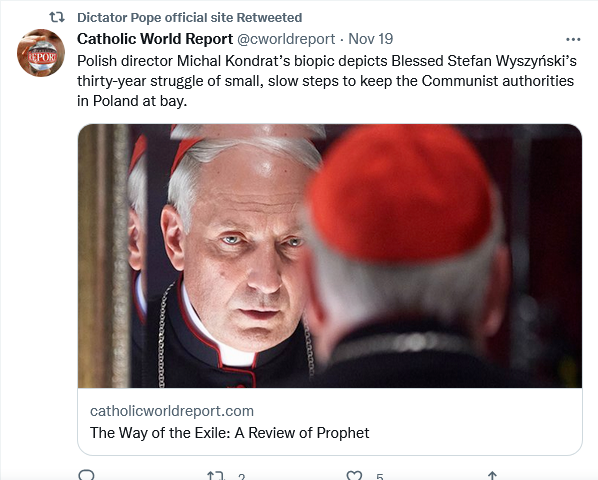
Stefan Cardinal Wyszyński for thirty years played a chess game against the Polish Communist government. Knowing that his life could be forfeit at any moment he skillfully outwitted adversaries wielding all the power of the State. Dying in 1981 he lived long enough to see his protege on the throne of Peter and to glimpse the beginnings of a movement that would lead to a free Poland.


He was a fearless servant of God, a witness to the horrors of Communism and a true patriot.
“Poland will be Catholic or she will cease to exist.”
FYI, in Polish, the W is pronounced like English V and sz sounds like SH.
The W sound is signified by an L with a slash through it. Crazy…and how my last name is spelled in Polish.
Djiejuke.
My husband’s grandparents came through Canada to Buffalo around 1900. They substituted the ending J with a Y which kept the ee sound, yet easier for non Poles to pronounce. The Cleveland branch kept the J.
For Penguins Fan and Cam:
The Polish Language by Langfocus:
https://youtu.be/hfJinyofQdk
Another comment to Penguins Fan and Cam:
Since you made comments about the Polish language (which is Slavic), the following additional video may also interest you:
The Slavic Languages and What Makes Them a FAMILY
https://www.youtube.com/watch?v=PfpEPjfB12g
Interestingly, like Latin and Greek, Slavic languages are highly inflected with declensions for nouns and adjectives, and with two exceptions (Bulgarian and Macedonian) they lack articles (i.e., the, a and an).
Polish, Slovak and Czech are west Slavic languages whereas Russian, Ukrainian and Belorussian are east Slavic languages, and Serb-Croatian, Bulgarian and Macedonian are south Slavic languages. Many Slavic languages use the Cyrillic alphabet. Polish uses the Latin alphabet with many diacritics and consonant dipthongs for special Slavic pronunciation. The two things I find difficult about Polish is assignment of gender to verbs (not done in either Latin or Greek), and only two tenses: past and non-past tense. It takes some getting used to.
The reason for the useage of different alphabets: those nations that were Catholic defaulted to the Latin alphabet and those that were Eastern Orthodox defaulted to the Cyrillic alphabet. BTW, there are significant differences between certain Ukrainian Cyrillic letters and certain Russian ones. Not everything is standardized.
Sidenote: Old Church Slavonic is to Slavic Eastern Orthodoxy what Elizabethan English is to Anglicanism, what Greek is to non-Slavonic Eastern Orthodox Churches, and what Latin is to the Roman Catholic Church.
While I have seen those videos, thank you for posting.
I know just a few words of Polish and have had little time or opportunity to study it…which won’t help much when (if) we travel to Polska next summer.
Polish does have a surprising amount of words taken from Latin.
LQC, Thank you passing on to family.