
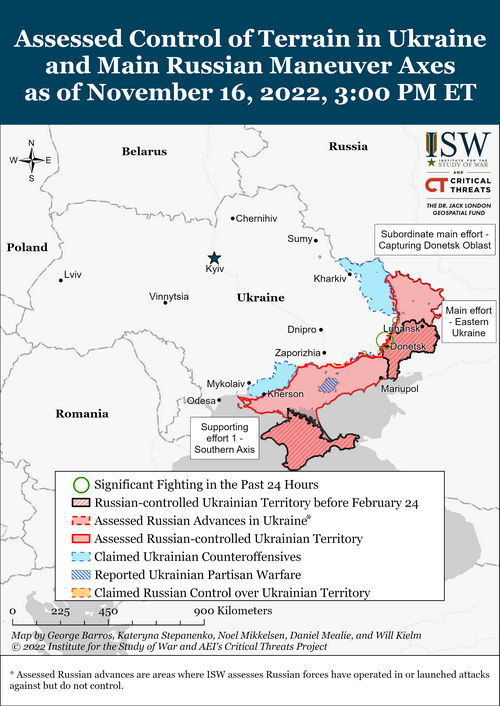
From The Institute For The Study of War:
Karolina Hird, Riley Bailey, Grace Mappes, Madison Williams, Yekaterina Klepanchuk, and Frederick W. Kagan
November 16, 6:45pm ET
Click here to see ISW’s interactive map of the Russian invasion of Ukraine. This map is updated daily alongside the static maps present in this report.
Russian sources and proxy officials are flagrantly touting the forced adoption of Ukrainian children into Russian families. Prominent Russian milbloggers began circulating a multi-part documentary series on November 9 featuring several Ukrainian children from Donbas after being adopted into Russian families.[1] The documentary series claims that Russian officials have evacuated over 150,000 children from Donbas in 2022 alone.[2] It is unclear exactly how Russian sources are calculating this figure, and Ukrainian officials previously estimated this number to be 6,000 to 8,000.[3] Head of the Chechen Republic Ramzan Kadyrov additionally stated he is working with Russian Federation Commissioner for Children’s Rights Maria Lvova-Belova to bring “difficult teenagers” from various Russian regions and occupied Donetsk and Luhansk Oblasts to Chechnya to engage in “preventative work” and “military-patriotic education.”[4] Lvova-Belova has continually advocated for deportations and adoptions of Ukrainian children and herself adopted a child from Mariupol.[5] Forced adoption programs and the deportation of children under the guise of vacation and rehabilitation schemes likely form the backbone of a massive Russian depopulation campaign that may amount to a violation of the Convention on the Prevention and Punishment of the Crime of Genocide and constitute a wider ethnic cleansing effort, as ISW has previously reported.[6]
Ukrainian sources continued to clarify the damage caused by the massive November 15 Russian missile strike across Ukraine. The Ukrainian General Staff stated on November 16 that Russian forces launched over 90 Kh-101 and Kalibr cruise missiles and 11 drones over the course of November 15 and targeted critical infrastructure in a number of oblasts.[7] Ukrainian Air Force Command reported that Ukrainian air defense and ground forces shot down 75 missiles and 10 Shahed-136 drones.[8] US Secretary of Defense Lloyd Austin noted on November 16 that the US-provided National Advanced Surface-to-Air Missile System (NASAMS) had a 100% success rate in intercepting Russian missiles.[9] As ISW previously reported, Russian forces likely used a substantial portion of their high-precision weapon systems in the November 15 attack.[10]
The Russian information space largely followed the official Kremlin framing of the missile strike on Polish territory as a Western provocation. The Russian Ministry of Defense (MoD) stated on November 16 that Ukrainian and other foreign officials’ statements about Russian missiles in connection with the strike on Polish territory constitute a “deliberate provocation with the aim of escalating the situation.”[11] Russian Deputy Chairman of the Security Council Dmitry Medvedev accused the West of moving closer to world war by waging a hybrid attack against Russia following the strike on Polish territory.[12] Russian milbloggers widely accused Western and Ukrainian officials of trying to falsely blame Russia for the strike in order to justify increased support to Ukraine and further escalation in Eastern Europe.[13] Some Russian sources also asserted that Ukrainian and Western officials were trying to use the incident to either pressure Russia to end its coordinated missile campaign against Ukrainian critical infrastructure or to justify sending “better” air defenses to Ukraine.[14] The Russian milbloggers’ support of the Kremlin framing of the strike as a Western provocation is to be expected of a Russian information space that widely views the conflict in Ukraine as a Western operation aimed at degrading Russia as a regional and global power.
Wagner financer Yevgeny Prigozhin is continuing to establish himself as a central figure in the pro-war ultranationalist community, likely in pursuit of ambitious political goals. Russian opposition media outlet Meduza reported on November 16 that two sources close to the Kremlin stated that Prigozhin is thinking about creating a “conservative movement” that may become a political party.[15] Meduza’s sources reported that Prigozhin has established an information campaign of constant anti-elite rhetoric modeled after jailed opposition figure Alexei Navalny’s social media campaign against Russian corruption, but to a very different effect.[16] Meduza’s sources reported that Prigozhin intends to simultaneously use the anti-elite social media campaign to cast himself as a populist figure while currying favor with Russian President Vladimir Putin by intimidating elites that may be viewed as insufficiently loyal to Putin.[17] ISW has previously reported that Prigozhin is attempting to appeal to a constituency in Russia that is both interested in Russia’s claimed national superiority and Soviet brutalist strength and opposed to Russian elite corruption.[18] Prigozhin has previously denied that he is attempting to cast himself as a politician or that he intends to create a political party or movement.[19] ISW has previously reported that Prigozhin is also pursuing the creation of parallel military structures to advance his influence in the ultranationalist pro-war community.[20] Ukrainian Main Military Intelligence Directorate (GUR) representative Andriy Chernyak reported on November 15 that Prigozhin initially began constructing parallel military structures to suppress potential uprisings in Russia but capitalized upon the Kremlin’s need for more capable forces in Russia’s offensive campaign in Ukraine.[21] ISW has previously assessed that Prigozhin’s personal army serves his own personal political goals first and the Russian war effort in Ukraine second.[22] Prigozhin will likely continue efforts to establish parallel military structures and form an anti-elite campaign to cement himself as the central figure of an ultranationalist pro-war political movement in Russia.
Key Takeaways
- Russian sources and proxy officials are flagrantly touting the forced adoption of Ukrainian children into Russian families.
- Ukrainian sources continued to clarify the damage caused by the massive November 15 Russian missile strike across Ukraine.
- The Russian information space largely followed the official Kremlin framing of the missile strike on Polish territory as a Western provocation.
- Wagner Group financer Yevgeny Prigozhin is continuing to establish himself as a central figure in the pro-war ultranationalist community likely in pursuit of ambitious political goals.
- Russian sources claimed that Ukrainian forces continued counteroffensive operations in the directions of Svatove and Kreminna.
- Russian forces continued ground attacks near Bakhmut and Avdiivka, and in western Donetsk Oblast.
- Ukrainian forces continued targeting Russian forces and logistics nodes in southern Ukraine.
- Multiple reports indicate that the morale and psychological state of Russian forces in the Luhansk and Donetsk oblasts are exceedingly low.
- Russian officials continued their efforts to replace proxy officials in occupied territories with Russian officials, forcibly relocate residents, and integrate occupied areas with Russia.
Go here to read the rest.
From Strategy Page:
November 16, 2022: The Russian government has growing morale problems with the families of men recently mobilized by the army and sent to Ukraine. Too many of these new soldiers tell their friends and families back home that they received little or no training and few supplies. Officers are few and soldiers often have to organize their own leadership and sources of basic supplies like shelter, food and fuel. These new soldiers report that when the Ukrainians attack there is little they can do to defend themselves because they often have little ammunition for their rifles and some of the men have never used a rifle before.
At first the government denied that this was happening or, if it was occurring, it was rare. As more soldiers managed to report back to their families, many Russians agreed that this situation was real. Many of these new soldiers were never heard from again. They died in Ukraine and there was no one around to get their names and send word to their families. Some of these soldiers did come back, after being wounded, surviving primitive front line medical care and being evacuated to a hospital in Russia or Belarus. These wounded veterans of the Ukraine fighting confirmed what other soldiers down there were saying.
The basic problem was that the government was broke with little cash to spend on equipping new troops, much less operating training camps to give the new men essential training. The government told the provincial officials how many were needed from their area and left it to local officials to supply the new recruits with needed equipment and other essentials. A few provinces were actually able to do this but most could not because the sanctions have created an economic recession and there are more demands on provincial officials than there is cash available to pay for things. Most newly mobilized men went to Ukraine with inadequate equipment and little training. As the extent of this problem became known, the federal government ordered an economic mobilization and the creation of a Government Coordination Council which would somehow create equipment and other items the new soldiers needed. The reality was that there were no resources to call on. Many defense firms were idle because essential components were not available, especially if they were imported. Defense firms that were still operating had nothing they could divert to help the new soldiers. The Coordination Council found that there was little available to coordinate and mobilize. Nothing happened. Another issue not discussed much by the government-controlled media was widespread corruption in the government. That was often a major factor in the new troops not receiving what they needed. There were some private volunteer organizations that raised money to purchase basic equipment for the new soldiers but the body armor, proper boots and cold weather clothing obtained was not enough.
The government is trying to give some new soldiers proper training and equipment before sending them to Ukraine but shortages and corruption interfere. These factors were largely responsible for the poor performance of the initial invasion force that crossed the Ukrainian border on February 24th.
The current problems began on September 21st when the government ordered the mobilization of 300,000 “reservists”. Easy to say, hard to do. The mobilization did not go as planned because a third of those summoned did not appear and those who did were often sent to Ukraine unequipped and unprepared. The normally pro-Russian Internet based media, especially those who report via the encrypted Telegram app, have been covering the mobilization disaster, especially an incident in early October where hundreds of mobilized men from one city were sent to Ukraine and most were killed or wounded by Ukrainian artillery as they moved towards the front line. Their families back home discovered that many of the mobilized men were in hospitals receiving treatment and complaining that there was a shortage of personnel and supplies at the hospital. The government was reluctant to crack down on the wounded men or their families for going public with their complaints because of increasing physical attacks on mobilization personnel and their local offices.
Some Russian media was reporting that many mobilized men were showing up in Ukraine and finding that the unit they were assigned to had few officers or veteran soldiers available to take charge, and that troops already in Ukraine were not much better off. There were shortages of weapons, ammunition, food, medical care, cold weather gear, communications equipment and shelter. The new recruits were forbidden to take their cellphones with them but, with no one supervising the new troops, it was easy to disobey the order and take their phones to Ukraine. That enabled many new soldiers to report back home that the situation was bad and there were so many of these reports from wounded soldiers in hospitals as well as those in Ukraine that news of the mess was picked up by the Russian media and there were calls for the mobilization officials and commanders in Ukraine to be held accountable.
Ukrainian media reported that general Mikhail Zusko, the commander of the 58th Combined Arms Army had ordered one of his regiments to the front line even though that unit had hundreds newly arrived, recently mobilized men who were unprepared for combat and suffered heavy casualties from Ukrainian artillery before they reached the front line. General Zusko was one of several senior officers accused of such behavior. The Russian government soon allowed this news to be made public to show that Vladimir Putin was cracking down on subordinates who did not do their jobs. This approach was meant to portray Putin as not (or at least less) responsible for the muddled mobilization. Not publicized was the fact that Putin and his defense minister ignored the warnings from their military experts that the mobilization was being mismanaged and that problems with supplying existing troops and training newly mobilized recruits was ignored in a rush to get more troops to Ukraine as quickly as possible.
Russian media, which included many men with military experience, were now able to point out the losses that would be incurred by sending untrained, ill-equipped and poorly led new troops to Ukraine. The estimates were that at least 50,000 of the 200,000 newly mobilized men would be killed or wounded by the end of the year. The Russian media confirmed that the Defense Ministry was not keeping families of new troops aware of where their men were. It was also pointed out, first in Ukrainian media and then in Russia, that a growing number of Russian offensive operations in Ukraine were being called off because the newly mobilized troops were useless for offensive operations and not much more effective when defending. The new troops were increasingly surrendering to Ukrainian forces, who were better trained, led and supplied and veterans of months of combat. The Ukrainian soldiers were told how to encourage surrenders and how to deal with those Russian prisoners. The Ukrainians did this by the book and allowed the Red Cross to meet with and confirm the well being of each POW (prisoner of war) so that they could report this to the families. All this was reported by Ukrainian media, but not by Russian media.
Go here to read the rest.
The Russians now have in the field a force lacking in morale which cannot withstand a major Ukrainian offensive. Much fighting remains, but unless this changes for the Russians, the outcome is inevitable.


Prigozhin should remember that he is not #1 and that Putin has Stalinist tendencies. The lessons of Trotsky and Bukharin should not be lost on him. If he thinks he can outlast Putin, he should reflect on Beria’s fate.