
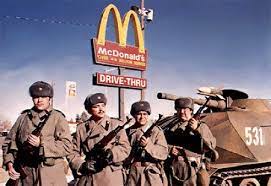
Interview of Donald R. McClarey-conducted in Dwight, Illinois on November 2, 2022. Interviewer: Teresa Schwartz, staff historian, National World War III Remembrance Project.
TS: Please state your name, age and occupation.
DM: Donald R. McClarey, 65, attorney.
TS: You are a veteran of World War III.
DM: Correct, although I had a decidedly minor role.
TS: What was that role?
DM: I was living in Mattoon, Illinois with my wife in August 1984 when the nuclear attacks were made, the Soviets launched their assault across the Bering Straits, and the invasion occurred up from Mexico in the middle of the country.
TS: What was it like to be living through such events?
DM: Sheer terror for me. I thought that a full scale nuclear war would occur. Happily I was wrong about that with both sides adopting a no nukes policy after the initial strikes. President Reagan made it plain in his War Speech that if the Soviet Union used any more nukes that he would order their complete obliteration, but if they used no more nukes we would fight them only conventionally.
TS: Did you find the speech inspiring?
DM: Yes I did, although I realized that repelling the invaders was going to be a hard fight.
TS: You served in the Army.
DM: I was in one of the hundreds of ad hoc militia regiments that were hastily raised and sent to the Mississippi to hold that line. I was stationed across from Saint Louis. After a few initial probes by the enemy my unit saw no fighting. My wife served as a volunteer nurse and was later commissioned as an officer translator. I believe you will be interviewing her next.
TS: What was that part of the war like?
DM: Utter chaos. The Regular Army and most of the National Guard were concentrating against the Soviet invasion force in Canada. We in the militia lacked food, uniforms and ammunition. Our weapons initially were a jumble of every fire arm known to Man. One guy I saw came with a Civil War rifled musket. Things got more organized after the first 30 days.
TS: What happened next?
DM; The militia regiments were federalized and formed into National Army Divisions. I received a temporary Second Lieutenant commission and served in the 45th Mechanized Infantry.
TS: Did you see any fighting?
DM: No, thank God. We were scheduled to participate in the Summer Offensive of 1985, to take back Missouri, when the Treaty of Sacramento was announced, with the Soviets withdrawing. I was demobilized on December 20, 1985 after my division helped with reconstruction in the Freed States. The destruction wreaked by the Soviets in those areas beggared description. I was back at home with my wife for Christmas that year.
TS: Did you agree with the Treaty?
DM: Not at the time, but after the Soviet Union collapsed, from the economic strains imposed by the War, in 1991, I guessed that President Reagan knew better than me what was coming when he signed it.
TS: How would you wish the fortieth anniversary of the War to be commemorated?
DM: Somberly. How else to remember something that cost five million American lives? I hope Americans lucky enough to not having been alive at that time will appreciate the magnitude of that loss, and the heroism of many Americans, especially the behind the lines partisans, who fought with such raw courage and ferocity that the Soviets became convinced they could never conquer us. I pray to God each day that we may never see such dire times again.


I pray to God each day that we may never see such dire times again.
Scary to be honest. I think the only thing that prevents all-out nuclear obliteration is God.
I am glad that alternate time line is fiction. Yet in a way, things today miht be better if it had happened.