
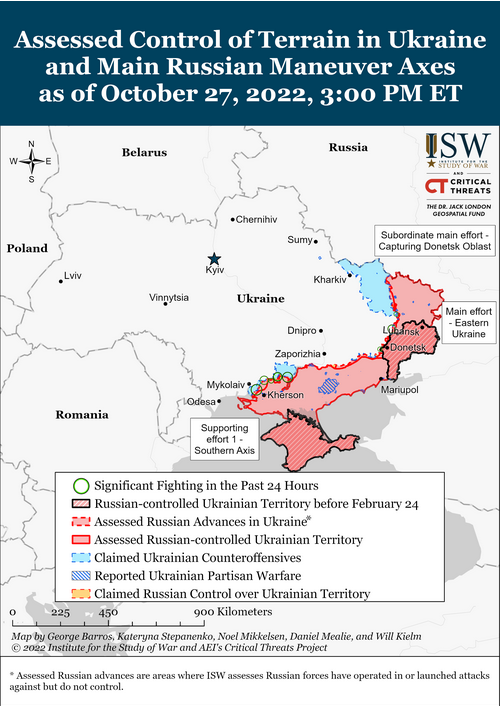
From The Institute For The Study of War:
George Barros, Riley Bailey, Karolina Hird, and Frederick W. Kagan
October 27, 7:30 pm ET
Click here to see ISW’s interactive map of the Russian invasion of Ukraine. This map is updated daily alongside the static maps present in this report.
Russian President Vladimir Putin continues to reject the idea of Ukrainian sovereignty in a way that is fundamentally incompatible with serious negotiations. Putin continued to reject Ukrainian sovereignty during a speech at the Valdai Discussion Club on October 27. Putin stated that the “single real guarantee of Ukrainian sovereignty” can only be Russia, which “created” Ukraine.[1] Putin reiterated that it is a “historical fact” that Ukrainians and Russians are fundamentally “one people” that were wrongly separated into “different states.”[2] Putin stated on October 26 that Ukraine has “lost its sovereignty” and become a NATO vassal.[3]
Putin’s statements reject the legal fact that Ukraine is a fully sovereign state, that the Russian Federation recognized Ukraine’s sovereignty, and that the Ukrainian people exist as a distinct nation. Putin’s perpetuation of the narrative that Ukraine and Russia are a single people separated into different states by arbitrary historical circumstance indicates his continued objective to destroy the Ukrainian state and erase the notion of a Ukrainian people. He added during the question-and-answer period that “if some part of that single ethnicity at some moment decided that it had reached such a level as to consider itself a separate people, then one could only respond with respect.”[4] The many conditionals in this comment underscore Putin’s rejection of the idea that there is currently any independent Ukrainian national identity. These statements, along with many Russian actions, must cause serious reflection on the question of whether Russia’s war against Ukraine is a genocidal action since genocide is legally defined as “acts committed with intent to destroy, in whole or in part, a national, ethnical, racial or religious group.”[5]
A senior Russian official threatened that Russia could target Western commercial satellites supporting Ukraine. Russian Foreign Ministry Deputy Director of the Department for Non-Proliferation and Arms Control Konstantin Vorontsov told the United Nations that the United States and its allies were trying to use space to enforce Western dominance and that “quasi-civilian infrastructure may be a legitimate target for a retaliatory strike.”[6] Reuters reported that US National Security Council Spokesperson John Kirby stated that the United States will meet any attack on US infrastructure “with a response.”[7]
Key Takeaways
- Russian President Vladimir Putin continues to reject Ukrainian sovereignty in a way that is fundamentally incompatible with serious negotiations.
- A senior Russian official threatened that Russia could target Western commercial satellites supporting Ukraine.
- Russian sources claimed that Ukrainian forces conducted counteroffensive operations in northeastern Kharkiv Oblast and along the Kreminna-Lysychansk line.
- Russian forces are continuing to make defensive preparations along the east bank of the Dnipro River in Kherson Oblast.
- Russian sources claimed that Ukrainian forces conducted limited ground assaults in Kherson Oblast.
- Russian forces continued to conduct ground attacks in Donetsk Oblast.
- The Russian military sent mobilization notices to foreign citizens working in Russia.
- Yevgeny Prigozhin‘s Wagner Group may be further developing its air warfare capabilities and fielding more complex equipment on par with the conventional Russian military.
- Russian and occupation administration officials began seizing residents’ cell phones in Russian-occupied territories to support law enforcement and operational security measures.
Go here to read the rest.
From Strategy Page:
October 27, 2022: Most of the military and economic support Ukraine has received so far has come from the United States, which provided nearly $17 billion worth so far. More is on the way, but the Americans and other NATO nations are literally running out of the weapons Ukraine needs the most and requests most often. This includes GMLRS guided missiles launched from HIMARS vehicles, as well as 155mm artillery ammunition and portable anti-tank weapons like Javelin as well as Stinger anti-aircraft missiles.
The U.S. can send Ukraine about 10,000 more of all these missiles. The Americans must retain some of these missiles for training and military emergencies. They will not have enough for a major war until more are manufactured. That will take a while, even though the U.S. is spending money to reopen or expand manufacturing facilities. For example, current production of GMLRS missiles is about 420 missiles a month. Doubling that won’t happen until 2023.
The situation with Javelin missiles is worse. While Ukraine has received 8,500 so far, current production is about 90 missiles a month. Stinger missiles are suffering from the fact that production stopped in 2020 and is now being revived but once more, it will be several months before a significant number of new Stingers are available.
Russia is in worse shape when it comes to guided missile production because Russia depended on Western suppliers for key components, and those have been cut off by sanctions from Russia’s 2022 invasion of Ukraine. Russia now depends on unguided rockets and 152mm artillery shells as well as 120mm (and smaller) mortar shells. At the same time American and other Western production of 155mm shells is already large and being expanded.
Iran has provided Russia with some cruise missiles but not enough to make a difference on the battlefield.
The problem for Ukraine is that the donated missiles, especially GMLRS, are a vital weapon in their offensive operations against the enemy in Russian-occupied parts of Ukraine. Russia is losing control of more of that territory every day but not quickly enough to end the Russian occupation of any Ukrainian territory by the end of the year.
The war in Ukraine resulted in NATO nations now facing major military, economic and security problems. What it comes down to is that military leaders back all possible military aid for Ukraine while political leaders face problems with paying for it. Not just the financial cost, but the impact on voters who find themselves facing higher taxes and as well as inflation and shortages of essential goods. Supporting the Ukrainian war with Russia is expensive and exposes the true costs of cutting defense expenditures in the past by not maintaining sufficient stockpiles of weapons and munitions.
The basic problem is that it is a historical fact, reinforced by the current situation, that you must maintain adequate stockpiles of ammunition and equipment for use against a large, well-equipped force in a war. These stockpiles are also referred to as the “War Reserve”, as in large quantities of munitions and spares stockpiled to keep the troops supplied during the initial 30-60 days of fighting until production can be increased to sustain the fighting. These stockpiles must contain the most useful munitions and other supplies and be positioned so they can be moved to the combat zones as quickly as possible. Without adequate logistics, as in the right supplies delivered in time, wars or at least battles, are often lost early and often. This is happening to the Russians and is crippling Ukrainian war efforts because NATO cannot keep key weapons and other supplies coming. NATO military leaders point out that supporting Ukraine is not just about supporting a nation facing conquest and annexation by Russia. The real issue is that the war in Ukraine is between NATO and Russia only because attacking Ukraine, which is not a NATO member but wants to be one, does not trigger the mutual defense aspect of NATO membership. If Ukraine were a NATO member the Russian attack would face NATO troops from all NATO members. That would mean all NATO members would be suffering troop losses and that motivates voters to support paying the high economic costs of defending Ukraine. Russia sees victory in Ukraine as a victory over NATO and a weakening of NATO resolve to comply with mutual defense aspects of membership. Russian victory in Ukraine would make the new (since the 1990s) NATO members vulnerable to attack and annexation by Russia before other NATO members could help prevent it. For NATO nations adjacent to Russia, these fears aren’t theoretical but historical and often include centuries of Russian aggression and brutal occupation that sometimes led to annexation.
The original reason for NATO, according to the British, was “keeping the Russians out, the Americans in and the Germans down”. NATO was formed after World War II ended in 1945. That also ended over 70 years of major wars instigated by Germany. After the war Germany was partitioned and the Western half faced another Russian invasion. The military occupation of West Germany was short and the West Germans were eager to join NATO and help keep the Russians out. That attitude has persisted through the Cold War, the collapse of the Soviet Union and reunification of Germany. The Germans had lost all interest in wars of aggression, but the Russians had not.
The Soviet Union prospered for a while after Nikita Khrushchev, who took over when Josef Stalin died in 1953, concentrated on the economy and well-being of Russians rather than the world conquest goal, and generally murderous attitudes, of Stalin. This was a welcome change for most Russians if only because Stalin’s policies had resulted in 18 percent of the Russian population dying in wars or domestic terror against Russians by Stalin to protect his power.
Khrushchev was gone within a decade, as the first Russian leader in a long time to “retire” alive from office rather than die or be killed while in power. Khrushchev was replaced by less altruistic politicians who had aligned with Russian military leaders who wanted to start an arms race with the West and prepare for an eventual attack on Western Europe and that new NATO alliance. Then as now Russia described this as necessary to defend Russia from more prosperous NATO countries who might think and act like Russians. This is a bad habit that Russia is having a difficult time overcoming even though the old Soviet Union collapsed from, among other things, this arms race.
After the Soviet Union dissolved, Russia tried democracy for a decade. There was some success but not enough because Vladimir Putin, a former KGB officer, took power and returned to the police state and military buildup that Stalin and Khrushchev’s successors tried with such disastrous results. Putin won the support of the military by spending a lot of money Russian could not afford to update the Cold War era weapons. Those updates, as well as new tactics and unit organizations turned out to be failures and this was made clear when the overconfident Russian military invaded Ukraine. Despite the initial failures, Russia persists and is still seeking to intimidate NATO into submission. For Russia it is a three-front war. First there is the very obvious combat in Ukraine as well as an Information War against politicians and journalists in NATO countries. Then there is an economic struggle to deal with the economic sanctions.
The economics of war have changed since the end of the Cold War, an event that was expected to deliver a “peace dividend” made possible by major cuts in military forces and defense spending. That did not work out as expected because many countries eliminated conscription but underestimated the cost of a smaller all-volunteer force. Another unpleasant surprise was the higher costs for maintaining war reserves. The widespread use of GPS/INS guided shells and rockets since the late 1990s has led to most artillery being retired. One guided shell or rocket can do the work of dozens of unguided projectiles. The validity of this was proven time and again while fighting Islamic terrorists since 2001. This included 2016-18 battles against ISIL (Islamic State in Iraq and the Levant) where the Islamic terrorists were defending urban areas the same way a conventional force would, but smart shells and rockets were used effectively and frequently rather than the older tactic of using far more unguided shells and rockets. In both cases, the urban areas are destroyed but with guided projectiles, it is done with more precision and that enables the friendly ground forces to advance more rapidly and with fewer casualties than in the past. Because of the battles with ISIL in Iraq and Syria, the effectiveness of fewer guided projectiles replacing many more unguided ones was proven and ammunition stockpiles could be adjusted accordingly. Russia has some guided shells, but cannot afford to stockpile many of them and they are less effective than American designs. Russia and East European nations that lost their communist governments by 1990 were stuck with huge stockpiles of old ammo. Not all of it could be exported because so much of it was now available. Moreover bombs, rockets and artillery shells have expiration dates because the propellants, detonators and explosives used degrade over time. Elderly ammo first becomes unreliable and eventually too unstable for use because this ammo will detonate spontaneously as it is used. This is why so many Russian shells and rockets fail to explode. It’s expensive to dispose of elderly ammo and Russia tends to consider older ammo as either “unreliable” but still acceptable for use, or dangerously unstable because even moving it or trying to fire it will cause it to explode on the spot. Dangerously unstable artillery munitions is supposed to be disposed of but sometimes isn’t, and that is often first discovered by unlucky Russian artillery crews in Ukraine.
Since 2018, U.S. Army orders for 155mm artillery shells were up from 16,573 to 148,287 for 2019 because of a new precision guidance option. In 2020 the emphasis switched to GPS guided 227mm rockets (GMLRS) and upgrades for the longer range 600mm ATACMS guided rocket. In 2020 the army has ordered 10,193 GMLRS rockets versus 8,101 in 2019 and 6,936 in 2018. In that time the Army discovered that it was easier to use the longer range (70 kilometers or more) GMLRS than trying to develop longer range tube-based artillery. The need here was to match longer range artillery developed and put in service by Russia and China. Even with longer barrels and rocket-assisted shells, tube artillery could not reach as far as GMLRS. Moreover, jamming the GPS signal is a less effective enemy option with the much-improved microchip-based INS (Inertial Guidance System) long used as a less accurate backup in weapons using GPS for projectile guidance. The new INS is nearly as accurate as GPS and if you have to be sure-fire two or three GMLRS at the same target. That works, especially since INS cannot be jammed.
There is still a need for guided and unguided 155mm artillery shells. To provide choice the army has been ordering many more of the PGK (Projectile Guidance Kit) 155mm fuze. The PGK fuze turns an unguided 155mm shell into a GPS/INS guided one. These were found to be exceptionally useful in Syria and Iraq and, in mid-2017, the U.S. Army ordered another 5,600 PGK fuzes and has been building a large stockpile. The army still uses unguided artillery shells for situations that don’t require precise accuracy for each shell but the PGK provides options that can be implemented quickly to turn any “dumb” shell into a smart one. It is unknown if any of these PGK fuzes have been sent to Ukraine.
Recent U.S. defense budgets accelerated purchases of numerous items that have to be stockpiled to sustain a major war, even a short one. Although fighting in Iraq, Syria and Afghanistan has involved few American troops, it has seen enough action and use of artillery in support of Iraqi, Syrian and Afghan forces to deplete stockpiles and indicate which items would be needed in another major war. That war came along unexpectedly in 2022 when Russia invaded Ukraine and much of the NATO’s support was in the form of modern ATGMs and other guided weapons.
Before 2008, as the war began to wind down in Iraq, there were warnings that stockpiles and war reserves were being allowed to shrink to dangerously low levels. The impact of this was first seen during the 1973 Arab-Israeli war where ammo expenditures were much higher than expected. That lesson remains relevant and politicians don’t like when it stands in the way of keeping the defense budget from interfering with other spending priorities that appeal to more voters.
In early 2016 American military leaders went public about how their complaints about smart bomb and missile shortages being ignored. In 2015 over 25,000 smart bombs and missiles were used by American (mostly) and allied (NATO and local Arabs) warplanes operating over Iraq and Syria. Nearly all weapons were supplied by American firms but the American politicians and military leaders couldn’t agree on how to get the money to replace bombs being taken from the war reserve stocks. That debate was largely halted in 2022 when Ukraine was invaded. Now there is lots of support for increasing production of the items most useful to Ukrainian forces (like Javelin and Stinger) and rebuilding war reserves of those weapons.
Without NATO membership, Ukraine has to depend on the voluntary contributions of military assistance to defeat the Russian attack. The initial NATO response was massive and demonstrated the superiority of NATO weapons. It also revealed that NATO nations had underestimated the need to stockpile sufficient munitions to fight this kind or war and nations manufacturing most of these weapons had not paid enough attention (despite frequent warnings) to how long it would take to achieve wartime production levels. Also neglected were the problems of additional economic burdens placed on NATO member civilian populations. The new NATO members had warned of the growing possibility of a Russian attack, even though that was dismissed as unlikely because of the mutual defense aspects of Article 5 in the NATO membership agreement. But it happened in pro-NATO Ukraine and the new NATO members see doing everything they can to support Ukraine as essential to prevent future attacks on NATO members. Taking Ukraine is part of Russia’s plan to rebuild the Russian empire in spite of Article 5 and Ukraine is the place to prove their plan works. Some of the original (Cold War era) NATO members do not believe the Russians are that reckless. The new NATO members suggest that all NATO members should review the long and violent history the new NATO members have had with Russia in light of the current war in Ukraine and Russian plans for continuing their aggression after they conquer Ukraine.
Go here to read the rest. Russian attempts to knock out Western satellites would be a dangerous escalation of the conflict. Let us hope that such talk is only talk.


Apparently today, Putin announced that he saw no need to use nuclear weapons at the present time in Ukraine. The real reason appears to be that the US military fast-tracked the new B61–12 guided precision thermonuclear missile, Which originally was not scheduled to be deployed until 2025, so that it now will be deployed in December of this year to US bases in Europe. The weapon is delivered by US stealth bombers but is a standoff weapon.
Ukrainian Blogger Denys Davydov States that there is a serious military buildup of a Belarusian/Russian attack force north of Kyiv, apparently with the intent of trying to launch another attack on Kyiv, to draw forces away from the Bakhmut and Kherson areas. The Ukrainians according to Davydov have long anticipated this and have built extensive defensive lines protecting Kyiv, and the terrain favors Ukrainians because it is heavily forested: he thinks that newly deployed constriction Russian troops and inexperienced Belarusian soldiers will suffer horrific losses if they launch the apparently imminent attack.
About last Friday, October 21st, the Russian military employed truly primitive efforts yet again to try to recapture the key railroad and supply junction of Bakhmut, using successive WW2 style human assault waves—9 of them—in a failed effort to overrun the Ukrainians and to exhaust their supplies and ammunition. Information coming out from this failed offensive suggests Bakhmut has become an apocalyptic graveyard of Russian bodies. Two really gripping interviews of captured Russians caught one’s attention: in particular, one captured Russian admitted he was a prisoner sentenced to 20 years for murder, but they came to his prison camp and offered them full amnesty and expunging of his record if he went to fight for 6 months in Ukraine. The reality was that the high command simply deliberately used him and other undesirables as lead waves and human decoys at Bakhmut, so that when the Ukrainians opened up fire, Russian artillery could target them. He said whole masses of them were wiped out, and he realized what fools they had been played for and he surrendered.
Another Russian related how when he had been called up, they had one day of firearms training, and one day of emergency medical training that was extremely primitive. In all, the “training” was about 10 days. He said they drove his group up to a forest and dumped them there where they left them with no water or food for three days. Periodically a Russian officer, whom he said could always be identified by how fat they were, because they were obviously hiding in bunkers and were well supplied in some rear area, would show up and start screaming orders and then disappear again. The Ukrainians finally spotted their position and after a brief initial skirmish, used a drone to bring in murderous artillery fire. And it was all over for his battalion-sized unit. He was badly injured.
Numerous reports indicate that the Russians do not have winter gear or clothing, and they’re already suffering from the low temperatures, nothing like what is to come.
The Iranian suicide drones deployed in Ukraine have turned out to have precision Austrian “Rotax” aircraft engines, based on a captured intact drone. (The US also uses the Rotax engines in some of their drones .) The parent company of Rotax is Bombardier Aircraft of Canada. The Austrian Prime Minister promises of full investigation. Nice that our European allies are supplying suicide drone components to help the Russian cause.
So, all in all, the Russians at nine months in have learned nothing. And they think they can get away with it.
Not often mentioned is the increasing unease of the oligarchs and the danger to their fortunes. Interesting episode this week on Story cable channel about the machinations that went into the assassination of Julius Caesar. Lots of parallels.
The draining of our military stockpiles is extremely worrisome. I’m in favor of arming Ukraine in its fight, but not if it leaves us with a depleted armory.
It looks like Joe is doing to our munitions what he’s doing to the strategic oil reserve. Lord help us.