
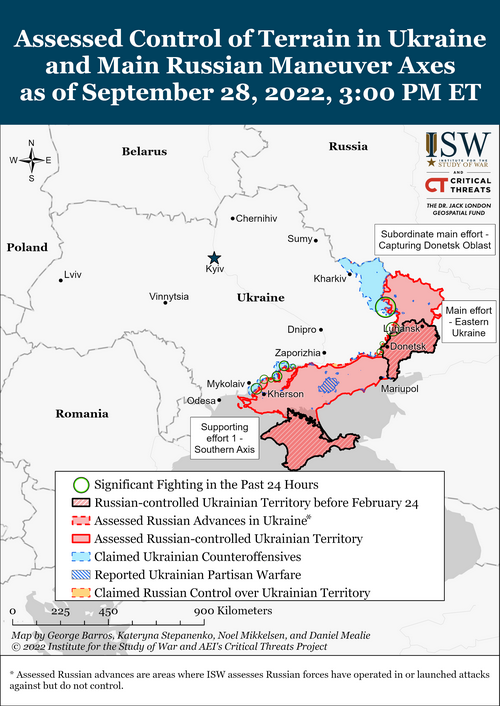
From The Institute For The Study of War:
Karolina Hird, Katherine Lawlor, Grace Mappes, Riley Bailey, and Frederick W. Kagan
September 28, 7:30pm ET
Click here to see ISW’s interactive map of the Russian invasion of Ukraine. This map is updated daily alongside the static maps present in this report.
Russian milbloggers discussed Ukrainian gains around Lyman with increased concern on September 28, suggesting that Russian forces in this area may face imminent defeat.[1] Several Russian milbloggers and prominent military correspondents claimed that Ukrainian troops advanced west, north, and northeast of Lyman and are working to complete the envelopment of Russian troops in Lyman and along the northern bank of the Siverskyi Donets River in this area.[2] Russian mibloggers stated that Ukrainian troops are threatening Russian positions and lines of communication that support the Lyman grouping. The collapse of the Lyman pocket will likely be highly consequential to the Russian grouping in northern Donetsk and western Luhansk oblasts and may allow Ukrainian troops to threaten Russian positions along the western Luhansk Oblast border and in the Severodonetsk-Lysychansk area.
Russian military leadership has failed to set information conditions for potentially imminent Russian defeat in Lyman. The Russian Ministry of Defense has not addressed current Russian losses around Lyman or prepared for the collapse of this sector of the frontline, which will likely further reduce already-low Russian morale. Russian military authorities previously failed to set sufficient information conditions for Russian losses following the first stages of the Ukrainian counteroffensives in Kharkiv Oblast, devastating morale and leading to panic among Russian forces across the Eastern axis. The subsequent ire of the Russian nationalist information space likely played a role in driving the Kremlin to order partial mobilization in the days following Ukraine’s initial sweeping counteroffensive in a haphazard attempt to reinforce Russian lines. Future Ukrainian gains around critical areas in Donetsk and Luhansk Oblast may drive additional wedges between Russian nationalists and military leadership, and between Russian forces and their superiors.
The Kremlin could temporarily postpone announcing the annexation of Russian-occupied Ukrainian territory to better prepare the Russian information space and administrative organization, although September 30 remains the most likely date for some kind of annexation announcement. ISW forecasted on September 27 that Russian President Vladimir Putin will likely announce the Russian annexation of occupied Ukrainian territory on September 30 in his planned address to both houses of the Russian parliament.[3] The Russian Ministry of Defense announced on September 28 that Russia will “fulfill the aspirations of the residents of the LNR, DNR, Zaporizhia, and Kherson oblasts to be together with Russia” in the “near future.”[4] However, Russian State Duma speaker Vyacheslav Volodin announced on September 28 that the State Duma should hold its accession sessions to approve the annexation of occupied Ukrainian territory on October 3 and 4.[5] Latvian-based Russian-language opposition outlet Meduza quoted Kremlin sources on September 28 who claimed that the Kremlin decided ”not to rush things.” Those sources told Meduza that ”the PR effect from [annexation] will be almost zero” due to broad dissatisfaction with partial mobilization in Russia.[6] Meduza reported that the Kremlin conducted a dissatisfactory closed public opinion poll that demonstrated broad Russian discontent and may be attempting to rectify public unhappiness with mobilization before announcing annexation.
Russian-appointed occupation administration leaders of Kherson, Zaporizhia, Donetsk, and Luhansk Oblasts each shared an appeal to Russian President Vladimir Putin by September 28, asking Putin to recognize their sham referenda and welcome them to Russia.[7] The Russian occupation leaders of each oblast will likely meet with Putin in the coming days to present their requests. Putin could announce those performative accession negotiations, rather than final annexation, in his September 30 speech.
Russian authorities continue to send newly-mobilized and undertrained recruits to directly reinforce severely degraded remnants of various units, including units that were previously considered to be Russia’s premier conventional fighting forces. The Ukrainian General Staff reported that newly-mobilized Russian men arrived to reinforce elements of the 1st Tank Regiment of the 2nd Motorized Rifle Division of the 1st Guards Tank Army in unspecified areas of Ukraine with no training at all.[8] Social media footage from September 27 shows a Russian soldier mobilized into the 1st Tank Regiment explaining that he will be sent to fight in Kherson Oblast within two days without any basic training, as ISW reported yesterday.[9] The 1st Guards Tank Army was considered Russia’s premier mechanized force prior to February 24, and that fact that its elements are being reinforced with poorly disciplined, untrained men is consistent with ISW’s previous assessments that even Russia’s most elite units have sustained substantial losses in Ukraine and are therefore increasingly degraded.[10] The addition of newly mobilized forces to elements of the 1st Guards Tank Army is unlikely to lend these units any decisive combat power.
Key Takeaways
- Russian military leadership has likely failed to set information conditions for the potential defeat of the Russian grouping in Lyman, despite increasingly concerned discourse among Russian milbloggers regarding the potential for a Ukrainian envelopment of Lyman.
- The Kremlin could temporarily postpone announcing the annexation of Russian-occupied Ukrainian territory to better prepare the Russian information space and administrative organization, although September 30 remains the most likely date for some kind of annexation announcement.
- Russian authorities continue to send newly-mobilized and undertrained recruits to directly reinforce severely degraded remnants of various units, including units that were previously considered to be Russia’s premier conventional fighting forces.
- Ukrainian forces likely continued to make significant gains around Lyman on September 28, advancing from the north along the Zelena Dolyna-Kolodiazi arc and from the southeast around Yampil.
- Ukrainian military officials largely maintained operational silence regarding specific Ukrainian actions in Kherson Oblast on September 28 but stated that Ukrainian troops are continuing positional battles in unspecified locations to consolidate and improve their positions along the Southern Axis.
- Russian forces continued unsuccessful ground attacks in Donetsk Oblast.
- Russian military recruitment officials are openly contradicting the Kremlin’s publicly-stated guidelines for mobilization to meet quota requirements even as Kremlin propaganda is attempting to change the public perception of partial mobilization.
- Russian authorities are beginning to restrict movement of Russian citizens into Russian border regions to cope with hundreds of thousands of Russian men attempting to flee the country.
Go here to read the rest.
From Strategy Page:
September 28, 2022: The Ukrainian September offensive took about two weeks to liberate (or “de-occupy”) over 8,000 square kilometers and captured hundreds of Russian tanks and other armored vehicles intact as well as warehouses containing large quantities of ammunition, fuel and other supplies. Russian units disintegrated and troops fled in civilian vehicles for the Russian border. The Ukrainians usually don’t fire on civilian vehicles. Besides, Russian deserters do more for the Ukrainian cause back in Russia than as Ukrainian prisoners. The deserters spread the word about the disaster to the Russian government and its leader Vladimir Putin. The bad news from Ukraine caused Putin to admit, for the first time, that Russian forces had suffered a major defeat in Ukraine. Previous defeats were explained as a planned repositioning of Russian forces. The September defeat was different because it resulted in a major loss of Russian troops, most of them deserting or surrendering. Putin declared a national emergency and ordered 300,000 army reservists be activated and sent to Ukraine.
Russian military reserves are a myth because they are simply a list of soldiers who were in the military for at least a year and their last known address. Technically these are “unorganized reserves” and not nearly as useful as reservists who are organized into units and regularly trained. In some countries the reservists are paid for the days spent training. Putin insisted that only men with military experience were being called up. That was not how it was carried out by local military recruiting personnel, including the conscripts who are called up twice a year (spring and fall). Many recruiters supplement their income by taking bribes to get men off the conscription lists. This mobilization did not yield a lot of bribe income because many of those called up simply refused to show up.
In some parts of Russia, the recruiters have access to security force police and troops who can forcibly activate “reservists.” This was often necessary because in many parts of the country there were not enough veterans to activate. Recruiters grabbed whoever they could, including unpopular local ethnic minorities or students who were supposed to be exempt from activation until they graduated. Anti-war protesters that were arrested were often taken. Since these men were already in custody, some were “activated” into the army. The government quickly noted this widespread resistance to activation and banned military age men from leaving the country. The government threatened to call up as many men as it required until it got 300,000 into uniform. The initial mobilization announcement implied that the reservists would receive two months of training before being sent to Ukraine. The reality was that most got two weeks of training, if that. Russia has lost over 100,000 troops in Ukraine so far to death, disabling injury, desertion and capture. Active-duty units throughout Russia were ordered to provide troops for duty in Ukraine and most of those sent were lost in Ukraine. Now commanders of active-duty units report that they have no more soldiers to send, even when they do.
Commanders in Ukraine wanted trained replacements they could depend on. For months they have been getting a lot of men in uniform who were often not useful as many were untrained and had little military experience or enthusiasm for being in Ukraine. The government has been trying to hide the defeats and losses in Ukraine, which began right after the invasion began in February. There were some initial successes but now the Ukrainians are armed and able to take that territory back along with territory seized in 2014. Russia conducted sham local referendums to incorporate the 2014 territories and those taken in February and March as independent states that then agree to be annexed by Russia. The UN points out that without UN election monitors the Russian referendums and elections are not legal. There is no international support for recognizing these annexations as valid and most Russian seem to agree with that, especially men mobilized for duty in Ukraine, which was and is still considered a foreign country by most Russians. While many Russians like the idea of rebuilding the Russian Empire, few are willing to fight in a combat zone to make that happen.
Ukrainian forces have learned to exploit this Russian reluctance to fight in Ukraine. Russian soldiers are given opportunities to surrender or desert, and few choose to stand and fight because the Ukrainians have a well-deserved reputation for defeating Russians who stand and fight. Russia recently passed a law that makes any Russian prisoner-of-war in Ukraine subject to a ten-year prison term unless he can escape Ukrainian captivity. Usually, it’s only the commander of the Russian units who wants to fight. Most of their troops prefer less violent solutions to the problem. This has led to heavy losses among officers who died trying to get their reluctant troops to fight. There were a lot of Russian troops willing to fight in February but as the months went by the Ukrainians were better at it while most of the invaders have lost any enthusiasm for fighting.


Treatment of lower ranking Russian troops, never very good, has deteriorated to the point where open rebellion is a real possibility. The only thing preventing it is lack of a leader in the lower ranks but that might be unnecessary if the situation gets much worse. The Ukrainians would much prefer to knock off the officers and militants but they are quite difficult to identify in the fog of war. Recent pictures of Russian operations have reflected a difficulty in identifying officers unless they are actually visibly giving directions.
I saw a picture which showed a group of what were purportedly recent conscripts marching with Mosin-Nagant rifles on their shoulders.
https://en.wikipedia.org/wiki/Mosin%E2%80%93Nagant
Wow. Wonder how long those rifles have been in storage? And will they even work properly? I am not knowledgeable enough about bolt-action rifles to have much of a clue as to that question.
I’m sure that the Russians protecting Putin are better armed that the Russians resenting him.