
From The Institute For The Study of War:
Karolina Hird, Kateryna Stepanenko, Katherine Lawlor, and Mason Clark
September 22, 8:15 pm ET
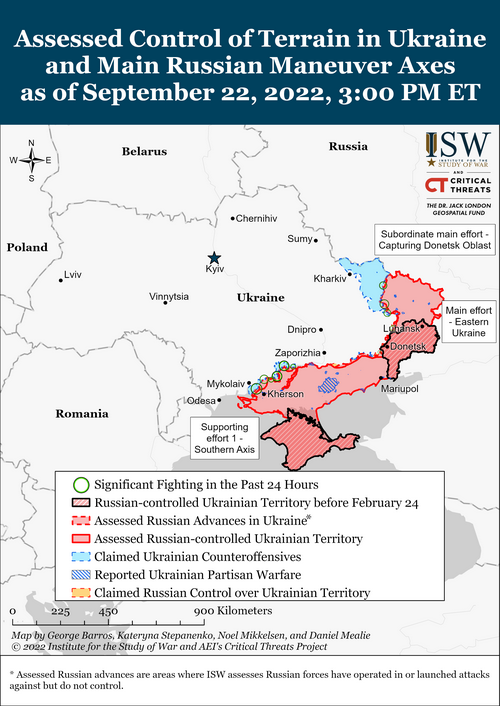
Click here to see ISW’s interactive map of the Russian invasion of Ukraine. This map is updated daily alongside the static maps present in this report.
The Kremlin’s heavy-handed approach to partial mobilization may successfully meet the Kremlin’s internal quota of mobilized personnel but is unlikely to generate effective soldiers and is prompting significant domestic backlash for little gain. Russian authorities are forcibly recruiting Russian citizens to fight in Ukraine on flimsy pretexts, violating the Kremlin’s promise to recruit only those with military experience. Russian authorities are also demonstrably mobilizing personnel (such as protesters) who will enter the war in Ukraine with abysmal morale. The Kremlin’s heavy-handed approach to partial mobilization will likely exacerbate domestic resentment of a measure that would have been unpopular even if implemented without the harsh approaches observed in the last 24 hours.
The Kremlin is openly not adhering to its promised conditions for partial mobilization just 24 hours after its September 21 declaration. Russian officials previously claimed that partial mobilization will only impact 300,000 men and only those with previous military experience.[1] Kremlin Spokesperson Dmitry Peskov stated on September 22 that the practice of administering mobilization notices to detained protesters does not contradict the September 21 mobilization law. Peskov’s threat contravenes the Kremlin’s claim that it will abstain from mobilizing men outside of composed reservist lists.[2] Western and Russian opposition media outlets reported instances of Russian military commissars administering draft notices to protesters in Moscow and Voronezh.[3] Russian opposition outlets also reported on a bank IT specialist who had received a draft notice despite never having served in the army or attended military-education courses in university.[4] The IT specialist is likely one of many Russian men who received mobilization notices despite not meeting the stated criteria for partial mobilization. A university student in Buryatia released footage of Rosgvardia and military police pulling students from lessons, reportedly for mobilization, despite Russian Defense Minister Sergey Shoigu repeatedly stating that Russian students will not be mobilized.[5]
Kremlin quotas will likely force local officials to mobilize men regardless of their military status. The quota for mobilized men remains unverifiable, with Kremlin officials claiming that Russia will mobilize only 300,000 men and Russian opposition outlets’ sources suggesting that the number might reach a million.[6] Regardless of the total quota, the Russian federal subjects executing the mobilization order will likely undertake recruitment measures outside of the outlined reservist call-up. Some Russian federal subjects such as the Republic of Yakutia (Sakha) and Kursk Oblast are imposing laws restricting reservists from leaving their places of permanent residence.[7] Russian enlistment officers and police are also reportedly enforcing unscrupulous mobilization practices (as ISW previously observed during their crypto-mobilization campaigns) by calling up men by phone, issuing notices in the middle of the night, and notifying men of their mobilization via state social benefits websites.[8]
The Kremlin will also likely mobilize ethnically non-Russian and immigrant communities at a disproportionate rate. A member of the Kremlin’s Russian Human Rights Council, Kirill Kabanov, proposed mandatory military service for Central Asian immigrants that have received Russian citizenship within the last ten years, threatening to confiscate their Russian citizenship if they do not mobilize.[9] Current Time reported that residents of Kurumkan, a village in the Republic of Buryatia, noted that Russian enlistment officers mobilized about 700 men of the total population of 5,500 people.[10] If witness reports from Kurumkan are accurate, they would indicate that Russian officials mobilized about 25% of the male population from a single village in a majority ethnically Buryat district. An Armenian Telegram channel published a mobilization list from Tuapse, Krasnodar Krai that reportedly consists of 90% ethnically Armenian residents, despite the town’s total Armenian community being only 8.5% of the population.[11]
The Kremlin’s heavy-handed approach to mobilization is prompting public anger and distrust across Russia. Independent Russian human rights outlet OVD-Info reported that protests took place in 42 cities across the country, including protests even in small villages in the Republic of Dagestan.[12] Unidentified assailants set fire to several military recruitment centers and local administration buildings in Nizhny Novgorod, St. Petersburg, Tolyatti, and Zabailkalsky Krai.[13] The Kremlin will likely subdue such protests in the coming days. However, the declaration of partial mobilization and blatant disregard for even the government-dictated parameters for the mobilization may alienate concerned swathes of the Russian public who were previously more tolerant of the less personally impactful Russian invasion of Ukraine.
The Kremlin likely attempted to downplay a prisoner swap with Ukraine that is deeply unpopular among Russian nationalists and milbloggers by undertaking the swap the same day Putin announced partial mobilization. The Kremlin exchanged 215 Ukrainian prisoners of war (POWs), including captured foreign nationals and Azov Battalion leaders, for at least 55 Russian POWs and political prisoners, including Putin’s personal friend, Ukrainian billionaire Viktor Medvechuk, on September 21.[14] The Russian Ministry of Defense claimed on September 22 that Russian and DNR and LNR POWs were in “mortal danger” in Ukrainian custody.[15] Far-right Russian milbloggers criticized the exchange and asked if the Kremlin had given up on the ”de-Nazification” of Ukraine, one of the stated goals of the Russian invasion.[16] Kremlin propagandists had heavily publicized the capture and planned prosecution of Azov personnel, accusing them of being Ukrainian Nazis. Other milbloggers criticized the Kremlin for enabling what they called Ukrainian information operations and ”allowing Kyiv to manipulate the mood in Russia.”[17] Chechen leader Ramzan Kadyrov described the exchange as ”incomprehensible,” implied that Chechen forces tortured Azov prisoners in captivity, and implied that Russian forces who capture ”Nazis” should kill them rather than take them as POWs if they will be traded back to Ukraine.[18] Torturing or killing POWs is a war crime and violates the Geneva Conventions.
The International Atomic Energy Agency (IAEA) announced that it began negotiations to establish a nuclear safety zone around the Zaporizhzhia Nuclear Power Plant (ZNPP). Such negotiations are unlikely to significantly ameliorate the situation due to continued Russian efforts to stage provocations at the plant. IAEA Director General Rafael Grossi stated on September 22 that the IAEA had begun “productive conversations” with Ukrainian Foreign Minister Dmytro Kuleba, Russian Foreign Minister Sergey Lavrov, and French President Emmanuel Macron in order to establish a Nuclear Safety and Protection Zone at the ZNPP.[19] Despite the positive intentions of external negotiators, Russian forces may use negotiations as an opportunity to stage further provocations at the ZNPP and accuse Ukrainian troops of endangering the safety of the plant, as they have repeatedly done in the past. As ISW has previously reported, Russian forces previously exploited the IAEA presence at the ZNPP in order to accuse Ukraine of disregard for nuclear safety and blame Ukrainian forces for shelling the plant, despite being unable to provide visual evidence to support their accusations.[20] Russian authorities may seek to leverage the IAEA negotiations to accuse Ukraine of nuclear irresponsibility in an attempt to degrade continued Western support to Ukraine.
Key Takeaways
- The Kremlin’s heavy-handed approach to partial mobilization may successfully meet the Kremlin’s internal quota of mobilized personnel, but is unlikely to generate effective soldiers and is prompting significant domestic backlash for little gain.
- The Kremlin is openly not adhering to its promised conditions for partial mobilization.
- Kremlin quotas will likely force local officials to mobilize men regardless of their military status and will likely incentivize the mobilization of ethnically non-Russian and immigrant communities at a disproportionate rate.
- The Kremlin likely attempted to downplay a prisoner swap with Ukraine that is deeply unpopular among Russian nationalists and milbloggers by undertaking the swap the same day Putin announced partial mobilization.
- IAEA negotiations around the Zaporizhzhia Nuclear Power Plant are unlikely to significantly improve the situation at the plant and may provide an opportunity for Russian forces to stage provocations.
- Ukrainian forces likely continued limited counteroffensive operations along the Kharkiv-Luhansk Oblast border and continued attacks toward Lyman on September 22.
- Ukrainian military officials maintained their operational silence regarding Ukrainian ground attacks in Kherson Oblast on September 22 and reiterated that Ukrainian forces are conducting an operational-level interdiction campaign in Kherson Oblast.
- Russian forces conducted limited ground attacks along the frontlines in Donetsk Oblast on September 22.
- Russian forces did not conduct any confirmed ground attacks west of Hulyaipole on September 22 and continued routine strikes throughout western Zaporizhia Oblast.
- Russian occupation forces are hurriedly setting conditions to hold sham annexation referenda across occupied Ukraine from September 23-27.
- Russian officials created polling stations in parts of Russia, ostensibly to enable displaced (in many cases meaning kidnapped) Ukrainian residents of occupied territories to “vote.”
- Russian occupation officials in Ukraine likely expect to be forced to provide personnel to meet Russian regional mobilization quotas after the Kremlin illegally annexes occupied Ukrainian territories.
Go here to read the rest.
From Strategy Page:
September 21, 2022: Russia invading Ukraine in 2022 was one of those events that forces a nation to reconsider what it has become. The invasion was another effort by Vladimir Putin to turn Russia into a successful police state dictatorship. He had been working on that for two decades and having a difficult time, though there were successes. He had eliminated independent media and political parties that opposed him. He had created a police state capable of quickly punishing public dissent. Not all public dissent, because the Ukraine War created a permanent pattern of public protest. This was annoying but not seen as a threat to the Russian dictatorship. The side effects of the Ukraine invasion were another matter. That decision had persistent and growing economic and political costs. It was economic problems that brought down the last two Russian dictatorships; the economic impact of the Ukraine War was no different. Putin thought he had found a way to stifle dissent by not disrupting migration, something the Soviet Union had restricted. That worked for those dissidents with education and skills that made leaving Russia practical and tolerable. For most Russians, emigration was not much of an option.
The new laws criminalizing criticism of the government reduced the number of public protesters. In the weeks after the Ukraine invasion there were public and heavily attended protests against the war in 70 cities throughout Russia. The government responded by arresting over 13,000 protesters. Nearly all were soon released but warned that another arrest for demonstrating could result in prosecution. Meanwhile most Russians were apathetic about this because it did not impact them personally. No one was invading Russia and the government sought to cushion the impact of the increased economic sanctions. The government had been doing that since 2014, when the seizure of Crimean and part of Donbas led to sanctions that gradually increased the poverty rate in Russia. That upward creep had become more visible in 2022, although most of it was outside the cities. The number of government employees remained stable and it was made clear that getting involved with anti-government demonstrations could cost you your government job.
Despite all the government efforts to eliminate protests, there were still several hundred Russians who protested individually or in small groups and avoided arrest. These protesters had a lot of support and if you watched them as they carried out their solitary protest you would see a lot of people passing by silently but obviously showing their support. You would not get arrested for doing that. Opinion polls showed that the majority of Russians either approved of the Ukraine invasion or did not oppose it. As the war went on, without much success, the polls showed shrinking approval of or tolerance for the war. The shrinkage accelerated as Russian defeats in Ukraine piled up. The growing number of Russian dead had already led to demonstrations by parents and families of the dead protesting about the lack of information from the government about what happened to their sons. In many cases the government didn’t know. Many Russian dead were left behind during a retreat after losing a battle with the Ukrainians. To make the Russian government look worse, the Ukrainian military maintained a web site with photos of the Russian dead and their names, if ID was found on their bodies. In many cases there was no ID and just the photo was displayed. This is how many Russian families found out what happened to their soldier sons. It was illegal for Russians to visit these Ukrainian military web sites but the government realized that prosecution was not an option. Older Russians, especially those the same age as Putin, remembered similar protests during the 1980s because of parents protesting the deaths of their sons in the Afghan War. The situation is much worse in Ukraine, where in six months twice as many Russian soldiers died than during nearly a decade in Afghanistan. The Russians protesting in the 1980s were one of the many reasons for the collapse and dissolution of the Soviet Union in 1991. Contemporary Russia is not as large or populous as the Soviet Union because Russia was all that was left after the many regions of the Soviet Union that wanted out, got out in 1991. That included Ukraine, which was one of many unwilling members of the Soviet Union. The current Russian war in Ukraine is an effort to put the Soviet Union back together. Most Russians either agree with this goal or are not opposed to it. This is partly the result of Putin putting all Russian media back under state control and changing what is taught to Russian students about Russian history. The Putin version regards the dissolution of the Soviet Union as one of the great tragedies of the 20h Century. Openly disagreeing with that was discouraged.
Go here to read the rest. Russia has traditionally been ruled by autocrats, tsars, commissars and now Putin. Being an autocrat is a grand thing until matters go south. When you are an autocrat you often get all the blame as well as all the credit. What tends to happen in Russian history when a ruler messes up as badly as Putin? As a Russia nobleman said to a diplomat from Hanover in 1801 after the assassination of Tsar Paul I: “Despotism tempered by assassination, that is our Magna Carta!”

