
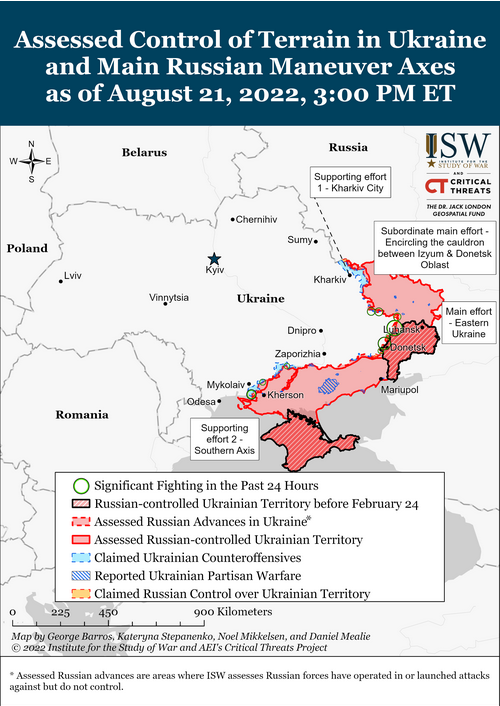
From The Institute For The Study of War:
Russian Offensive Campaign Assessment, August 21
Kateryna Stepanenko, Grace Mappes, Layne Philipson, and Frederick W. Kagan
August 21, 9:30 pm ET
Click here to see ISW’s interactive map of the Russian invasion of Ukraine. This map is updated daily alongside the static maps present in this report.
Russian forces’ momentum from territorial gains around Bakhmut and Avdiivka in late July is likely exhausted, and Russian attacks in eastern Ukraine are likely culminating although very small Russian advances will likely continue. Russian forces seized Novoluhanske and the Vuhlehirska Thermal Power Plant (TPP) southeast of Bakhmut on July 25 and 26, respectively, consolidating Russian control around difficult water features after many weeks of fighting. Russian sources celebrated these gains as a significant military victory without noting that Ukrainian military Ukrainian forces successfully broke contact and withdrew from the area.[1] Russian forces also celebrated the capture of Ukrainian fortifications around the Butivka Coal Mine ventilation shaft southwest of Avdiivka, after Ukrainian forces withdrew from the area on July 30.[2] Russian forces capitalized on these gains to a limited extent and have been attacking toward Bakhmut from the northeast and southeast, and around Avdiivka, but these attacks are now stalling. Russian forces have not made significant territorial gains around Bakhmut or Avdiivka since their advances through Novoluhanske, the power plant, the Butivka Coal Mine, and a few small settlements near those areas.
Russian forces’ failure to capitalize on prior gains around Bakhmut and Avdiivka is an example of a more fundamental Russian military problem—the demonstrated inability to translate tactical gains into operational successes. Russian forces have consistently failed to take advantage of tactical breakthroughs to maneuver into Ukrainian rear areas or unhinge significant parts of the Ukrainian defensive lines. They therefore continually give the Ukrainians time to disengage tactically and re-establish defensible positions against which the Russians must then launch new deliberate attacks. This phenomenon helps explain the extremely slow rate of Russian advances in the east and strongly suggests that the Russians will be unable to take much more ground in the coming months unless the situation develops in unforeseen ways. Russian forces will likely remain unable to commit enough resources to any one offensive operation to regain the momentum necessary for significant territorial advances that translate to operational successes. Russian forces will also need to generate and commit additional assault groups, equipment, and morale to resume even these limited territorial advances yielding small tactical gains.
Russian forces likely face issues repairing combat aircraft due to Western sanctions and may be attempting to bypass these sanctions by leveraging Belarusian connections with less severe sanctions. The Ukrainian Military Intelligence Directorate (GUR) stated that the Russian and Belarusian Defense Ministries signed “urgent” contracts on August 20 to repair and restore Russian military aviation equipment on Belarusian territory reportedly for further use in Ukraine.[3] Western sanctions against Russia have largely banned the transfer of equipment to the state of Russia as a whole, while sanctions against Belarus largely target individual Belarusian entities.[4] Western countries have previously sanctioned Belarusian industrial-military complex entities producing radar systems, automobiles, and repairing tracked vehicles, but it is unclear to what extent the sanctions impacted Belarusian import of aviation repair parts.[5] The Ukrainian General Staff reported that Russian forces transferred some unspecified air defense equipment to Belarus from Russia on August 21. The Ukrainian General Staff also reported that Russian forces will close certain sections of Russian airspace in the Lipetsk, Voronezh, and Belgorod Oblasts from August 22-25.[6] The Russian-Belarusian agreement may suggest that Russian officials are attempting to circumvent sanctions on Russia, as it may be easier to import repair parts to Belarus than to Russia.
Key Takeaways
- Russian offensive operations in eastern Ukraine have likely exhausted the limited momentum they gained at the end of July and are likely culminating. The Russian military has shown a continual inability to translate small tactical gains into operational successes, a failing that will likely prevent Russia from making significant territorial advances in the coming months barring major changes on the battlefield.
- Ukrainian military intelligence reports that Russia and Belarus have reached an “urgent” agreement for Belarus to repair damaged Russian aviation equipment for re-use in Ukraine. This agreement could be part of a Russian effort to use the looser sanctions regime on Belarus to circumvent sectoral sanctions on Russia.
- Russian forces attempted several unsuccessful ground assaults southwest and southeast of Izyum.
- Russian forces launched a ground attack southeast of Siversk and northeast and south of Bakhmut.
- Russian forces made limited gains west of Donetsk City but did not conduct any ground assaults on the Donetsk-Zaporizhia Oblast administrative border.
- Russian forces attempted unsuccessful ground assaults southwest of Donetsk City and continued attacking settlements northwest and southwest of Avdiivka.
- Russian forces conducted several assaults on the Kherson-Mykolaiv frontline and made partial advances east of Mykolaiv City.
- Russian forces are likely not training new recruits in discipline, creating an entitled force engaging in disorderly conduct in Russia and illegal conduct in Ukraine.
- Russian occupation authorities intensified filtration measures and abductions in occupied territories ahead of Ukraine’s Independence Day on August 24.
Go here to read the rest.
From Strategy Page:
On August 8th the United States admitted that it had quietly shipped an unspecified number of AGM-88 HARMs (High-speed Anti-Radiation Missile) to Ukraine in July. This revelation came a day after a photo appeared on the Internet showing the debris of a HARM missile used in Ukraine to destroy a Russian air defense radar. The U.S. admitted that some HARMS were being used by Ukrainian warplanes. This is possible via a HARM feature that uses the missile’s own radar detection and homing capability. This is a short-range option, good for detecting and locating a radar up to 50 kilometers distant. The Ukrainian have demonstrated a skill at adapting military and equipment for new uses. Rigging a MiG-29 fighter or SU-25 ground attack aircraft to carry and use a HARM missile in “HARM as Sensor” mode is feasible and might have been demonstrated in Poland to show the Americans that Ukrainian warplanes could use HARM to shut down the many Russian SAM (Surface to Air Missile) batteries that make it difficult for Ukrainian aircraft to operate freely. The HARM-carrying aircraft come in low (“under the radar”) and fire the HARM when close enough for the detection sensors in the missile to become aware of the SAM radar. At that point the pilot launches the HARM and turns away. Until receiving HARM the only anti-radar missile Ukraine had was a Russian design that lacked many of the HARM capabilities.
The U.S. has lots of HARM missiles which are continuously improved. The latest upgrade is a major one. Since 2012 the U.S. has been upgrading older ABM-88B HARMs to the AGM-88E/F AARGMs (Advanced Anti-Radiation Guided Missiles) standard. Upgrading older HARMs costs about half as much as buying a new AGM-88E. In most cases AARGMS are created by using the case, rocket motor and warhead of an AGM-88 HARM missile with new components (mainly guidance and control).
New 88Es costs $1.26 million each. Originally the plan was to produce 1,879 AARGMs but increased demand from U.S. forces and export customers (currently sixteen nations, if you include Ukraine) led to the current goal, set in 2016, for 2,435 AARGMs. The increased demand was prompted by the improved air defense systems of potential adversaries that rendered the 88B model less effective. Most customers believed potential enemy defenses were still vulnerable to the AARGM upgrade. The current production program ends in 2023 because that’s when a new HARM model will be available.
For over half a century most guided missiles were built with these upgrades and refurbishments in mind. The older missiles not only have more advanced components installed, but the entire missile is examined and any component needing replacement gets that done. Older spare parts for the 88B are also replaced, as needed, with those that work in the 88E. Most AGM-88s are being used on the U.S.-made EA-18G electronic warfare (EW) aircraft, which now takes care of certain EW missions, like SEAD (suppression of enemy air defenses) for the air force and marines as well. To do that they need the latest model HARM. But the U.S. Air Force and Marine Corps aviation also use some HARMs and AAARGMs.
The AGM-88 comes in various models, giving users lots of options. Some users only need the older 88B but most want the latest model. The AGM-88B HARM entered service in 1983 and used a passive radar seeker which homed on enemy fire-control radars emissions in order to destroy the radar and thus render surface-to-air missile (SAM) systems useless by destroying radars needed for target tracking. In 1999 (the Kosovo War against Serbia) the 88B HARM was found to be vulnerable. The Serbian forces limited their radar usage to a minimum and used quick radar shutdown techniques and “pack and leave” tactics for their SAM units. Because of these tactics, HARM had problems acquiring targets. That’s because the missile has precision guidance only when enemy radar is working all the time. Otherwise, the 88B reverts to “offline mode” (using less accurate INS/GPS only).
NATO forces failed to silence most Serbian SAMs during the campaign. There were calls for upgrades to the 88B and some software upgrades seemed to deal with the problems encountered against Serbia. But the potential threats kept appearing and AGM-88 upgrades continued and resulted in some major changes and a new model HARM.
Not only is the E model an improved version of the 88B, but it also includes major modifications that enable it to hit moving ships. This makes the AGM-88E an effective anti-ship weapon as well. Meanwhile, another upgrade of the AGM-88 entered service. The AGM-88F is very similar to the 88E but comes from a different manufacturer and is aimed at export sales. The 88F completed testing in 2014 and entered production. This version also has the anti-ship capability.
All these upgrades seen in the 88E and 88F contributed to the missile getting a new name. It’s now an AARGM (Advanced Anti-Radiation Guided Missile) instead of a HARM. AARGM weighs 361 kg (794 pounds) and can detect and attack targets more than 150 kilometers away while traveling at a speed of 2,450 kilometers per hour. The AGM-88E can transmit a picture of the target, just before it is hit, so the user can be certain of what was taken out. The AARGM was developed jointly by U.S. and Italian firms.
The AGM-88F has GPS guidance added (with less accurate but jam-proof INS as a backup). The older AGM-88D also used GPS so that the missile, which normally homes in on radar transmissions, could be used to attack targets by location alone. The F model expands on basic GPS capabilities and also includes other features that assist in defeating enemy electronic defenses. What the GPS/INS provides is for a way for HARM to act on previous intelligence (about where an enemy radar is) while also using its radar signal homing capability and new anti-decoy features. Many countries now use a decoy emitter that sends out a fake radar signal to lure the HARM away from the real radar. The 88F model uses GPS and more sensors and new software to get around all known deceptions (and some that haven’t been invented yet).
There is also a longer-range AGM-88G. The AARGM-ER model has a different shape so that it will fit inside the internal bomb bay of the F-35A and C models. The G model also has improved performance including longer range, about 280 kilometers. This is twice the range of other AGM-88s. By carrying these missiles internally, the stealth of the F-35 is maximized. This is essential for the first aircraft encountering enemy air defenses. These aircraft will take out key radars so subsequent SEAD aircraft, like the non-stealthy EA-18G, can do their job with less risk of loss. The AARGM-ER will enter production after 2023 but it is not yet clear if it will replace or just supplement the existing AARGM. The development of the AARGM-ER began in 2016 and has remained on schedule with production to begin in 2023.
Go here to read the rest. Putin may be losing interest in his War. I think he will find that the Ukrainians have not. It is always much easier to start a war than finish one.


The assassination attempt has much more a GRU Russian smell than Ukrainian. Ukraine gains nothing from it as the present policy in Moscow has already been set. On the other hand, there is considerable disunity among the key players in Russia. The economy worsens by the day. The company that took over the McDonald’s franchise still has not learned to make proper French fries and inflation and shortages are a problem for the people who were just getting used to a modest level of prosperity. This drama is far from over and Putin may wish to review the old film Battleship Potemkin for a History lesson.