
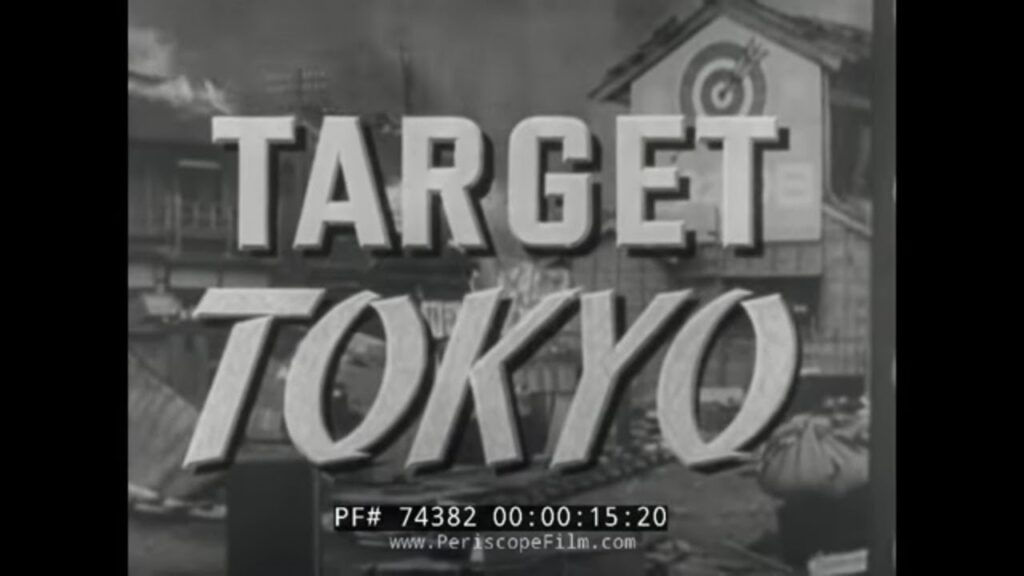
Narrated by Captain Ronald Reagan, United States Army Air Forces, this film features the first B-29 raid on Tokyo. The raids on Tokyo would culminate in the raid of March 9-10, 1945, which burned out 15.8 square miles of the city and killed between 100,000-200,000 people. The Commanding General of XXI Bomber Command, Major General Curtis E. LeMay, was unimpressed by the two atomic bombs. As he noted at the time, his bombers would have destroyed all cities in Japan by the time of the November 1945 invasion of Japan in any case. The movie The Purple Heart (1944), a fictional look on the fate of the captured Doolittle Raiders, predicted the use of air power to bring about the ending of the war in the Pacific:
https://www.youtube.com/watch?v=nv9wbTbS_a4&t=6s
President Reagan’s speech to the Japanese National Diet on November 11, 1983:


Also a good illustration that in war the reaction is often greater than the initial action that started the war. Had the Axis powers remembered that, the world might have been spared two world wars.
No offense intended to American readers, but it is also a good illustration of a war crime: the deliberate targeting and massive killing of civilians. That’s a moral no-no, directly against the 5th commandment and the laws of war. I know the usual rationalizing about provocation, the enemy did it too, need to avoid American casualties, there were factories in the cities, etc., but it does not alter the moral qualification of the action. However humanly understandable, those deliberate bombings of civilians, with or without atomic bombs, were a horrible crime. In WWII, there were war crimes galore, committed by the leaders of both sides (that, of course, does not mean it was an unjust war in itself, but God’s Law is what it is, and it does not apply only to the enemy).
Again, I hope I have not caused offense with my comment.
How many civilian casualties would have been incurred if we had to execute Operation Downfall, especially since every man, woman and child were expected to fight against the Allied invasion? We have some idea in that on Okinawa our forces took pains, including evacuations, to avoid civilian casualties. Between 30,000 to 100,000, out of a civilian population of 300,000, died. In the Battle of Manila in 1945 some 100,000 civilians died. If preventing civilian casualties was a goal, avoiding Operation Downfall was a must. An additional factor is that some 300,000 Allied civilians died each month in the parts of Asia occupied by Japan. The moral calculus was not an easy one in 1945.
“The moral calculus was not an easy one in 1945”
The decision was not easy, as it always happens in war, because the consequences are so serious. But the moral calculus was as easy then as it is now, i.e., there is no calculus involved. The end does not justify the means. In morals you cannot say “I will kill one hundred thousand innocents, but that will save three hundred thousand elsewhere”. That is always immoral. You shall not deliberately kill the innocent, period.
Sorry to insist. This might seem nitpicking, but it is not. It is the foundation of all Catholic morals (and therefore of natural law): we must not do evil in order to bring about good. Moral evil is to be avoided at any cost, no matter the consequences, including military defeat and any other physical evils, even the death of thousands or millions. This is what the Church has always taught, a basic premise of morals and divine law.
Don, regarding the perennial dispute about civilian casualties caused by Allied bombing in WW2, and especially the nuclear attacks on Japan, I came across this article in a comment over at Instapundit yesterday, and found it quite thought-provoking. It is nearly 14 single spaced pages, but well worth the time to read all of it. Be warned, it contains descriptions of some aspects of infantry combat that are almost unimaginably horrific, unless you’re a ground combat veteran, which I am not. Also, please don’t be put off by the title of the piece, which is “Thank God for the Atom Bomb.” Once you read the entire essay, you will understand exactly what the author means and why. It’s easy for us to debate the morality of the use of nukes against Japan over coffee in our comfortable settings. But the issues were entirely different for the frontline troops whose fate hinged on the success of those attacks in bringing Japan to surrender. After reading this piece, I will never again judge harshly the actions of President Truman in ordering them.
https://www.uio.no/studier/emner/hf/iakh/HIS1300MET/v12/undervisningsmateriale/Fussel%20-%20thank%20god%20for%20the%20atom%20bomb.pdf
Frank:
We are, of course, told by the Lord himself not to judge others. That said, we must judge actions, as Saint Paul tells us to do. And the decision to bomb civilians deliberately, with and without atomic bombs, is indefensible in Catholic morals. There is a whole commandment against it.
I’m going to Mass now, so I won’t be around to comment for a few hours.
On 8 December 1941, FDR should have forwarded to Tojo, through diplomatic channels, a strongly worded letter.
Much of Japanese war industries were dispersed in small home and neighborhood shops. Up to the 1980’s, the aircraft industry was hue on Long Island, NY. In addition to Grumman, there were hundreds of smaller machine shops that fed parts to the big war contractors.
The bombings were not motivated by the killing of civilians – they weren’t shooting at us. That would have been a waste of relatively scarce military resources. The bombings were meant to disrupt the imperial Japanese warlords’ means to and will to prosecute their vicious, genocidal aggressions.
Tojo could have stopped the killing at any timer.
Likely, your conscience would be soothed if two or three million more American GI got killed before the war ended in 1948.
Thanks Frank. I am familiar with the essay, which veterans who were living there would doubtless almost uniformly endorse:
https://the-american-catholic.com/2015/08/07/hiroshima-survivors/
“But the moral calculus was as easy then as it is now,”
Only for people who did not have to make the decisions. If huge numbers of innocent people are going to die no matter what you do, and if the foreseeability of their deaths is certain, I think a moral course is to take action to minimize the innocent deaths and let moral theologians quibble about it later. I had several relatives who likely lived to ripe old ages due to the atomic bombings and I thank God that Harry Truman had the fortitude to act as he did. Good people can, and do, differ with me, but the agony of the choices involved should not be minimized by those of us living 77 years later.
My uncle Bob (RIP) [WWII USN machinists mate] said he would fight someone that said anything against the A bombs.
True story. He was granted a three-day pass to attend his brothers wedding. He got back after his Liberty ship sailed. He received a Captain’s Mast [Article 15/company punishment in the Army], lost his stripe and was fined $50. The ship he missed was the Mount Hood which was blown to atoms in Manila Bay.
No offense intended to American readers, but it is also a good illustration of a war crime: the deliberate targeting and massive killing of civilians.
The Americans (or anyone else) who are even passingly familiar with the tactics in the war in question are probably wondering, at least rhetorically, why on earth you are targeting the folks who attempted to minimize civilian casualties.
To quote Chesterton-
“There is a case for telling the truth; there is a case for avoiding the scandal; but there is no possible defense for the man who tells the scandal, but does not tell the truth.”
Don:
“Only for people who did not have to make the decisions. If huge numbers of innocent people are going to die no matter what you do, and if the foreseeability of their deaths is certain, I think a moral course is to take action to minimize the innocent deaths and let moral theologians quibble about it later”
I am sorry to tell you that what you said is not according to Catholic morals (tough, of course, I have no doubt you said it in good faith, but you are gravely mistaken). The essential morality of that kind of action is not determined by the number of people that are going to die if you don’t do it. It is determined by whether or not you are purposefully trying to kill innocents. If you are, your action is in itself a mortal sin (and, on top of that, a war crime), no matter how many lives are potentially saved. Actions that are intrinsically evil must never be done and are always a sin, no matter the circumstances and/or consequences.
This is NOT a complicated thing that only moral theologians can understand. It is a basic principle of basic morality. As I already said, the 5th commandment directly forbids the deliberate killing of innocents. It doesn’t get much simpler than that.
For example, if you go to bed with your secretary, it doesn’t matter if you try to minimize the hurt for your wife by keeping it secret or if you cheat on her only on Tuesdays or if she cheated on you first or if you rationalize it with the excuse that it is the only way that you can stand her and cheating is better than abandoning her and the children. That’s all balderdash. You are committing adultery and you should not. You shall not commit adultery is perfectly clear. You shall not kill the innocent is also clear.
“I had several relatives who likely lived to ripe old ages due to the atomic bombings…”
That is, of course, great, but all the good consequences in the world do not justify a sin. This is not complicated. It should be learnt before one receives First Communion.
“and I thank God that Harry Truman had the fortitude to act as he did”
Please, don’t say that. Thanking God for a grave sin is a scandal.
“the agony of the choices involved should not be minimized by those of us living 77 years later”
Again, there is no agony of choice. When one of the options is an intrinsically evil action, it should never be chosen, regardless of everything else. Please, read Veritatis Splendor. Read any manual of basic morals. Read the Catechism (1753-1756). Read the saints. This is a constant and basic teaching of the Church.
I have no agenda and have no animosity against the USA (and what I said is true regardless of who you are talking about). But I am a theologian, and it is my duty to tell you that you are wrong in a very serious matter. Not because I say you are wrong, because the Church teaches that what you said is wrong.
Or course, these things, when written, always sound harsh and even smug and I apologize if I have given offense. This conversation would be much easier and more pleasant in person, over a beer or a soda, but what we have is the Internet, with all its limitations.
“It is determined by whether or not you are purposefully trying to kill innocents.”
As in going forward with a land invasion which you know will likely kill millions? As in blockading Japan leading to a famine which you know will likely kill millions? Doing nothing and having the war drag on which on the Asian mainland is killing 300k a month? There is no option which confronted Truman which would likely not have led to a much higher body count. The idea that doing nothing was a moral choice I deny, as we are responsible for sins of omission as well as commission. If never killing innocent people is the sine qua non of Catholic morality in war, we might as well embrace pacifism, place the worst of humanity in charge, and stand by patiently as our love ones are murdered by their security agencies.
I would note that traditionally the Church did not believe that actions which impacted the innocent could not be taken. Popes laying entire nations under the interdict for example. Papal armies would routinely engage in sieges where civilians would often die of famine or plague. Popes launching crusades where innocents would have to suffer, no matter how carefully the crusade was conducted. A fair amount of utopianism entered the Church when the Popes ceased being secular rulers, and it has obscured a very complicate past to many Catholics.
No problem with the debate Bruno. I have these types of arguments each year during what I call the August bomb follies. Our longest debate on the subject at TAC was ten years ago:
https://the-american-catholic.com/2012/07/24/father-wison-miscamble-defends-bombing-of-hiroshima-and-nagasaki/
Foxfier:
“are probably wondering, at least rhetorically, why on earth you are targeting the folks who attempted to minimize civilian casualties”
I am not targeting anyone. What I said is true no matter who are we talking about. It is just as true regarding the bombing of London by the Germans, to mention just one example among many.
It was the article that talked about the bombing of Tokyo. I just pointed out that the conclusion was wrong according to Catholic morals and explained why. Minimizing casualties is, of course, a good thing, but, per Catholic teaching, it does not excuse intrinsically evil actions.
I have many good things to say about America and the Americans (many of those good things I’ve known for a long time and many more I have discovered in the past few years, living in your beautiful country). We can talk about them if you want to. I have nothing against the good old USA, but grave sins are grave sins (and war crimes are war crimes) no matter which side commits them.
Courtesy would lead me to only say good things about your country, specially here, in The American Catholic, but sometimes truth must trump courtesy, just as the Catholic part must trump the American part, don’t you think?
I am not targeting anyone.
That is an absolute lie, so there is no reason to read anything further you have to say.
“There is no option which confronted Truman which would likely not have led to a much higher body count”
You still don’t get it. You are talking about consequences, which are certainly a prudential matter and must be weighed by the person who is choosing. In that part we agree.
There is, nevertheless, another part of a choice, which you also have to take into account: the object of the action (which in this case is the deliberate killing of civilians). If the object is intrinsically evil (as this one is), the action is always evil and can never be chosen morally. Never. At that point, consequences are irrelevant. It is an action forbidden always, semper et pro semper, by God himself. You should never choose that. Never. This is the doctrine of the Church, which you can find in the Catechism, among thousands of magisterial teachings, manual of morals, writings of the saints and Fathers of the Church, etc.
If many millions are going to die, it is a tragedy. If you kill even one innocent deliberately, that is a grave sin. You should try to avoid tragedies, but sometimes you cannot. You should never commit a grave sin, even if that sin would save all the people in the world.
A moral evil (i.e., a sin) is qualitatively different than all physical evils (sufferings, deaths, etc.). That is why you should suffer all physical evils in order not to commit one sin.
“If never killing innocent people is the sine qua non of Catholic morality in war, we might as well embrace pacifism”
I did not say that. I said that DELIBERATELY killing an innocent is always a moral evil and should never be done. You can wage a just war, even if you know innocents will die, if the wrong you are trying to right is grave enough. What you can never do is INTENTIONALLY kill innocents. In the first case, you try to avoid the killing of innocents, but you know some will die (lost bullets, people that were in the wrong place at the wrong moment, indirect consequences of war, etc.). In the second one, you intentionally kill them. Nothing can justify the latter; it is a direct disobedience and offense against God.
Foxfier:
“That is an absolute lie”
It most certainly is not a lie, as it is obvious. Why on earth should I lie? What do I stand to win? I have commented for years here. I have only good things to say about The American Catholic. I have prayed for you all and agreed with you all in almost everything that you have said over here. And when, after years of agreeing, I point out that something that was said in an article is wrong according to Catholic doctrine (because it obviously is) you accuse me of lying? I don’t thing that is fair or healthy. Even The American Catholic might get something wrong once in a decade or so.
Why on earth should I lie?
I have no idea, nor do I need to in order to recognize it.
None the less, you singled out a target, and then denied doing so– on the very same page.
That is a lie.
The question becomes– when you are objectively bearing false witness it is blindingly obvious, and attempt to deny it– why on earth should anyone believe you when it is anything less obvious?
“None the less, you singled out a target, and then denied doing so– on the very same page.”
I did not. The article talked about the Tokyo bombings. I pointed out that the article contradicted a Catholic principle that is true for the subject and also for any other similar actions carried out, both in WW2, before it and after it, semper et pro semper. How can defending a general principle be targeting anyone? How can reminding everybody of a basic principle of Catholic morals be bearing false witness? It makes no sense whatsoever.
I can understand you thinking that I am wrong, but the lying accusation is completely baseless and unearned, and I cannot understand it.
Don (II):
” A fair amount of utopianism entered the Church when the Popes ceased being secular rulers, and it has obscured a very complicate past to many Catholics”
That is true and it was a very good article by Zmirak (which I read because of your recommendation). Nevertheless, the moral principle I am telling you about is something that has always been taught by the Church, from the beginning, because it is one of the foundations of Catholic morals.
“I have these types of arguments each year during what I call the August bomb follies”
If I may, I dare to advise that first you read up a little more on moral theology before discussing the bombings and all that, because you don’t seem to understand what an intrinsically evil object is, and that is such a basic principle (no matter what you are talking about, be it abortion, adultery, war or contraception, among many others) that you can never understand a moral question if you don’t get it right.
Forget about the bombings, which after all happened a long time ago, and try to understand the principle of intrinsically evil objects of actions. That is essential for moral reasoning. I can give you the numbers of Veritatis Splendor, the Catechism, etc. or older manuals if you prefer. This has nothing to do with pacifism or modern “feelgood” pseudomorals (actually, a Catholic a couple of hundred years ago would have instinctively known this principle; it is only the feelgood morality of our times which has obscured it in the mind of Catholics).
Please, forgive me for taking the liberty of giving you advice. I certainly did not mean to imply any moral or intellectual superiority on my part. I’ve just studied these things all my life.
Not only did you do so, but you did so in a manner that made it clear you were doing so.
And yet now the same judgement you wish us to bow to says that you did not.
“Not only did you do so, but you did so in a manner that made it clear you were doing so”
I don’t know what you mean. Actually, I know I did not lie, so you cannot be right. And, on top of that, I don’t understand how I could be lying, because it is evident that quoting a principle of Catholic morals and stressing that it is always true no matter who you are talking about, cannot be targeting anybody.
Again, if you think I am wrong, by all means let’s discuss it, but I don’t think discussing my intentions (which you cannot know, but I know perfectly well) can lead anywhere.
“And yet now the same judgement you wish us to bow to says that you did not”
Sorry, I don’t understand that sentence. My English is reasonably good, but I sometimes I don’t get the idioms.
I can only stress again that I have nothing against the USA or you or The American Catholic and would not lie to you, but of course, a liar would say that, so I guess once you’ve decided that I am a liar nothing I say would matter. It is just that it is so unfair being accused of lying when I’ve done nothing of the sort…
Well, misunderstandings do happen. God bless you.
Bruno is right. You might believe that worse things would’ve happened if we hadn’t dropped the bomb, and that’s all fine and dandy, it’s a valid opinion, but that’s an “ends justify the means” excuse (and one that requires prognostication). Say what you want about the decision to drop the bomb, but the decision to deliberately kill tens of thousands of non-combatants to end a war does not jive with Catholic just war theory. Anyone who says otherwise is either ignorant of the theory or is lying to themselves.
to deliberately kill tens of thousands of non-combatants to end a war does not jive with Catholic just war theory.
Popes did it CAG every time they had their armies besiege a city. The deaths of innocents in a siege of a city was entirely foreseeable. The Popes have also given limited approval of nuclear weapons as deterrent weapons. Pius XII outlined the circumstances under which nuclear weapons may be used.
CAG-
the subject Bruno was opining on was firebombing.
Not The Bomb.
And if the point of the Bombs dropped on Japan was to kill off non-combatants, then dropping warning fliers was a really counter-productive choice.
Sorry to insist. This might seem nitpicking, but it is not. It is the foundation of all Catholic morals (and therefore of natural law): we must not do evil in order to bring about good. Moral evil is to be avoided at any cost, no matter the consequences, including military defeat and any other physical evils, even the death of thousands or millions. This is what the Church has always taught, a basic premise of morals and divine law.
—————-
No offense. Just frustration in that a know it all (who is missing a lot of facts about the war or simply ignoring the facts) is misapplying God’s law, once again. The US bombing the Japanese brought the war to a close at least a year earlier than it otherwise would have ended—thereby saving lives on all fronts. Don has pointed out to tippy already that entering Japan proper with ground troops would have required the slaughter of every civilian in site. President Truman was given military estimates that indicated opt woujd require the loss of 1 million more American lives ( just American lives—not including the lives of other country’s citizens—not those injured & crippled from the US & elsewhere.) Doing whatever was necessary to end the war, including destroying Japan’s war making machine in mainline Japan saved US lives, our ally’s lives, & Japanese lives. Why do you not understand that? Do you think you seriously think you could have done better? Well, let me be the first to tell you that you could not have. No offense to you, by the way.
You can wage a just war, even if you know innocents will die, if the wrong you are trying to right is grave enough.
——————-
The motivation of the US military was to bring the war with Japan to a close as soon as possible in order to save lives across the board. The motivation was never to kill innocents. So please stop falsely stating that it was.
The Christian teacher:
I am not second guessing anyone. I am just reminding you of a principle of Catholic moral teaching you don’t seem to know. We cannot do evil so that good may come from it. No matter the consequences, that is always morally wrong.
The clear sign that you are mistaken is that you point to consequences, but consequences don’t matter when you are talking about an intrinsically evil action (such as deliberately killing innocents). Those actions are always immoral. Talking about consequences is a red herring, similar to talking about the consequences for your marriage if you don’t cheat in these special circumstances, because your cheating actually means you love your wife more, and you’ll be more relaxed and your life together will be better and whatever. That is all beside the point: adultery is always wrong and intentionally killing the innocent is always wrong.
This is not about the war. It is a general principle of Catholic morals that is always true, always. Do read the numbers of the Catechism I mentioned above or Sain John Paul II’s Veritatis Splendor, for example.
Thanks for your answer and no offense taken.
The Christian teacher:
“The motivation was never to kill innocents. So please stop falsely stating that it was”
When you indiscriminately firebomb a city, you do it to kill civilians. When you bomb a city with an atomic bomb, you do it to kill civilians. When the Germans did it to London, they did it to kill civilians, and when the Americans did it to Tokyo (a hundred thousand civilians dead) or Nagasaki, they did it to kill civilians. And the same thing happened in several German cities, where it was the city center that was destroyed (in Europe, the city center is always the historical part of the city, where generally there are no factories, only civilians and maybe government offices). Let’s not pretend otherwise.
Of course, they wanted to kill as many civilians as possible for a good end, i.e., shortening the war. But that they wanted to kill civilians is undeniable. And that was intrinsically wrong for both sides.
Foxfier:
“And if the point of the Bombs dropped on Japan was to kill off non-combatants, then dropping warning fliers was a really counter-productive choice”
Not if the purpose of the killing was to terrify the Japanese, which it obviously was. You destroy a city and then warn the citizens that you will destroy another and another and another if they don’t force the Emperor to surrender.
When an abusive husband tells the wife that he beats her for her own good and that she should cook better the next time in order to avoid the beating, his “advice” is not an excuse for his behavior, but rather a threat, an aggravating circumstance.
Don:
“Popes did it CAG every time they had their armies besiege a city. The deaths of innocents in a siege of a city was entirely foreseeable.”
For whatever reason, you keep missing the point I am trying to make. Foreseeing something is not the same as doing it. For example, a pregnant woman with cancer has the right to receive chemotherapy to treat her cancer, even if it is foreseeable that the baby will die as a consequence. Morally, she is not doing something wrong, because she is not killing the baby, she only receives treatment for her illness, which she has a right to, even if that treatment also kills the baby. Of course, she can also decide to forgo the treatment in order to protect the baby and that will be laudable, but she is not morally obliged to do so. If she receives treatment and the baby dies, it is something she did not seek, but rather she suffered. There is no sin in what she did (even if someone would prefer her doing the heroic thing and giving her life for the baby). This is classical moral doctrine.
With war it is the same thing. A war always has terrible consequences, and no war should be entered into lightly. But there is all the difference in the world between something that is an unwanted consequence of actions you have a right to take (such as the fortuitous deaths of civilians when you are fighting the enemy army) and something you have directly sough (such as intentionally killing civilians), even if it is with a good end in sight. The former is an example of the double effect doctrine, and the latter is an intrinsically evil action.
All:
I don’t want to bore you. I only started this discussion because, well, I believe Don (and several commenters) are wrong, due to their not knowing or understanding one of the basic foundations of Catholic morals, and I think it would be in their interest to improve their knowledge in that field. To tell you the truth, I don’t care about the war, because the actions of past presidents are mainly of interest to historians, but the moral principle is always true and essential for living as a Catholic now. So, if I may be so bold, I advise you to look it up (it is called the principle of intrinsically evil object of an action or negative precepts or something similar, I’m translating).
If you read it up and learn something, that’s great. It is always good to learn something new, specially something important for your life. If you decide it is not worth it, well, at least you are not worse off than you were yesterday, so no harm done.
And I apologize again if I may have inadvertently caused offense with my words. I did not mean to, but maybe I should have been more careful with what I said. God bless you all and a long life to The American Catholic, which has provided me with such a pleasant and interesting reading throughout the years.
Note: Of course, in my comment for Don I meant fortuitous in the old sense of the word, i.e., simply accidental, though I realize now that in America it has come to mean by a lucky accident.
Popes did it CAG
That doesn’t make it right, Don. I’m talking about just war theory. Lots of Popes (the current one included) have done unjust stuff.
And if the point of the Bombs dropped on Japan was to kill off non-combatants …
That’s irrelevant, foxfire … The deaths of non-combatants was foreseeable and inevitable. It doesn’t have to be the objective to be unjust.
Who was responsible for continuing the war ordering children to fight the Americans with “sticks and stones”?. Who refused to surrender after the A-bomb was dropped? Who surrendered on condition that he retain his god-like powers and not receive any blame for the war? Who lied to his people about the US soldiers? Who carries the bloodguilt for the casualties on both sides of the war? “Deliberately” starting a war, Hirohito bears full guilt for WWII.
When you indiscriminately firebomb a city, you do it to kill civilians. When you bomb a city with an atomic bomb, you do it to kill civilians. When the Germans did it to London, they did it to kill civilians, and when the Americans did it to Tokyo (a hundred thousand civilians dead) or Nagasaki, they did it to kill civilians. And the same thing happened in several German cities, where it was the city center that was destroyed (in Europe, the city center is always the historical part of the city, where generally there are no factories, only civilians and maybe government offices). Let’s not pretend otherwise.
Of course, they wanted to kill as many civilians as possible for a good end, i.e., shortening the war. But that they wanted to kill civilians is undeniable. And that was intrinsically wrong for both sides.
————
You simply do not understand the facts on the ground in Japan & Germany re: their war effort. This denial is causing you to claim an end justifies the means argument on my end which I am not making. Therefore you are coming to the wrong conclusion about the general motivations re: bombing by US forces across the board during WW 2. Ending the Axis’ evil reign & Godless slaughter was sufficient justification for the actions taken. We disagree about motivations & justification purely, it appears in re: to WW 2. I believe the US’ actions were morally justified due to the evil we ended. Period.
World War II was a war of self-defense. Self-defense is a God-given civil right expressed in the Second Amendment. America had less than 500,000 soldiers at Pearl Harbor.
Self-defense includes the killing of the criminal. “Thou shalt not kill in stealth” is the Fifth Commandment. Why wasn’t Hirohito stopped by his people? Why wasn’t Hitler stopped by his people?
Bruno, I want an answer.
That doesn’t make it right,
It makes it the praxis of the successors of the Big Fisherman for well over a thousand years. The current neo Pacifist attitude of the leadership of the Church is quite new in the history of the Church.
The current neo Pacifist attitude of the leadership of the Church is quite new in the history of the Church
True, it’s hard to imagine any war fitting the Catholic just war model as many describe it today, (was Grenada a war?) and the just war theory has certainly changed over time. It’s my understanding that when St. Augustine first developed the theory, one of the stipulations for a war to be just was that it was conducted with the Pope’s permission. I’m no expert in this, and we’d need to know how a “just war” was defined at the time in question, but I doubt the President asked permission from the Pope regarding war strategy. (Just so you know, I’m fine with that 🙂 ) But there are certain aspects to the theory that have remained consistent. Firebombing a city full of civilians fails several of them. Proportionality and humane treatment of non-combatants being just two. I don’t think it even meets the criterion of self defense, unless the bombers were only targeting the anti-aircraft guns. Again, I’m not debating whether it was the right or wrong thing to do … That’s for someone else to decide. I’m just saying that as Catholic just war theory is currently enumerated, firebombing a civilian population doesn’t seem to fit the model.
Mary the Voe:
“Who was responsible for…”
Those are different questions, and not what is being discussed. They are most certainly interesting questions, but they do not affect in the least the matter we are talking about: whether intentionally bombing civilians is an intrinsically evil object and, therefore, regardless of circumstances, ends and consequences, can never be a moral choice.
Don:
“The current neo Pacifist attitude of the leadership of the Church is quite new in the history of the Church”
That is true, but, again, it has nothing to do with the question discussed. That the end does not justify the means and that the killing of innocents is an intrinsically evil action that can never be morally right is a constant doctrine of the Church and has nothing to do with pacifism. It is the basis of Catholic morals on abortion, euthanasia, contraception, the exercise of authority, the exploitation of workers, adultery, and mostly everything else.
Modern pacifism has nothing to do with this.
Cag:
“it’s hard to imagine any war fitting the Catholic just war model”
Strictly speaking there is no “model” or “theory”. There is a doctrine of the Church. Which is true and part of divine revelation. Maybe you are alluding to its explanation or, more probably, its application, which, by definition, requires a prudential judgement and can vary from pope to pope or statesman to statesman. When John Paul II said that the second Iraq war was not a just war that was a prudential judgement, and a Catholic could respectfully differ. However, no Catholic should deny the doctrine about the just war.
” It’s my understanding that when St. Augustine first developed the theory, one of the stipulations for a war to be just was that it was conducted with the Pope’s permission”
No. Than would make no sense in the historical context. St. Augustine pointed out that a just war should be waged by legitimate authority, which is obvious. The legitimate authority can change and has changed throughout the centuries: emperors, kings, elected presidents, international bodies, etc. At one point in history, the Pope did constitute a sort of supranational authority for Christendom and, therefore, his permission was usually (but not always) sought for waging war. Popes haven’t played that role for centuries, so it would not make sense for an American President to seek his permission, and the USA have never been a Catholic country anyway.
Nevertheless, the matter under discussion is not primarily one of just or unjust war. As Mary de Voe points out, we can assume WWII was a just war. And it does not change anything, because the action of intentionally killing civilians is intrinsically evil. That is a much more basic doctrine than the doctrine about just war. It is a basic foundation of Catholic morals and there is a specific commandment about it: thou shall not kill (the innocent).
“that the killing of innocents is an intrinsically evil action that can never be morally right is a constant doctrine of the Church”
I deny that Bruno. I would note that the intrinsically evil formulation is new to the Church. The Church has condemned various sins over its history, but I believe that the concept of certain acts being intrinsically evil is a formulation of the last century.
In Veritatis Splendor Pope John Paul II refers to Vatican II for a laundry list of what is intrinsically evil:
80. Reason attests that there are objects of the human act which are by their nature “incapable of being ordered” to God, because they radically contradict the good of the person made in his image. These are the acts which, in the Church’s moral tradition, have been termed “intrinsically evil” (intrinsece malum): they are such always and per se, in other words, on account of their very object, and quite apart from the ulterior intentions of the one acting and the circumstances. Consequently, without in the least denying the influence on morality exercised by circumstances and especially by intentions, the Church teaches that “there exist acts which per se and in themselves, independently of circumstances, are always seriously wrong by reason of their object”.131 The Second Vatican Council itself, in discussing the respect due to the human person, gives a number of examples of such acts: “Whatever is hostile to life itself, such as any kind of homicide, genocide, abortion, euthanasia and voluntary suicide; whatever violates the integrity of the human person, such as mutilation, physical and mental torture and attempts to coerce the spirit; whatever is offensive to human dignity, such as subhuman living conditions, arbitrary imprisonment, deportation, slavery, prostitution and trafficking in women and children; degrading conditions of work which treat labourers as mere instruments of profit, and not as free responsible persons: all these and the like are a disgrace, and so long as they infect human civilization they contaminate those who inflict them more than those who suffer injustice, and they are a negation of the honour due to the Creator”.132
With all respect to a very great Pope, the list from Vatican II includes more than a few items that few prior to the last century would have thought as sinful, let alone intrinsically evil. For example, Popes usually had torturers on their payroll as torture was used in legal proceedings under Roman law. Deportations take place all the time. Living conditions being subhuman vary from time to time and place to place. Arbitrary imprisonment? The Popes had the power to imprison who they liked with very little due process. Degrading conditions of employment vary from time to time and place to place. This formulation was not the best work of John Paul II.
As to the Church forbidding all actions which would kill innocents that does not hold up in even a cursory examination of Church history. The Albigensian Crusade is but one of many, many counter examples that could be brought up.
Personally I view the killing of innocents as ghastly and to be avoided whenever possible, except when doing so will likely lead to the death of far more innocents.
The Christian Teacher:
“You simply do not understand the facts on the ground in Japan & Germany re: their war effort”
I am afraid that is pure speculation on your part. I haven’t talked about that because, once again, when you are talking about intrinsically evil actions, circumstances do not matter.
“This denial is causing you to claim an end justifies the means argument on my end which I am not making. […] I believe the US’ actions were morally justified due to the evil we ended. Period”
Read those two sentences together. In the second one you prove what you deny in the first one. You say that the actions (i.e., the means) were justified in order to eliminate an evil (i.e., the end). That is literally saying that the end justifies the means.
And you repeat it: “Ending the Axis’ evil reign & Godless slaughter was sufficient justification for the actions taken”. Again: literally the end justifies the means.
That is contrary to Catholic moral doctrine (and therefore, contrary to the truth). I am sorry I cannot tell you otherwise. This is not an attack on your country or your patriotism (which is a sorely needed virtue in our times), it is a simple correction of an obvious mistake you are making. I just felt obliged to point it out, in case the correction was useful for you.
Thank you for an interesting discussion.
” intentionally bombing civilians is an intrinsically evil object and, therefore, regardless of circumstances, ends and consequences, can never be a moral choice.”
When a woman is forced to have an abortion, she is guilty but not as guilty as the individual who forced her into the abortion mill. When Emperor Hirohito refused to end the war, Hirohito forced the Allies to bring the war home. The Japanese civilians were guilty of bloodguilt for consenting to the war. As a theologian you must be aware of consent and the guilt invovled. Innocent civilians is a questionable judgement.
Don:
“I deny that Bruno. I would note that the intrinsically evil formulation is new to the Church. The Church has condemned various sins over its history, but I believe that the concept of certain acts being intrinsically evil is a formulation of the last century”
Not being a theologian, you confuse two things. A formulation can be new, but the doctrine cannot be. For example: the dogma of three persons and one nature in God was a formulation of Nicaea, Constantinople and several other councils. But that was just the formulation, the faith that the formulation expressed was the faith of the Church from the beginning. The faith formulated by Nicaea or Constantinople was the faith of the Apostles. There was no change in it, there could not be. The new formulation was just a response to the constant faith of the Church being denied by Arrio and his followers, which required new conceptual tools to explain why Arrio was in error.
The same thing is true of the principle of intrinsically evil actions. It has always been true and it has always been part of the Church’s doctrine. It could not be otherwise, even if the formulation “intrinsically evil” is a modern one in response to this doctrine being denied by modern “moralists”. You can find the same doctrine in the Bible, St Thomas Aquinas, St. Augustine, etc., because it is a fundamental doctrine for Catholic morals. Actually, without it, there is no Catholic morals at all. In the past it often went by the name of “negative precepts”, which obligate semper et pro semper.
“does not hold up in even a cursory examination of Church history. The Albigensian Crusade is but one of many, many counter examples that could be brought up”
Saying that is the same thing as saying that the Church did not forbid fornication because several popes had mistresses and children. Doctrine is one thing and human failings and sins of popes and bishops are something completely different (as our current pope and bishops, unfortunately, exemplify).
The faith does not change. It cannot change. If it did, it would be false.
The Lex Talionis is the law of an eye for an eye. How many civilians were murdered in Pearl Harbor? “Circumstances” do matter. I can forgive my murderer. I cannot forgive your murderer without becoming an accessory after the fact.
Jumping up and down on one issue in a world wide war is silly simply because everyone was involved.
The Germans in World War II were the defeated in World War I. If Tokyo had not been bombed World War III was on the agenda. Preventing evil is as good as it gets.
A formulation can be new, but the doctrine cannot be.
I demy that there is a doctrine like intrinsic evil as formulated by Pope John Paul II. There could not be as the laundry list cited by the Pope from Vatican II includes items that simply were not considered to be sins prior to the last century. I would appreciate citations prior to the last century referring to intrinsically evil acts.
Saying that is the same thing as saying that the Church did not forbid fornication
Not at all. You would have an argument if over a thousand years the Popes had been owners of whore houses and called upon faithful Catholics to be clients of them. For centuries the Popes called for Crusades which were bound to lead to the deaths of innocents.
The faith does not change. It cannot change.
It certainly develops or so taught Saint John Cardinal Newman.
The Japs planned to take America through Hawaii, while Hitler planned to take America through Great Britain. Americans were not war mongers as your issue that the end does not justify the means implies. Hindsight is twenty twenty. Self-defense and survival is the “end”. If self-defense and survival is the “end” and the means are desperate, God came to our aid. God did say that the good would die with the bad. But the bloodguilt is on Hitler and Hirohito and every man will be judged accordingly. America laid down its life for FREEDOM. (Freedom is a God-given civil right and therefore God’s truth was preserved.)
Mary de Voe:
“When a woman is forced to have an abortion, she is guilty but not as guilty as the individual who forced her into the abortion mill”
You are mixing two things that are very different. Someone is forced to do something if the person who forces him or her has power over him/her and, therefore, his or her freedom to act disappears or is substantially limited.
Nothing the Japanese did “forced” (in the moral sense) the allies to intentionally and massively kill civilians. Their freedom to not bomb the civilians was not removed or substantially diminished. They just consented to it, they chose to do it, because they considered it to be the best/easiest/quickest path to the end they sought, i.e., the unconditional surrender of Japan. And they might well have been correct in that. But it was a grievously immoral choice and a war crime.
That is what I was talking about, the objective immorality of the action itself. The personal guilt of the statesmen and high-level officers involved is, of course, beyond our knowledge and a matter that is usually best left to God’s judgement.
“The Japanese civilians were guilty of bloodguilt for consenting to the war. As a theologian you must be aware of consent and the guilt invovled. Innocent civilians is a questionable judgement”
You are confusing what “innocent” means in this discussion. Nobody is completely innocent. We are all guilty of many sins. Even children have original sin and the attached concupiscence. So the commandment about not killing the innocent does not refer to absolute innocence, which does not exist except in our Lord and our Lady.
In this context, innocence refers to those who are not directly harming you (that’s what innocens means in Latin, he who is not harming). In a war, it is considered that those who directly harm you are enemy soldiers. Civilians are considered (objectively) innocent, even if they are guilty of many things (as we all are) and even somehow, by omission o in other ways, they might indirectly cause you harm. There is nothing strange about that, it is similar outside of a war: someone who attacks you directly is not (objectively) innocent and, therefore, you can defend yourself and even kill the attacker if necessary. But you cannot kill someone who does not attack you directly, even if his actions indirectly cause you pain (for example, a politician that fraudulently approves a law that leaves you destitute).