
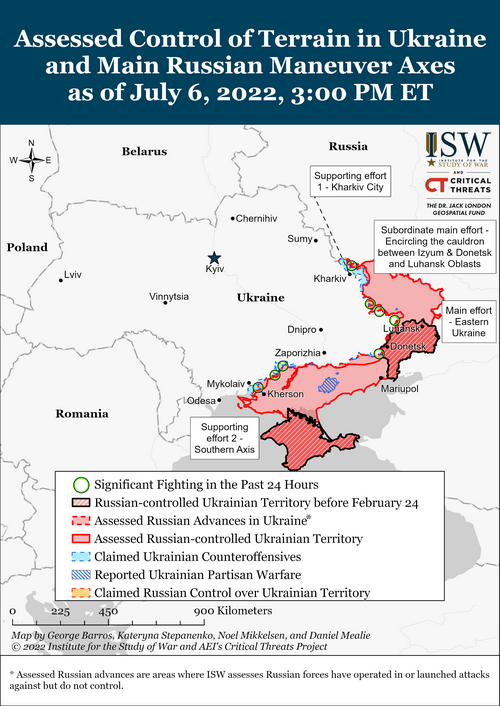
From The Institute For The Study of War:
Kateryna Stepanenko, Karolina Hird, George Barros, Grace Mappes, and Frederick W. Kagan
July 6, 6:00 pm ET
Click here to see ISW’s interactive map of the Russian invasion of Ukraine. This map is updated daily alongside the static maps present in this report.
There were no claimed or assessed Russian territorial gains in Ukraine on July 6 for the first time in 133 days of war, supporting ISW’s assessment that Russian forces have largely initiated an operational pause.[1] The Russian Defense Ministry claimed territorial gains every day from the start of the war but has not claimed any new territory or ground force movements since completing the encirclement of Lysychansk on July 3.[2] However, Russian forces still conducted limited and unsuccessful ground assaults across all axes on July 6.[3] Such attempts are consistent with a Russian operational pause, which does not imply or require the complete cessation of active hostilities. It means, in this case, that Russian forces will likely confine themselves to relatively small-scale offensive actions as they attempt to set conditions for more significant offensive operations and rebuild the combat power needed to attempt those more ambitious undertakings.
The Kremlin continued to set conditions for the crypto-mobilization of the Russian economy in anticipation of protracted operations in Ukraine. The Russian State Duma adopted the third and final reading of a law introduced by the cabinet of ministers on June 30 that will allow the Russian government to oversee and regulate labor relations in Russian enterprises (both state and privately-owned).[4] This law, as ISW has previously reported, will allow government officials to recall workers from personal vacations, reschedule time off without employee consent, and require employees to work weekends, holidays, and nights. These measures allow the Kremlin to take much more direct control of most aspects of the Russian economy, including suspending rights and protections some workers would normally have.[5] The law must still be sent to the Federation Council before it reaches Russian President Vladimir Putin and is officially published, but the Kremlin is likely seeking to use the law to leverage domestic labor to maximize economic output and prepare for protracted operations in Ukraine.[6] Russia’s largest lead production plant reportedly stopped production on July 6 due to the almost-total halt of Russian metallurgical exports, and the Kremlin will likely continue to take measures to codify economic mobilization to offset or mitigate the effects of sanctions and the war on essential industries.[7]
Key Takeaways
- The Russian Ministry of Defense has not claimed any territorial gains since July 3, supporting the assessment that Russian forces are conducting an operational pause while still engaging in limited ground attacks to set conditions for more significant offensive operations.
- The Kremlin continues to prepare for a protracted war by setting conditions for crypto-mobilization of the economy and largely initiating an operational pause in Ukraine.
- Russian forces conducted offensive operations northwest and east of Slovyansk.
- Russian forces continued efforts to push westward toward Siversk from the Luhansk-Donetsk oblast border.
- Russian forces continued attempts to advance toward Bakhmut from the south.
- Russian forces conducted limited ground attacks north of Kharkiv City.
- Russian forces conducted unsuccessful ground assaults in northwestern Kherson Oblast.
- Ukrainian forces may be setting conditions for a counteroffensive toward Kherson City.
- Russian forces may be forming a new military unit in Mulino, Nizhny Novgorod Oblast.
Go here to read the rest. From Strategy Page:
July 6, 2022: For centuries Ukraine has suffered periods of brutal occupation by invaders. The most frequent brutal occupier has been Russia, which has played the homicidal villain several times in the last century. The most infamous Russian occupation incident was in the use of famine during 1932 and 1933 to suppress Ukrainian opposition to Russian rule, especially new Russian dogma of communism, which prohibited private farms and expected all farmers to work for state-owned collective farms. This was resisted by many farmers throughout Russia but the opposition was most stubborn in Ukraine, where about 20 percent of the Soviet Union population lived. Ukrainian farmers were the most productive in Russia and produced most of the exportable wheat. Ukrainian resistance produced a horrific response, the seizure of nearly all the wheat crops in the areas of most resistance. This lasted two years and killed nearly four million Ukrainian, about an eighth of the population in what Ukrainians called Holodomor (great famine).
Russia denied the Holodomor ever happened and many Western nations, and their mass media, went along with that. One exception was Britain, where one British reporter risked his life by going to Ukraine and obtaining proof of the Holodomor. The Russian government kept denying the famine ever happened until 1983, when a more open communist government admitted that many communist crimes were true. This made an impression on Russians because they realized more of the victims of prison camps (Gulags) and communist terror in general were Russians. As a result, during the 0ccupations of Crimea and parts of Donbas in 2014 the Russians tried to win the support of locals.
That lowered the civilian death toll but did not turn most of the occupied population into loyal citizens of Russia. By 2020 most Ukrainians in the occupied territories wanted out. The most desperate moved to Russia, many others wanted to get to Ukraine and others sought to go anywhere but Ukraine and Russia.
The Holodomor and many other past incidents of Russian brutality led to Russian troops being ordered to not attack civilians during the 2022 invasion. That failed to cause civilians to be any more receptive to the Russian presence and, within a month troops were told they could loot and not tolerate any resistance from civilians. Russia denied that civilians were being killed or that widespread looting was taking place. Cell phone cameras carried by most Ukrainian made that disinformation difficult to sustain. Nor were the heavy casualties inflicted on the Russian forces who believed they would easily defeat the Ukrainians and occupy the capital, Kyiv, within two weeks. After a month of this Russian troops around Kyiv were ordered to withdraw to Russia and try to conceal evidence of mass murder before they left. This produced some mass graves but many bodies were left in plain view and many surviving civilians had video evidence of who did what. Russia again denied it, insisting these civilians were killed by Ukrainian forces to make the Russians look bad. Once more the video evidence, especially from Ukrainians who witnessed it and could identify some of the perpetrators, made the atrocities difficult to deny.
Mindful of that, Russian occupation forces in parts of Ukraine that were seized early on and are still under Russian control, were ordered to try really hard to win over the locals without resorting to mass murder. The main occupation zone is north of Crimea and centered around the city of Kherson, which is the capital of Kherson province. Kherson City was captured during the first week of the invasion and Russia has held onto most of the province ever since. The city is a major port because it is located near the mouth of the Dnieper River and the Black Sea. The Dnieper is a major navigable river for Ukraine and has long been used to handle the movement of cargo, especially wheat being exported.
Ukraine has been trying to recapture Kherson City and province ever since, and is making progress, aided by a growing partisan movement inside Kherson province and passive resistance to Russian occupation by most Ukrainians in the province. Some Ukrainians agreed to work for the Russian occupation and they were soon the targets of attacks by Ukrainian partisans. Some of the turncoats were killed but more worrisome to the Russians were indications that other Ukrainian officials quietly agreed to work for the partisans. The Russians now believe that many of their Ukrainian administrators were working with the resistance from the beginning. At the same time the Russian occupation forces still have their orders to try and win over the Ukrainians or at least discourage them from joining an armed insurrection. To help with that the Russians sought to Russify the province as quickly as possible. That meant replacing the Ukrainian cell phone service with a Russian one. Ukrainian TV and radio transmissions are blocked. Russian ID documents became mandatory and use of any currency but the Russian ruble was forbidden. Russia controlled utilities (especially water and electricity) and every effort was made to link Kherson to the Russian economy. The initial reason for pacifying the population was to make life safe for Russian troops in Kherson. That was never fully achieved and now Russian troops have to worry about roadside bombs or anti-vehicle mines as well as sniper fire and assassination via pistol or a bomb planted in a vehicle.
The goal of this was to hold elections that could be depicted as honest and show a majority of Kherson residents supporting annexation by Russia. The Ukrainians are not cooperating and doing so in clever ways that Russian Information War specialists can recognize and struggle to counter. The Ukrainian resistance is both armed and dangerous but also mindful of the importance of outperforming the Russian Information War campaign.
The Ukrainians depict the Russian occupiers as worse than the German Nazis of World War II infamy. This is particularly embarrassing for the Russians because the official Russian government justification for the invasion is to liberate Ukrainians from neo-Nazi Ukrainians led by president Zelensky, who is Jewish. This tragicomedy was understood by many in Russia early on and led to a largely unarmed, but often violent, resistance movement inside Russia and Belarus.
Go here to read the rest. Russia is simply not prepared to fight a full scale war against Ukraine. This operational pause is caused by an exhaustion of Russian military assets more than anything else.


I disagree with you about almost everything, to the point that I’m afraid of telling you how much I liked this post. I don’t want you to start favoring Russia now! Seriously, one thing I’ve come to appreciate is the number of people on the Right who understand the importance of supporting Ukraine now. There seems to be a fringe on both ends who want us to abandon the victims in this war and let Putin win, which makes no sense to men. Putin is neither a Christian nor a Leftist; he’s a dictator with a certain skill for making the right kind of show. The world is only safe if we stand up to bullies, and I appreciate very much the fact that you’re on the correct side of this!
sometimes people’s prejudices are overcome by their insight into what’s right and wrong. That doesn’t happen often with people on the left, but it does sometimes, for example in the Right to Life and who is a dictator.
However, I’m trying to think of a leftist who is pro-life? any candidates?