
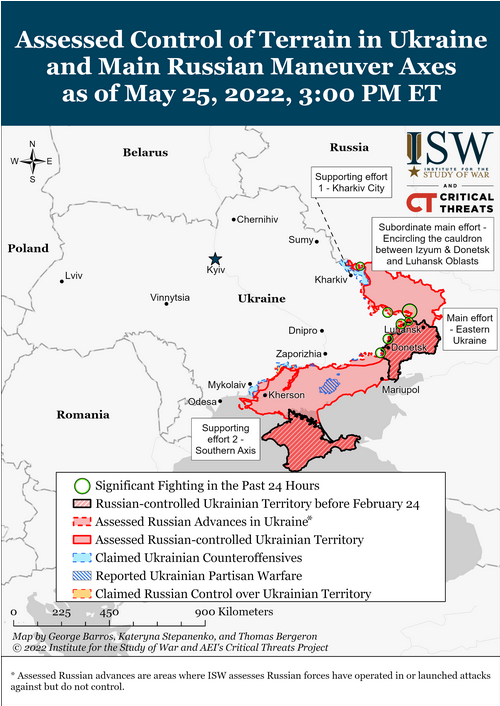
From The Institute For The Study of War:
Russian Offensive Campaign Assessment, May 25
Kateryna Stepanenko, Karolina Hird, Frederick W. Kagan, and George Barros
May 25, 7:15 pm ET
Some pro-Russian milbloggers on Telegram continued to criticize the Kremlin for appalling treatment of forcefully mobilized Donetsk and Luhansk People’s Republics (DNR and LNR) servicemen–contradicting Russian information campaigns about progress of the Russian special military operation. Former Russian Federal Security Service officer Igor Girkin (also known by the alias Igor Strelkov) amplified a critique to his 360,000 followers from a smaller milblogger discussing a video wherein a DNR battalion appealed to DNR Head Denis Pushilin about maltreatment of forcefully mobilized forces.[1] The milblogger blamed Russian leadership, not Pushilin, for beginning the invasion with insufficient reserves and unprepared, forcefully mobilized forces. The milblogger added that Russia did not provide the soldiers of its proxy republics with new weapons, despite claiming that Ukrainian forces prepared to attack occupied Donbas areas for a year prior to Russian invasion. The milblogger also claimed that the Kremlin failed to mobilize and adequately prepare the next batch of reserves, while Ukrainian forces are successfully preparing their troops for counteroffensives. Girkin also criticized the Kremlin for failing to pay the DNR battalion for three months. Some milbloggers claimed that Ukrainian forces staged the video, but the video still gathered attention of pro-Russian Telegram users.[2]
The incident highlights a continuing shift in the Russian-language milblogger information space regardless of the video’s authenticity. Milbloggers would likely have either attacked or dismissed such a video loudly and in near-unison earlier in the war, when they all generally focused on presenting optimistic pro-Russian and anti-Ukrainian narratives. The response to this video in the Russian-language milblogger space demonstrates the strong resonance anti-Kremlin narratives can now have. It is impossible to know what effect this change in this information space might have on general perceptions of the war in Russia, but it is one of the most visible and noteworthy inflections in the attitudes of previously strongly pro-Kremlin ostensibly independent Russian voices speaking to Russians that we have yet seen.
Today’s statement by DNR Militia Head Eduard Basurin explaining that Russian forces would focus on creating “smaller cauldrons” rather than on a single large encirclement is likely in part a response to a critique that surfaced both in the milblogger space and in the Russian Duma that Russian forces had failed to form and reduce “cauldrons” of the sort they used in 2014.[3] Basurin’s statement, along with other changes in the ways in which Russian officials have spoken about cauldrons and Russian operations in the east following those critiques suggest that the Russian and proxy leadership is sensitive to shifts in this information space.[4]
Russian forces are increasingly facing a deficiency in high-precision weaponry. The Ukrainian General Staff reported that due to an increasing lack of high-precision weapons Russian forces are seeking other methods of striking critical infrastructure and have intensified the use of aircraft to support offensives.[5] The Ukrainian Main Intelligence Directorate (GUR) noted that up to 60% of Russia’s high-precision stockpile has already been exhausted, which is consistent with previous reports by Western defense officials that Russian forces have been increasingly relying on “dumb bombs” because they are facing challenges replenishing their supplies of precision munitions in part due to sanctions targeting Russia’s defense-industrial production.[6] A lack of high-precision weapons will likely result in an increase in indiscriminate attacks on critical and civilian infrastructure.
The Kremlin is attempting to expand the pool of Russian passport-holders in occupied areas. Russian President Vladimir Putin signed a decree on May 25 that will simplify the procedure for obtaining a Russian passport within Kherson and Zaporizhia Oblasts.[7] This renewed campaign of so-called ”mass passportization” is occurring in occupied territories and likely represents an effort to set conditions for some sort of post-conflict political arrangement (the precise form of which Putin prefers remains unclear) through manipulating access to Russian citizenship.[8] Occupation authorities may additionally attempt to exploit this new decree to carry out covert mobilization in occupied areas, as having a Russian passport would make conscription-eligible residents of occupied territories subject to forced military service.
The Kremlin and Russian military commanders are introducing new regulations aimed at addressing the diminishing level of combat-ready reserves. The Russian State Duma and the Russian Federation Council passed a bill raising the maximum age for voluntary enlistment into the Russian military from 40 to 50.[9] Russian Telegram channels also reported that Russian leadership forced operational officers and commanders of the Russian Border Guards of southern Russian regions including Rostov Oblast and occupied Crimea to indefinitely cancel all summer vacations–a rather unsurprising step in light of the military situation in principle, but an indication of the next source of manpower to which Putin will apparently turn.[10] Russian Border Guards will reportedly deploy to training grounds for unspecified exercises in late May. The Ukrainian General Staff also reported that Russian forces are forming new reserve units within the Southern Military District.[11]
Key Takeaways
- Russian forces prioritized advances east and west of Popasna in order to cut Ukrainian ground lines of communication (GLOCs) southwest of Severodonetsk and complete encirclement efforts in Luhansk Oblast.
- Russian forces have likely entered Lyman and may use this foothold to coordinate with advances southeast of Izyum to launch an offensive on Siversk.
- Russian forces may start the Battle of Severodonetsk prior to completely cutting off Ukrainian GLOCs southwest and northwest of Severodonetsk.
- Russian forces struck Zaporizhzhia City in an attempt to disrupt a key logistics hub for Ukrainian forces operating in the east.
Go here to read the rest. During World War II Soviet Offensives tended to run out of steam with pauses as supplies, ammunition and manpower were amassed prior to the next offensive. In the current War the pauses are constant because Russia lacks supplies, ammunition and manpower and thus the Russian offensives have been short term affairs for limited objectives.


Reports today are that Russia is receiving record high income from its oil sales due to the high price of crude. Seems many countries continue to do business as usual. Quite a contrast to WW II and treatment of the Axis powers.
Ukrainian sources are admitting that the situation for Severodonetsk and also for Lysychansk is pretty dire. Apparently the Russians have been able to concentrate their artillery in the semi-circle around these two cities and slowly roll forward their advance. Largely because the West, not just the US, but also France and Germany, have slow-walked any real help, especially heavy artillery, the Ukrainians are stating that they’re outgunned and that Russian artillery is having an effect. At some point they’re probably going to have to pull back most of their forces to preserve them, and surrender the two cities. The Ukrainian command may also ask for volunteers to stay in the urban environment of Severodonetsk, just to inflict a costly slow, delaying Mariupol-type war of attrition on the Russians.
Besides the strategic objective, Severodonetsk is supposed to have one of the largest chemical facilities in all of Europe. It appears the Russians have avoided shelling and destroying these three facilities because they want to take them somewhat intact.
Kissinger showing up and offering to appease Russia with a gift of the most valuable Ukrainian agricultural and petro-producing lands did not sit well with Zelensky nor the Ukrainians—especially since it appears at a time that Ukrainian fortunes are suffering. This war is far from over. Reversals typically happen in war, but Russian losses and morale are not endorsing a win. If the Ukrainians can survive the typical Biden/Blinken administration military-support half-measures, there is likely to be a powerful counterattack by the Ukrainians not far off. Most military analyst think it will come in June when they’re able to completely re-supply an arm up. What is clear is that the Ukrainians have not yet thrown in the towel.
@Donald Link: additionally, the Biden/Blinken administration has refused to completely cut off cash payments, for Russian petroleum allowing them until June 30, according to Larry Kudlow. Why we would not immediately cut off funding Russia, and probably that we are paying them in rubles at that, is incomprehensible. Unless you acknowledge that Joe Biden is a compromised president.