
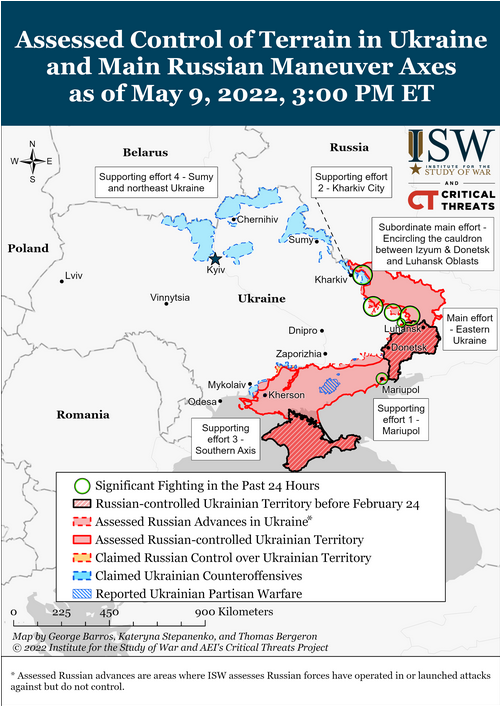
From The Institute For The Study of War:
Russian Offensive Campaign Assessment, May 9
Karolina Hird, Kateryna Stepanenko, and Mason Clark
May 9, 7:15pm ET
Russian forces continue to face widespread force generation challenges. A senior US defense official stated on May 9 that the US has not observed any indicators of a “new major Russian mobilization” and that members of the private military company Wagner Group “urgently” requested hundreds of thousands of additional troops to reinforce Russian efforts in Donbas.[1] The official noted that Russia currently has 97 battalion tactical groups (BTGs) in Ukraine, but that BTGs have been moving in and out of Ukraine to refit and resupply, suggesting that Russian troops continue to sustain substantial damage in combat.[2] ISW has previously assessed that most Russian BTGs are heavily degraded and counting BTGs is not a useful metric of Russian combat power.[3] The Main Ukrainian Intelligence Directorate (GUR) claimed that under-trained, ill-equipped Russian conscripts are still being sent into active combat despite the Kremlin denying this practice.[4] A prisoner of war from the BARS-7 detachment of the Wagner Group claimed that a ”covert mobilization” is underway in Russian to send conscripts to clean damage caused by combat in the self-proclaimed Donetsk and Luhansk People’s Republics.[5]
Russian troops in Ukraine continue to display low morale and poor discipline as fighting in many areas has stalled out against Ukrainian resistance. A senior US defense official claimed that Russian troops in Donbas are failing to obey orders from top generals.[6] Russian forces deployed to the Zaporizhzhia area reportedly are experiencing very low morale and psychological conditions, complain about the ineffectiveness of operations in the area, frequently abuse alcohol, and shoot at their own vehicles in order to avoid going to the frontline.[7] This is consistent with reports made by the Ukrainian General Staff that the extent of Russian losses is having widespread impacts on the willingness of Russian troops to engage in offensive operations.[8]
Russian authorities are likely setting conditions to integrate occupied Ukrainian territories directly into Russia, as opposed to creating proxy “People’s Republics.” The Kherson occupation Deputy Chairman of Military Civil Administration Kirill Stremousov stated on May 9 that the Kherson region intends to become part of Russia and that Kherson authorities do not intend to hold a referendum to create an independent republic.[9] Spokesperson for the Ukrainian Defense Ministry Oleksandr Motuzyanyk reported that Russian occupation authorities are intensifying reconnaissance measures and increasing checkpoints and patrols in occupied areas in order to prepare to integrate these regions directly into Russia.[10] Motuzyanyk noted that Russian and Crimean groups have been arriving to occupied regions to intensify propaganda measures to prepare for integration. ISW will publish our assessment of the Kremlin’s most likely course of actions towards their occupied territories in Ukraine in the coming days.
Key Takeaways
- Russian forces did not make any confirmed advances to the southeast or southwest of Izyum on May 9 but are likely attempting to concentrate the forces necessary to resume offensive operations in the coming days.
- Russian forces made marginal gains around Severodonetsk in the past 24 hours.
- Russian forces are likely continuing to amass troops in Belgorod Oblast to stop Ukrainian counterattacks around Kharkiv City from reaching the Ukrainian-Russian border.
- Russian units in Zaporizhia Oblast are regrouping and will likely receive reinforcements from forces previously deployed in Mariupol.
- The Kremlin continues to face severe force mobilization challenges, and ongoing “covert mobilization” efforts are unlikely to generate substantial combat power.
- Russian authorities are likely setting conditions to integrate occupied Ukrainian territories directly into Russia, as opposed to creating proxy “People’s Republics.”
Go here to read the rest.
Putin’s Victory Day Speech Forgoes an Opportunity to Escalate Russia’s Invasion of Ukraine
Katherine Lawlor and Mason Clark
May 9, 2022
Key Takeaways:
- Russian President Vladimir Putin used his May 9 speech to praise ongoing Russian efforts in Ukraine and reinforce existing Kremlin framing rather than announcing a change. He did not announce an escalation or declare victory in the Russian war in Ukraine.
- Putin likely calculated that he could not ask the Russian population for a greater commitment to the war effort and implicitly reassured the Russian people that he would not ask for a greater societal commitment in his speech.
- Putin may be recognizing the growing risks he faces at home and in Ukraine and may be adjusting his objectives, and his desired end state in Ukraine, accordingly.
- The Kremlin has already scaled down its objectives in Ukraine (from its initial objective of capturing Kyiv and full regime change) and will likely do so again—or be forced to do so by Ukrainian battlefield successes.
- Regardless of any change—or lack thereof—in the Kremlin’s objectives, Putin’s speech indicates that the Kremlin has likely decided to maintain its current level of resourcing in the war.
- The Kremlin attempted to demonstrate the alleged popularity of its occupation of eastern Ukraine through forced Victory Day celebrations in occupied Ukrainian territories.
Russian President Vladimir Putin used his May 9 speech to praise ongoing Russian efforts in Ukraine and reinforce existing Kremlin framing rather than announce a change. He did not announce an escalation or declare victory in the Russian war in Ukraine.[1] May 9, Victory Day, is Russia’s most important patriotic holiday and commemorates the Soviet victory in the Second World War, known in Russia as the Great Patriotic War. Putin’s much-anticipated speech was a ready-made opportunity for him to alter the Kremlin’s current framing of the war in Ukraine or announce a policy change. Putin had three general options for his Victory Day address: declare some sort of Russian victory, make a policy change to ramp up the war effort in some way (such as by calling for a larger-scale mobilization or formally declaring war on Ukraine), or what he chose—to pursue a steady state narrative and reinforce the Kremlin’s existing framing (and resourcing) of the war.
Many Western officials and analysts speculated that Putin would formally declare war on Ukraine to enable a larger-scale mobilization.[2] Instead, the Kremlin’s framing of Victory Day celebrations reiterated existing Kremlin justifications for the war and drew on purported historical parallels between the Second World War and the Kremlin‘s framing of its invasion of Ukraine. Putin reinforced each of the Kremlin’s core (and patently false) narratives attempting to justify its unprovoked invasion of Ukraine: that Ukraine is a Nazi state; that the United States and NATO refused to acknowledge Russia‘s security concerns and provoked the war; and that the Ukrainian government was preparing an imminent attack and genocide against Russian speakers in eastern Ukraine. He did not introduce any new justifications for the conflict, nor did he ask for a greater commitment from the Russian military or population.
Putin bizarrely framed Nazi Germany and modern-day Ukraine as equal Nazi threats to Russia’s security. He relied heavily on present-tense language as he congratulated servicemembers who fought in World War 2 and who “these days … are fighting for our people in Donbas. For the security of our Motherland—Russia.” Putin celebrated the participation of “fighters of different nationalities” and “the great, indestructible strength of our united multinational people,” recognizing the Russian proxy fighters from the Donetsk and Luhansk People’s Republics and implicitly recognizing fighters from other Russian proxy separatist regions like South Ossetia.
Putin implicitly reassured the Russian population that he would not ask them for a greater commitment to the war effort. Putin likely calculates that he cannot ask the Russian people to mobilize without triggering a destabilizing backlash against his regime. Putin could have used Victory Day as a rallying cry to declare a larger mobilization. However, backlash from large-scale mobilization could destabilize Putin’s regime, whereas current levels of commitment appear to be acceptable to the Russian population—or at least generating controllable levels of discontent. Public opinion polling from Russia’s independent Levada Center in mid-April indicated that 80% of Russians supported Russia’s military activities in Ukraine, but only 50% strongly supported the war, and 31% of all Russians felt “anxiety, fear, and horror” relating to the invasion.[3] Western sanctions will likely increasingly impact Russian citizens in the coming months, limiting the enthusiasm of the general population to make greater sacrifices for the war effort. Putin likely also faces internal discontent from Russian elites and security forces, and the war has degraded the military that would defend his regime from large-scale domestic unrest.[4] Putin likely factored these calculations into his decision to pursue a steady-state approach to the war, rather than an escalatory mobilization.
The Kremlin also attempted to demonstrate the alleged popularity of its occupation of eastern Ukraine through contrived Victory Day celebrations in occupied Ukrainian territories. Russian forces and occupation officials likely compelled Ukrainian civilians to participate in Victory Day events across occupied Ukraine in parallel with over 15,000 Victory Day events across the Russian Federation.[5] Events in occupied territories included commemorative ceremonies, broadcasts of Putin’s parade and speech in Moscow, and Immortals Regiment marches commemorating veterans of the Second World War.[6] Occupation authorities in Kherson claimed that they prevented multiple ”provocations” and established checkpoints around the city to prevent Ukrainian counter-demonstrations.[7] The Ukrainian Armed Forces General Staff reported that Russian forces seized the personal identification documents of civilians in occupied Zaporizhia and promised to return the documents only if those civilians attended the demonstrations.[8] Ukrainian media reported that Russian forces brought people from Crimea and Luhansk to participate in a Victory Day event in Melitopol, and the Ukrainian mayor of Melitopol denied that any Melitopol residents participated in the event.[9]
Putin may be recognizing the growing risks he faces at home and in Ukraine and may be adjusting his objectives, and his desired end state in Ukraine, accordingly. Putin may still announce a full or partial mobilization in the future and has not given up his ability to do so. May 9 would have been an opportune time to announce a new policy or declare victory in Ukraine, but the Kremlin was certainly not bound to this date. Putin may also pursue a more covert mobilization, such as forcing conscripts into contract soldier positions or forcing public servants into conscription, to avoid the likely backlash to a larger-scale mobilization effort.
The Kremlin has already scaled down its objectives in Ukraine (from its initial objective of capturing Kyiv and full regime change) and will likely do so again—or be forced to do so by Ukrainian battlefield successes. Putin will likely seek the complete occupation and securitization of Ukraine’s Donetsk and Luhansk oblasts and large swathes of southern Ukraine, including Mariupol, Zaporizhia, and Kherson, which Russia may then annex. The Kremlin will likely announce sham referendums calling for the independence or ascension to Russia of Russian-occupied Ukrainian territories in the coming weeks. The fact that the Kremlin has not yet done so suggests that it may still hope to gain additional territory in Ukraine, or that it has not yet achieved sufficient securitization of occupied areas.
Regardless of any change—or lack thereof—in the Kremlin’s objectives, Putin’s speech indicates that the Kremlin has likely decided to maintain its current level of resourcing in the war. That level of investment is unlikely to be sufficient to achieve the Kremlin’s objectives for the current, second phase of the war (capturing the entirety of Donetsk and Luhansk Oblasts and holding its occupied territory in southern Ukraine). However, it is unclear if the Kremlin understands that reality, and the war remains likely to protract.
Go here to read the rest. No doubt the Russians are as puzzled as we are by Putin’s speech. They were expecting something sensational like Putin fully putting Russia on a war footing. Instead Putin delivered a more of the same speech, which means the Russians will continue to pursue a failed strategy. Nothing about the war makes much sense from the Russian perspective and Putin continues to pursue a baffling strategy that seems guaranteed to result in Russian defeat.


Don, I thought you were correct in your assessment that if Putin were going to do something cataclysmic, it would have been in advance of yesterday’s state holiday. Thus, there perhaps is now room for hope that he will not escalate further, and will try to declare victory at some level.
I also had to chuckle at the words these folks use in trying to sound like experts. (Maybe they are experts, but that’s not my point.) Example: “…force generation challenges.” Yeah, the Russians are in full retreat in the northeast of Ukraine and they are getting their bums kicked elsewhere as well, and they are running out of combat-capable troops in their front lines, and the ones they have are in various stages of mutiny. That’s a force generation challenge, all right. War is obviously no laughing matter but that one was funny.
I also had to chuckle at the words these folks use in trying to sound like experts. (Maybe they are experts, but that’s not my point.) Example: “…force generation challenges.” Yeah, the Russians are in full retreat in the northeast of Ukraine and they are getting their bums kicked elsewhere as well, and they are running out of combat-capable troops in their front lines, and the ones they have are in various stages of mutiny. That’s a force generation challenge, all right.
Any military conflict always generates more idiot comments than any other subject by “experts”.
So it seems. Especially in the social media world, where I really should spend less time. (Twitter, etc.)
The disheartening aspect is that our military and intelligence agencies are so often wrong. In Afghanistan the consensus was that it would take months for the Taliban to win; in Ukraine they predicted victory for Russia in days. Such bad guessing we should get for free.