
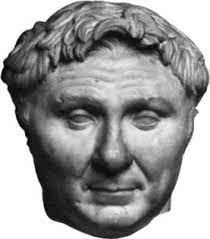
After these last words to his friends, he went into the boat. And since it was a long distance from the trireme to the land, and none of his companions in the boat had any friendly word for him, turning his eyes upon Septimius he said: “Surely I am not mistaken, and you are an old comrade of mine!” 2 Septimius nodded merely, without saying anything to him or showing any friendliness. So then, as there was profound silence again, Pompey took a little roll containing a speech written by him in Greek, which he had prepared for his use in addressing Ptolemy, and began to read in it. 3 Then, as they drew near the shore, Cornelia, together with his friends, stood on the trireme watching with great anxiety for the outcome, and began to take heart when she saw many of the king’s people assembling at the landing as if to give him an honourable welcome. But at this point, p323 while Pompey was clasping the hand of Philip that he might rise to his feet more easily, Septimius, from behind, ran him through the body with his sword, then Salvius next, and then Achillas, drew their daggers and stabbed him.102 4 And Pompey, drawing his toga down over his face with both hands, without an act or a word that was unworthy of himself, but with a groan merely, submitted to their blows, being sixty years of age less one, and ending his life only one day after his birth-day.
1 When the people on the ships beheld the murder, they uttered a wailing cry that could be heard as far as the shore, and weighing anchor quickly, took to flight. And a strong wind came to their aid as they ran out to sea, so that the Egyptians, though desirous of pursuing, turned back. But they cut off Pompey’s head, and threw the rest of his body unclothed out of the boat, and left it for those who craved so pitiful a sight. 2 Philip, however, stayed by the body, until such had taken their fill of gazing; then he washed it in sea-water, wrapped it in a tunic of his own, and since he had no other supply, sought along the coast until he found the remnants of a small fishing-boat, old stuff, indeed, but sufficient to furnish a funeral pyre that would answer for an unclothed corpse, and that too not entire. 3 As he was gathering the wood and building the pyre, there came up a Roman who was now an old man, but who in his youth had served his first campaigns with Pompey, and said: “Who art thou, my man, that thinkest to give burial rites to Pompey the Great?” And when Philip said that he was his freedman, the man said: “But thou shalt not have this honour all to thyself; let me too share in a pious privilege thus p325 offered, that I may not altogether regret my sojourn in a foreign land, if in requital for many hardships I find this happiness at least, to touch with my hands and array for burial the greatest of Roman imperators.” Such were the obsequies of Pompey. 4 And on the following day Lucius Lentulus, as he came sailing from Cyprus and coasted along the shore not knowing what had happened, saw a funeral pyre and Philip standing besides it, and before he had been seen himself exclaimed: “Who, pray, rests here at the end of his allotted days?” Then, after a slight pause and with a groan he said: “But perhaps it is thou, Pompey the Great!” And after a little he went ashore, was seized, and put to death.
This was the end of Pompey. But not long afterwards Caesar came to Egypt, and found it filled with this great deed of abomination. From the man who brought him Pompey’s head he turned away with loathing, as from an assassin; and on receiving Pompey’s seal-ring, he burst into tears; the device was a lion holding a sword in his paws. But Achillas and Potheinus he put to death. The king himself, moreover, was defeated in battle along the river, and disappeared. 6 Theodotus the sophist, however, escaped the vengeance of Caesar; for he fled out of Egypt and wandered about in wretchedness and hated of all men. But Marcus Brutus, after he had slain Caesar and come into power, discovered him in Asia, and put him to death with every possible torture. The remains of Pompey were taken to Cornelia, who gave them burial at his Alban villa.
Plutarch, Life of Pompey
No doubt Caesar would have had Pompey tried and probably executed. It was one thing for him to do it, however, and quite another thing for non-Romans to do it, especially in the barbarous manner of the Egyptians. Caesar and Pompey had been allies as well as rivals. Pompey had been a son-in-law of Caesar for a time and apparently very much in love with Caesar’s daughter Julia, Caesar’s only child until Cleopatra bore him a son, who died at age 18 in childbirth giving Pompey a child who did not survive. Perhaps memories of how much his daughter had loved Pompey flooded over Caesar as he beheld his head.


I love the fact that Caesar is outnumbered and in a foreign court but could not care less. Reminds me of Gaius Popillius Laenas drawing the circle in the sand around Antiochus IV.
The Romans could be barbaric pagans, but I can understand their loathing of the sensual cruelties of Egypt and other eastern paganisms.
And a Roman was a Roman, even if an enemy. It reminds me of Octavian interring both Antony and Cleopatra in a magnificent tomb after their suicides. There was something to be said for respecting the foe, even in death.
“I love the fact that Caesar is outnumbered and in a foreign court but could not care less.”
Cicero’s speeches against Verres illustrated the pride that Romans of Caesar’s generation had in being Roman. Cīvis rōmānus sum was the last refuge of all Romans and the Egyptians had violated this.
Middle Easterners could not understand the Via Romana, but I think the Greeks may have understood. Sadly Rome lost these traits. Then Rome was lost. 🙁
Auctoritas–“Spiritual Authority”: The sense of one’s social standing, built up through experience, Pietas, and Industria.
Comitas–“Humor”: Ease of manner, courtesy, openness, and friendliness.
Clementia–“Mercy”: Mildness and gentleness.
Dignitas–“Dignity”: A sense of self-worth, personal pride.
Firmitas–“Tenacity”: Strength of mind, the ability to stick to one’s purpose.
Frugalitas–“Frugalness”: Economy and simplicity of style, without being miserly.
Gravitas–“Gravity”: A sense of the importance of the matter at hand, responsibility and earnestness.
Honestas–“Respectibility”: The image that one presents as a respectable member of society.
Humanitas–“Humanity”: Refinement, civilization, learning, and being cultured.
Industria–“Industriousness”: Hard work.
Pietas–“Dutifulness”: More than religious piety; a respect for the natural order socially, politically, and religiously. Includes the ideas of patriotism and devotion to others.
Prudentia–“Prudence”: Foresight, wisdom, and personal discretion.
Salubritas–“Wholesomeness”: Health and cleanliness.
Severitas–“Sternness”: Gravity, self-control.
Veritas–“Truthfulness”: Honesty in dealing with others.