
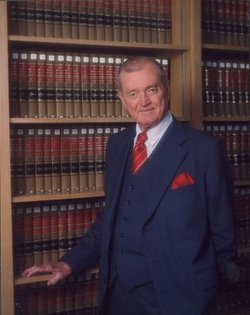
In the first year of law school I was blest to be taught constitutional law by the premier U.S. constitutional law scholar of all time, the late Professor Charles Alan Wright (1927 A.D – 2000 A.D.; RIP), He was the world’s foremost authority on the United States Constitution and also on federal court procedure.
Ever the gentleman, he never demeaned or insulted a student. He asked questions and would only call on students who volunteered to speak. His prodigious memory was beyond photographic, beyond, eidetic. If asked, for example, when the subject was a case with a particular strange or arcane fact pattern, e.g., “Professor Wright, has the Supreme Court ever decided a case like this one ?” he would become pensive for a few moments, and then respond like this: “ Yes, five times in the past. The first time was in 1844, the case of McClure v. Boston, the citation is 50 U.S. 777, and in that case . . . “. He could read from memory the pages of the textbook that he used for class. Once after asking a student where the student was quoting from in the textbook, the student replied, “Page 72.” Professor Wright thought out loud, “That’s not on page 72.” Then he corrected himself, “Oh, yes, you have the old edition of the text.”
One student legend at the law school was that, in recently appearing before the Supreme Court on behalf of a client, the Chief Justice had interrupted him before he could proceed and said something like “Professor Wright, my colleagues and I are always appreciative when you come here and educate us in constitutional law.“ One time after class, while walking down the hall and discussing a point of law with him [a state’s inability to rescind denial of ratification of the so-called “Equal Rights Amendment”], we arrived at the sacrosanct faculty elevator. I stopped at the invisible line outside the elevator and told him I would take the stairs and meet him on the 3rd floor where his office was located. He told me to “Get in here with me,” and as I did the several other professors already in the elevator dared not speak.
I kept in touch with him after graduation and we became friends, me sharing new jobs and the births of new children and he letting me know when he had another grandchild. Once upon the arrival of one of his new grandchildren, I sent him a copy of the best-selling childrens [actually adult too] book, Love You Forever. He was truly appreciative.
In my over forty years in this job, there are two things of which I am proud: appointment as a Judge Advocate General in the U.S. Army Judge Advocate General Corps, and admission to the Bar of the United States Supreme Court – both, according to my membership certificates, upon the recommendation of Professor Charles Alan Wright.
When the time came to discuss the Roe v. Wade decision in class, instead of his usual procedure of beginning with a terse question to start the discussion, he told us that it was generally accepted by legal scholars across the country that Roe v. Wade was the worst decision ever handed down by the Court. The condemnations he stated for the decision echoed those of a Yale law professor, Professor John Hart Ely:
“What is frightening about Roe is that this super-protected right is not inferable from the language of the Constitution, the framers’ thinking respecting the specific problem in issue, any general value derivable from the provisions they included, or the nation’s governmental structure. Nor is it explainable in terms of the unusual political impotence of the group judicially protected vis-a-vis the interest that legislatively prevailed over it.”
“It is, nevertheless, a very bad decision. . . .. It is bad because it is bad constitutional law, or rather because it is not constitutional law and gives almost no sense of an obligation to try to be.” [John Hart Ely; The Wages of Crying Wolf: A Comment on Roe v. Wade; Yale Law Journal; Vol.82(5), p.920-949 (1973).
Professor Ely stated that: Roe was jurisprudentially unsound; it was not based on the constitution’s text, understanding or structure: it did not protect a politically vulnerable group; a right of privacy could not include a right to abortion; a “right to abortion” could not be a fundamental right; and the opposing interests of protecting unborn children (a much less politically-potent group than living women) was a sufficiently compelling interest that justified government regulation.
In effect, the seven justices who signed off on the decision, despite the woefully inadequate and legally pitiful arguments of the counsel for the plaintiff Roe [and, as came to light years later, the case was a fraud on the court regarding how the plaintiff became pregnant], did an end run around the explicit requirements of the Constitution for its amendment. Some have called this usurpation of power illegal “constitutional amendment by judicial fiat.”
Primarily because of Roe, and some ensuing equally erroneous opinions, the group of nine persons is no longer a viewed as a “Court,” but is now considered a judiciallegislative agency of government or a legislativejudicial bureau. Almost without exception, how this legislativejudicial department will vote on a given disputed issue can be accurately predicted on the basis of whichever party has had the fortune to appoint the majority of the persons, [who no longer deserve the title “justice”] who are currently serving as the most high ranking legal bureaucrats in the history of America.
Professors Wright and Ely were correct in the mid 1970s and what they said is still correct today. May they both rest in the peace of now knowing that they were right and that the seven men who tried to legislate their personal morality from the judicial bench were wrong, and, sadly, in the case of abortion, dead wrong.
After all these decades________________


Almost without exception, how this legislativejudicial department will vote on a given disputed issue can be accurately predicted on the basis of whichever party has had the fortune to appoint the majority of the persons, [who no longer deserve the title “justice”] who are currently serving as the most high ranking legal bureaucrats in the history of America.
If that were the case, Roe would have been decided differently, Casey would have been decided differently. Romer v. Evans would have been decided differently, Obergefell would have been decided differently, Bakke would have been decided cleanly, Grutter would have been decided differently, &c. The last time the majority on the court consisted of Democratic appointees was around about 1969. The culture of the elite bar is deeply diseased.
Wasn’t there some world-class lying going on in Roe? Pretty much a seamless garment of bearing false witness.
Thank you for sharing this Guy. I enjoyed reading this. Particular about Professor Charles Wright.
I was in Prof. Wright’s Constitutional Law class in 1970-71 and can attest to his photographic memory and courtesy, too. We were all in awe of him, for sure. Another Wright legend was that he dictated revisions to his signature treatise on federal procedure using two dictating machines, seamlessly dictating text into one and footnotes into the other. And then there was the intramural football team that he coached, the Legal Eagles. He was a truly great lawyer, professor and man. Eternal memory.
Roe never bore the burden of proof that the newly begotten sovereign person was not an human being.
Art Deco:
“If that were the case, Roe would have been decided differently”
You have an erroneous premise there, i.e., that Republicans are really, unanimously and universally in favor of what they sometimes they say they are in favor of (such as the Constitution, protecting the unborn, etc.). It is obvious they are not and, therefore, Mr. McClung’s thesis is not disproved. Republican-appointed judges often vote as RINOs would, because many, if not most, Republican Congressmen and Presidents are RINOs too.
You have an erroneous premise there, i.e., that Republicans are really, unanimously and universally in favor of what they sometimes they say they are in favor of (such as the Constitution, protecting the unborn, etc.). It is obvious they are not and, therefore, Mr. McClung’s thesis is not disproved. Republican-appointed judges often vote as RINOs would, because many, if not most, Republican Congressmen and Presidents are RINOs too.
When you can distinguish between Mr. McClurg’s premises and mine, get back to me. You’re not there yet.
My con law professor, Wm. Van Alstyne, no political conservative, was pro-choice and anti-Roe. He was a constitutional scholar of the highest rank and an honest liberal.
Art Deco:
What’s with the attitude? You always come across as angry and smug. No offense intended, but a little courtesy in your answers would not go amiss. Especially when you don’t seem to understand the commentary you are reacting to.
“When you can distinguish between Mr. McClurg’s premises and mine, get back to me”
I distinguish between them perfectly well. The only way your argument made sense was by taking for granted that a Republican-nominated judge is deciding a case as a Republican would if and only if he decides it in a pro-life, pro-Constitution, etc. way (and therefore, as you concluded, the Republican-nominated judges had not decided Roe v. Wade as a Republican would, because if they had, it “would have been decided differently”, so Mr. McClung’s thesis was wrong).
The problem for that argument against Mr. McClung’s thesis is that it takes for granted that deciding as a Republican (or, in Mr. McClung’s words, in a way that can be “accurately predicted on the basis of whichever party” nominated the judge in question) means voting against abortion “rights” in Roe v. Wade, Casey v. PP, etc., which is not true, because many or most Republicans are RINOs and don’t really care about abortion and many other matters they are supposed to care about.
Is that distinction enough? I did not think it was necessary to explain such an obvious thing.
Folks, How about this clarification: instead of “Almost without exception,” this: Today, almost without exception,…. Guy, Texas