
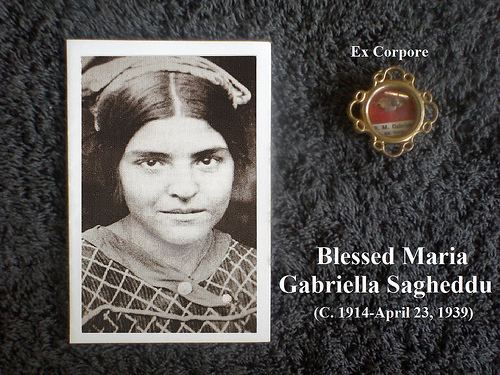
Maria Sagheddu was born to shepherds in Dorgali on 17 March 1914 as the fifth of eight children to Marcantonio Sagheddu and Caterina Cucca. Her father and one brother died in 1919 as did two other brothers sometime in their childhood.[1] Sagheddu was said to be obstinate as a child but was also known to be obedient; she was also described as being prone to laziness on occasion.[2] Once she concluded her initial education as a child she had to leave school to help out at home where she showed herself serious and endowed with a great sense of care and dutiful obedience. Yet she was often quick to criticize what she disliked and quick to ask for what she wanted.[3] There was one occasion when her mother asked her to throw out some potato peels though she ignored this despite her mother’s firm insistence that she do so. Sagheddu relented and did this but returned a moment later with the peels in hand in which she decided she did not want to throw them. Sagheddu was ranked among the best at her school where she was alert and intelligent; she excelled in arithmetic most of all her other subjects.
The death of her little sister Giovanna Antonia (whom she was closest to and was born in 1915) in 1932 prompted her to deepen her faith and she decided to enroll in Azione Cattolica not long after this.[2] It was there that she began to instruct the local children and adolescents in the faith and also to help the aged of the region.[1] In the process she began to augment her spiritual and contemplative life; she at first taught catechism with a stick in hand. But the local priest took the stick from her on one occasion and replaced it with a note that said: “Arm yourself with patience, not a stick”. Sagheddu accepted the criticism and changed her methods from that moment on.
Father Meloni helped her in entering the religious life for he was the single individual she had confided her dream in. Her mother approved this but reproached her for not having told her sooner. One brother even disapproved of her decision and believed that she would bring nothing more than disgrace upon their home.[3][2] On 30 September 1935 she entered the Trappists at their convent in Grottaferrata near Rome where she was given the religious name of Maria Gabriella; she was clothed in the habit for the first time on 13 April 1936 and made her vows on 31 October 1937 which marked the Feast of Christ the King.[3] The abbess of the convent at that time there was Mother Maria Pia Gullini whose enthusiasm for ecumenism (a fruit of the efforts of Abbé Paul Couturier) was passed on to the others there. Sagheddu became an ardent devotee to this cause and she offered herself as a spiritual sacrifice for the unification of the Christian Church during the special week for Christian unification in 1938.
Sagheddu fell ill with tuberculosis after a diagnosis in Rome and suffered with the disease for fifteen months before she died during the evening on 23 April 1939. The doctors declared her condition incurable in May 1938.[2] The significant fact here is that the Gospel reading for that week included the words: “There will be one flock and one shepherd” (John 10:16). Sagheddu’s remains are kept in a chapel at a Trappistine convent at Vitorchiano near Viterbo and were found to be incorrupt in 1957 upon exhumation.
Go here to read the rest.

