
These brutal reprisals upon helpless victims evidence the shallow advance from savagery which the Japanese people have made. We serve notice upon the Japanese military and political leaders as well as the Japanese people that the future of the Japanese race itself, depends entirely and irrevocably upon their capacity to progress beyond their aboriginal barbaric instincts.
General George Marshall, Statement on Japanese atrocities, particularly the Bataan Death March (1944)
Eighty years ago American and Filipino troops, on starvation rations and wracked with malaria, had made a heroic stand for months against the Japanese Imperial Army.
Believing themselves deserted by the US, the troops sang this bit of bitter doggerel:
We’re the battling bastards of Bataan,
No mama, no papa, no Uncle Sam.
No aunts, no uncles, no cousins, no nieces,
No pills, no planes, no artillery pieces.
And nobody gives a damn.
General Douglas MacArthur, in command of all American and Filipino troops in the Philippines, continually pleaded with Washington for a relief force to Bataan. Shamefully, some of the messages from Washington indicated that a relief force was being put together. These were lies. After Pearl Harbor the US simply lacked the naval assets to successfully reinforce Bataan. Any attempt to do so would almost certainly have led to a military disaster for America.
On Corregidor, MacArthur exposed himself to frequent enemy bombing to the point of recklessness. He visited his troops on Bataan only once, however, who gave him the lasting nickname of Dugout Doug. Why?
The reason was not lack of physical courage but rather his inability to lie to his troops to their face. Washington kept telling MacArthur that a relief force was on the way. MacArthur relayed this news to his troops, but I doubt if he believed it in his heart. A master strategist, MacArthur knew that neither the forces nor the logistics were there for a successful rescue of Bataan, and he could not bring himself to face his doomed men and lie about this to their faces.
When directly ordered by FDR to leave the Philippines, he came close to disobeying, something almost impossible to even contemplate for a career American officer, saying he would resign and join the troops on Bataan to fight as a volunteer. He was convinced to obey only with great difficulty. He refused to go out by submarine, taking a dangerous trip by a PT boat instead on March 11, 1942, to demonstrate that the Japanese blockade could be penetrated. For the rest of the War his goal was to liberate the Philippines and to rescue the men who had fought under him on Bataan.
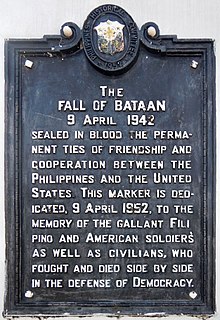
The men on Bataan fought on for another month after MacArthur left, until they could fight no more, lacking food, ammunition and medical supplies. Twenty thousand of them paid with their lives for their gallant stand. After their surrender they found that their ordeal had only begun. Awaiting them was the Bataan Death March, a 60 mile trek straight out of Dante’s inferno, organized by the Japanese Imperial Army after the fall of Bataan. Given virtually no food and no water, subject to random beatings and casual murder by their guards, out of a force of 75,000 troops, some 5000-10000 Filipinos died and some 600-650 Americans. Walt Straka, the last American survivor of the Death March passed away, fittingly enough, on July 4, 2021 at age 101.


Passed by Bataan back in the early fifties (on the way to Korea) I was young and had been made keenly aware of this amazing story. It so captured my interest that decades later I ventured into writing a short (so so) novel about this event, but the long research I had to do was the real eye opener.
Thanks for drawing attention to this historic event Don, particularly in lieu of the reality that, once again, the Philippines and its good people may be under military threat by the CCPs encroachment into that geopolitical area.
I have/read a book, “Tears in the Darkness” by Michael Norman, a Bataan survivor. Harrowing for years until liberated.
Lest we forget.
General Wainwright deserved his Medal, promotion and ticker-tape parade. Not to mention his front row at the surrender of Japan.
May God rest all their brave souls, Filipino and American.
I do recall reading about one moment of chivalry during the march.
Mario Tonelli was accosted by a Japanese soldier and relieved of his Notre Dame class ring at the point of a bayonet. A higher ranking Japanese officer intervened, took the ring–and then returned it to the prisoner.
It turned out that the Japanese officer had seen Tonelli rip off a long run that beat USC, and he was impressed.
Alas, that may have been the moment of humanity during the entire atrocity.
https://news.nd.edu/news/mario-g-motts-tonelli-1916-2003-ex-irish-star-survived-bataan/#:~:text=Tonelli%20broke%20several%20long%20runs%2C%20including%20one%20of,April%201941%2C%20five%20days%20after%20he%20was%20married.p.
Some Japanese officers and men acted humanely. Unfortunately they were a distinct minority.
Wainwright thought he would be regarded as a traitor for having surrendered. He was astounded when he realized that he was regarded, rightly, as a national hero.
Don
Pre-war the Army estimated it could retreat to Bataan and hold for six months.
The Navy estimated that it would two and a half years to relieve the Philippines,
Both estimates turned out to be correct.
I do not know if the discrepancy was ever briefed to the political leadership, though I think the leadership of both parties would have considered the cost of fixing to be politically impossible.
As the governing power we had a duty to defend. If we weren’t willing to effectively defend the place, why did we keep it.
Unfortunately, I think the current crop of leaders is even more out of touch.
Hank
As the governing power we had a duty to defend. If we weren’t willing to effectively defend the place, why did we keep it.
The plan was to have the Philippines independent by 1946, a schedule that was kept. A process of modernization actually was undertaken before the War, and put the forces of the Philippines in better shape than they would have been otherwise. All governments have to balance the cost of defense against other priorities. I have always been in favor of a strong defense, but I recognize that reality. From a US perspective it made more sense to have a strong Navy in the Pacific rather than a strong Philippine garrison that likely could have never been strong enough to deter the Japanese if they wanted to take it.
What eventually happened was that the Japanese had to garrison the Philippines at a cost they could ill afford, with most of the Philippine provinces slipping from their control even before the liberation due to intense guerilla warfare, a fact that contemporary Filipinos look back on with rightful pride. The US suffered a momentary defeat in the Philippines in 42. The Japanese probably made a strategic error in attempting to take the Philippines at all, other than a few of the smaller islands to serve as airbases for their oil convoys.
From 1987 to 1990 we lived on NAS Cubi Pt, in Bataan. My husband visited Corregidor on many occasions ferrying VIPs there by helo. Our then 8 yo son and I visited by boat. The abandoned buildings architecture was very similar to that of Ft. McNair, Washington DC. The Malinta tunnel was excavated in 1932 and the main tunnel and 25 laterals were completed in 1934. Quite an engineering feat by the Army Corps of Engineers; they had to use old mining equipment from the gold mines up in Baguio. Labor was provided by the Philippine Commonwealth in the form of 1,000 convicts from the Bilibid Prison in Manila. A company of engineers from the Philippine Scouts worked on the construction as foremen and clerks. Ironically the cement for concrete used to line the tunnels was bought from the Japanese. Additional laterals were constructed up to the start of the war. Touring Malinta was eerie. (Not as eerie as the Roman catacombs though) Some of the laterals were wide enough for trucks and jeeps to be side by side. Before the surrender to the Japanese Malinta housed a 1000 patient hospital. The Death March was brutal and those prisoners that made it to the POW at Camp O’Donnell in Tarlac suffered greatly. The Japanese were especially cruel to the Filipino POWS. The Boy Scouts had an abbreviated Death March up to Tarlac for which they earned a special merit badge. Taking anti malaria drugs beforehand was mandated to participate. The best thing about the small libraries on base was the collection of books with first hand accounts by survivors of the occupation. My late father-in-law was an army doctor who cared for the military and civilian prisoners at Santo Tomas after the Japanese surrendered Manila. He and my mother-in-law visited us over there. For the first time he spoke about the war telling us stories about what it was like. To this day my husband keeps on his bureau a small photo of Pawpaw sitting outside his tent in Quezon City.
Even in the ’80s and ’90s the Filipinos still hated the Japanese for their brutality.
The hotels had special prices for Japanese guests that were double and triple what other tourists were charged….a little revenge.
The hotels had special prices for Japanese guests that were double and triple what other tourists were charged….a little revenge.
It will be a long while before the Filipinos have any fondness for the Japanese as a group.