
From The Institute For the Study of War:
Mason Clark, George Barros, and Karolina Hird
April 4, 5:30 pm ET
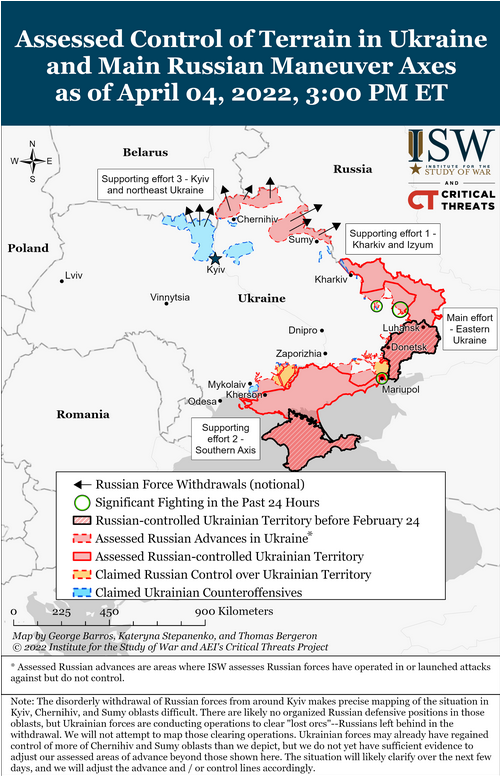
Russian forces continue to make little to no progress in frontal assaults to capture Donetsk and Luhansk Oblasts, their current main effort of the war. Russian units in Donbas face growing morale and supply issues. Additionally, the Ukrainian defenders of Mariupol have outperformed ISW’s previous estimates and continue to hold the city. Russian efforts to generate replacements from reservists and feed damaged units from northeastern Ukraine into frontal assaults in eastern Ukraine are unlikely to increase their chances of success.
However, Russian forces advancing from the Kharkiv axis are setting conditions to resume offensive operations through the city of Slovyansk to link up with other Russian forces in Donbas and encircle Ukrainian defenders. Russian forces captured Izyum (southeast of Kharkiv) on April 1 and have conducted active preparations to resume offensive operations for the past three days—stockpiling supplies, refitting damaged units, repairing the damaged bridge in Izyum, and conducting reconnaissance in force missions toward the southeast. Russian forces will likely begin offensive operations towards Slovyansk, 50km southeast of Izyum, in the coming days.
Efforts by Russian forces advancing from Izyum to capture Slovyansk will likely prove to be the next pivotal battle of the war in Ukraine. Russian forces likely intend to cut off Ukrainian forces in eastern Ukraine and will need to take Slovyansk as their minimum step to do so. If Russian forces take Slovyansk, they will then have the option to advance directly east to link up with Russian forces fighting in Rubizhne—a shorter drive that will not isolate many Ukrainian forces—or advance toward Horlivka and Donetsk to attempt a wider encirclement of Ukrainian forces. Both options could enable at least limited Russian breakthroughs in Luhansk Oblast. If Russian forces are unable to take Slovyansk at all, Russian frontal assaults in Donbas are unlikely to independently breakthrough Ukrainian defenses and Russia’s campaign to capture the entirety of Luhansk and Donetsk oblasts will likely fail.
Degraded Russian forces in northeastern Ukraine continued to withdraw to Russia and are unlikely to be effective elsewhere, despite ongoing Russian efforts to redeploy them to eastern Ukraine. Ukrainian forces are conducting operations to clear Russians left behind in the withdrawal, and Russian forces are unlikely to hold any cohesive defensive positions. The Ukrainian military reported that elements of Russian VDV (Airborne) units withdrawn from northern Kyiv flew to Belgorod, Russia, on April 4. These units are understrength, missing equipment, and likely highly demoralized. Russian servicemen from the Kyiv axis ordered to renter combat operations may desert or refuse orders, which has occurred in several Russian units throughout the war—including several units that had not yet entered combat.
Key Takeaways
- Russian forces in Izyum are setting conditions to begin offensive operations southeast toward Slovyansk in the coming days to link up with other Russian forces in Donbas and encircle Ukrainian defenders.
- Russian forces in Donetsk and Luhansk Oblasts continue to make little to no progress and face mounting casualties and declining morale. Replacements and reinforcements from northeastern Ukraine are highly unlikely to meaningfully change the balance of forces.
- Efforts by Russian forces advancing from Izyum to capture Slovyansk and threaten Ukrainian forces in Donbas with encirclement will likely prove to be the next pivotal battle of the war in Ukraine. If Russian forces are unable to take Slovyansk, Russia’s campaign to capture the entirety of Luhansk and Donetsk oblasts will likely fail.
- The defenders of Mariupol have outperformed ISW’s previous estimates, and Russian forces are likely taking heavy casualties in ongoing efforts to capture the city.
- Ukrainian forces likely conducted successful counterattacks in Kherson Oblast in the last 24 hours.
- Russian forces have almost completely withdrawn from Chernihiv and Sumy oblasts and will likely completely vacate these regions in the coming days.
- Russian forces withdrawn from the Kyiv axis are highly unlikely to be effectively deployed elsewhere in Ukraine and are likely a spent force.
Russian forces already deployed to the Kremlin’s main effort in eastern Ukraine are highly demoralized and do not have a cohesive command structure. The Ukrainian General Staff reported on April 4 that Russian forces are attempting to create an operational group and expand control structures to “prepare for an offensive operation in eastern Ukraine” and are continuing to deploy additional forces to eastern Ukraine.[1] Russian officers will struggle to develop a new command structure from highly damaged units while simultaneously attempting to continue offensive operations. The Ukrainian General Staff reported on April 4 that losses of the 33rd, 255th, and 294th Motor Rifle Regiments of the 20th Motor Rifle Division (part of the 8th Combined Arms Army and likely active in fighting in Donbas or Mariupol) amounted to up to 40% of equipment and personnel, and surviving servicemen are attempting to leave the military.[2] Ukraine’s Military Intelligence Directorate (GUR) separately reported that it acquired a document signed by Deputy Southern Military District commander Pyotr Gibert indicating that Russian officers are compensating their troops with the promise of additional leave days due to the inability to pay promised monthly salaries in cash.[3]
Russian efforts to generate reserves and replace officer casualties continue to face serious challenges. The Ukrainian General Staff stated that the Russian military is deploying students and educators at higher military educational institutions directly to Ukraine to replace mounting officer casualties.[4] The deployment of untrained officers—and more crucially educational staff—to the war in Ukraine will impede the Russian military’s ability to develop its next generation of officers for years to come. The General Staff additionally reported on April 4 that the Kremlin began “hidden mobilization” measures to send approximately 60,000 personnel to Ukraine.[5] The General Staff stated the Kremlin is prioritizing reservists of all ranks who already have combat experience, particularly in Krasnodar Krai, Perm Oblast, the Dagestan Republic, Ingushetia, and Kalmykia.
Go here to read the rest. From Strategy Page:
April 4, 2022: Ukrainian forces have received military aid from 27 nations, some of it before the February 24 Russian invasion. In some cases, Ukraine had purchased additional numbers of some particularly useful items, like the Starlink terminals that can receive high-speed and encrypted Internet access via thousands of SpaceX Starlink satellites in service.
The most important donations have been the thousands of anti-tank and anti-aircraft weapons delivered since the invasion began. These are usually the latest models and some had little or no combat experience. That was quickly remedied as Ukrainian forces used these weapons to defeat the seemingly superior Russian forces.
The Ukrainian have provided donor nations with data on the performance of their donated weapons, many of which had never been used so extensively against a modern force equipped with modern armored vehicles, jet fighters and helicopters. Donors were also told how easy it was for Ukrainian troops and civilian Territorial Defense personnel to learn to use the new weapons effectively. This enabled some donors to modify the usability of their weapons, especially the ant-armor and anti-aircraft systems.
Since the first Russian attack in 2014, the Ukrainians had been preparing for a possible full-scale Russian invasion. Thousands of civilians had joined Territorial Defense units before the invasion. Ukraine knew there would be a lot more volunteers if the Russians did attack and prepared for that by having enough uniforms and weapons available as well as brief but intense training courses developed to handle the influx. Ukraine expected some additional foreign aid and had already received or purchased weapons and equipment from NATO nations before 2022.
The Ukrainians had developed tactics for the Territorial Defense Units that emphasized using small groups of armed personnel to attack Russian support units, especially supply vehicles. That was quickly modified when the unexpected flood of aid came in, including thousands of portable anti-tank and anti-aircraft weapons. Many Territorial Defense units were soon armed with these weapons so they could take on Russian tanks and other armored vehicles. This proved to be decisive in rapidly defeating Russian efforts to advance into Ukraine and capture major cities, especially the capital Kyiv.
Copies of the Russian war plan, as well as dozens of working Russian combat vehicles and hundreds of Russian troops were captured. The Russian plan expected the fighting to be over in 15 days with Kyiv captured and a pro-Russian government installed. The reality was that by day fifteen of the invasion about half of the Russian combat units; Battalion size task forces called BTGs or Battalion Task Groups, were destroyed or disabled by heavy losses. By the end of March many BTGs were withdrawn to Russia for rebuilding, a process that could take months. The rebuilding process quickly ran into problems when many of the armored vehicles held in reserve proved to be inoperable because of inadequate maintenance and security. Many of the replacement troops were conscripts, who serve only for a year and by law cannot be sent into a combat zone. Most of the BTGs used for the initial attacks had few or no conscripts and used volunteer troops who are paid more and have more military experience. Many of these contract (kontrackti) troops were now seeking to cancel their contracts and leave the military, which proved to be a riskier job than they were led to believe.
Many conscripts inside Ukraine simply surrendered at the first opportunity. Ukrainian troops and the government managed to let many Russian troops know that prisoners of war were well treated and families of the prisoners would be notified. The Russian government had imposed an information blackout on who their troops were in Ukraine and which of them were killed, wounded or captured.
Russia had few additional BTGs to replace those lost and by the end of March the Ukrainians were counter attacking and retaking Russian controlled towns and villages. The Russian supply lines were under attack day and night. The night attacks were effective because of the use of a small Ukrainian UAV equipped with GPS, a night vision camera, a laser range finder and a link to a nearby artillery unit via Starlink. The UAV patrolled Russian supply routes at night and, when a convoy was spotted trying the move safely in the dark, the artillery unit had the continually updated location of the trucks. That enabled the Ukrainians to fire at the convoy and destroy many of the vehicles while demoralizing the survivors who didn’t believe the Ukrainians could detect them in the dark and call-in accurate artillery fire.
Go here to read the rest. The Ukrainians have shown a fighting spirit that reminds me of the Israelis in 47-48. Combine this with the Western technology and weaponry that the Ukrainians are becoming increasingly adept at using, and the Russians are beginning to face a military catastrophe. The temptation to redress the balance by using chemical and/or biological weapons or tactical nukes might be an increasingly attractive option for Putin and his generals, the reaction of the rest of the world be damned. Let us pray that the Russians do not do this. If they do, World War III might result, the sum of our nightmares over the past seventy-seven years.


Regarding the potential for worldwide disaster, prayers indeed are a daily thing now. According to Strategy Page today, Putin’s ability to launch nukes is supposedly somewhat constrained. Perhaps cooler heads will yet prevail. Ukraine needs to be reasonable in giving the Russians a way out of this mess they have made. That’s hard when someone has invaded your country multiple times over the years. Pray for good judgment all around. And for NATO to stay the h*** out of it except for shipping in defensive weapons. Which does not, IMO, include providing aircraft and armor, which seems a major step up from sending Stingers and Javelins. The pro-war Neocon types are claiming there is no qualitative distinction. I say let them fly the jets, then. Starting with Kristol, French, and Hannity.
“..Russian officers are compensating their troops with promises of additional leave days due to the inability to pay promised monthly salaries in cash..”.
No pay? For frontline soldiers? I wonder if the families of the soldiers who paid with their lives will get paid their back pay owing. I think we know the answer to that.
True definition of cannon fodder.
@Frank: A much more severe alternative action,according to Larry Kudlow, would be if the Biden administration would immediately cut off petroleum shipment payments now, instead of waiting till June 30; and also order all US banks to stop from transacting Russian government or corporate payments. Kudlow says that Chase Bank in particular continues to make payments on the interest of Russian debt. Kudlow says Chase should be ordered to stop and allow the loans to default, even though that will affect Western banks to some degree. However he says they can absorb that. The Russians cannot. He says this would be an immediate and severe blow, and if the Russians already are finding they are unable to pay their military payroll payments—as this article notes above—-this war could swiftly be brought to an end.
I’m hoping that if an order is issued to use WMDs the response down the line is ‘OK, we’re done here’. I’d like to think Putin’s project of re-assembling the Soviet Union and the Warsaw Pact carries no enthusiasm outside of his camarilla and outside of the Zhirinovsky acolytes on the street.
The translator tells me the Russian phrase is:
Хорошо, мы закончили здесь
Most people have probably heard the very interesting short interview of former Russian “oligarch,” Mikhail Khodorkovsky.
https://www.bing.com/videos/search?q=cnn+interview+mikhail+khodorkovsky&docid=20700518376373&mid=E078906BE0455155AA8DE078906BE0455155AA8D&view=detail&FORM=VIRE&msclkid=8658fec2b4ec11ec9e6e240321ad6108
I hate to refer to a CNN interview by Fareed Zakaria, who carefully steers Khodorkovsky away from criticisms of Biden: But It is still an interesting 11 minute “take”, and perhaps an accurate insight, into Putin’s thinking and how he operates—basically (as we have seen) he exploits any power vacuum with the West for his advantage. He also says the “oligarchs” really have no power in the Putin dictatorship. Putin, Khodorkovsky says, was long associated with the criminal world, and is basically part of the “criminal elements.” Only the military can finally tell Putin—carefully—they cannot accomplish his task, which is apparently happening now. But Khodorkovsky makes it clear Russia is already at war with NATO and the US, and Putin intends their ultimate defeat.