
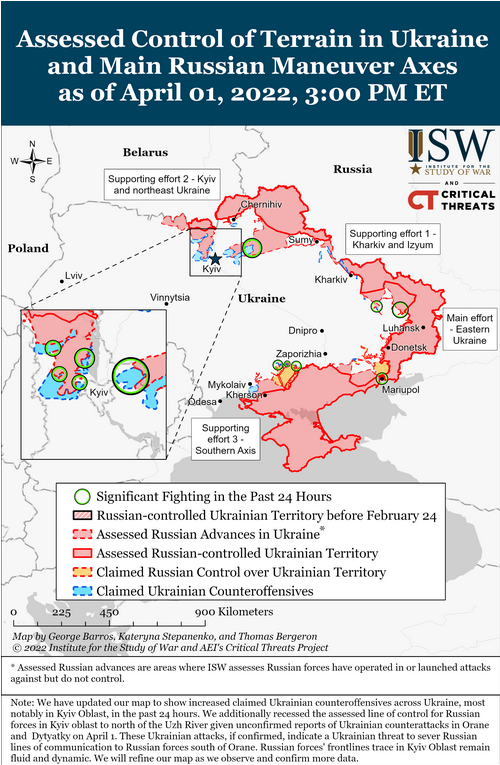
From The Institute For The Study of War:
Mason Clark, George Barros, and Karolina Hird
April 1, 7:00 pm ET
ISW assesses that the Kremlin has revised its campaign plan in Ukraine after the failure of its initial campaign to capture Kyiv and other major Ukrainian cities and its subsequent failure to adjust its operations in late March. ISW previously assessed that the initial Russian campaign of the war—airborne and mechanized operations to seize Kyiv, Kharkiv, Odesa, and other major Ukrainian cities to force a change of government in Ukraine—had failed as of March 19.[1] The Russian military continued to feed small collections of reinforcements into operations around Kyiv and across northeastern and southern Ukraine in an effort to keep its initial campaign plan alive throughout late March. We assess that the Russian military has now halted these failed efforts and is beginning a new phase of its campaign in Ukraine with new objectives. We are updating the structure of our campaign assessments to reflect the new structure and prioritization of Russian operations.
Russia’s main effort is now focused on eastern Ukraine, with two subordinate main efforts: capturing the port city of Mariupol and capturing the entirety of Donetsk and Luhansk Oblasts. The Kremlin claims the entirety of these oblasts as the territory of its proxies in eastern Ukraine, the Donetsk and Luhansk People’s Republics (DNR and LNR).[2] The Kremlin is increasingly redeploying troops from other axes of advance and channeling its remaining reinforcements from Russia into eastern Ukraine. Russian forces are unlikely to conduct active operations on other fronts in the coming weeks.
The Kremlin may intend to capture Donetsk and Luhansk Oblasts before seeking to negotiate a Kremlin-favorable ceasefire and claim that Russia has achieved its war aims. The Kremlin’s initial false justification for its unprovoked invasion of Ukraine was to protect the DNR and LNR from Ukraine and enable them to seize their “claimed” territory. The Kremlin is attempting to gloss over the failure of Russia’s initial campaign for a domestic Russian audience. The Kremlin has in fact been forced to alter its operations after the failure of its initial campaign. Kremlin claims that Russian forces solely attacked northeastern Ukraine to degrade Ukrainian forces before achieving the “main goal” of capturing Donetsk and Luhansk Oblasts – such as statements made by the Russian General Staff on March 25 – are false.[3]
Russian forces have three supporting efforts: Kharkiv and Izyum; Kyiv and northeastern Ukraine; and the southern axis, including Kherson.
- Russian forces on the Kharkiv axis have abandoned efforts to take the city. Their new objectives are likely to 1) pin Ukrainian mechanized forces in place, and 2) drive southeast to link up with Russian forces in Luhansk Oblast. Russian forces captured Izyum (southeast of Kharkiv) on April 1 after attempting to do so since at least March 7.[4] Russian forces, including elements redeployed from the Sumy axis in the past week, will likely continue offensive operations in the coming days in an effort to cut off Ukrainian forces on the line of contact in Donbas.
- Russian forces around Kyiv and in northeastern Ukraine seek to conduct a retrograde action—the orderly withdrawal of combat forces—for refit and further redeployment to other axes of advance. Russian forces remaining on the forward trace of Russian lines are a covering force intended to screen the retrograde of most of the combat power previously deployed around Kyiv. Ukrainian forces retook substantial territory both northwest and east of Kyiv in the past 24 hours. Ukrainian forces likely advanced faster than Russian forces anticipated, but Russian forces successfully withdrew much of the damaged combat power remaining around Kyiv into Belarus.
- Russian forces on the southern axis—centered on Kherson—are unlikely to conduct offensive operations in the near future and will aim to defend Russian-occupied territory around Kherson against Ukrainian counterattacks. Russian forces will additionally likely prioritize securing southern Ukraine against increasingly frequent Ukrainian partisan actions. Russian forces are unlikely to resume offensive operations west toward Mykolayiv or north toward Zaporizhzhia and Kryvyi Rih in the near future.
Key Takeaways
- We now assess that Russia has revised its campaign plan in Ukraine after the failure of operations to seize Kyiv and other major Ukrainian cities throughout March.
- The Kremlin’s claims that Russia’s main objective has been eastern Ukraine throughout the war are false and intended to obfuscate the failure of Russia’s initial campaign.
- Russia’s main effort is now concentrated on eastern Ukraine. Russian forces seek to capture the entirety of Donetsk and Luhansk oblasts.
- Russian forces will likely take Mariupol in the coming days but continue to suffer heavy casualties.
- Russian forces seek to fix in place the Ukrainian forces around Kharkiv.
- Russian forces captured Izyum after three weeks of fighting on April 1 and will attempt to advance southeast to link up with Russian forces in Luhansk Oblast in the coming days.
- Ukrainian forces recaptured large swathes of terrain both northwest and east of Kyiv in the past 24 hours, but Russia successfully withdrew elements of its damaged forces into Belarus.
- The Kremlin will continue to funnel reinforcements (including both low-quality individual replacements from Russia and damaged units redeployed from northeastern Ukraine) into operations in eastern Ukraine, but these degraded forces are unlikely to enable Russia to conduct successful large-scale offensive operations.
Go here to read the rest. From Strategy Page:
March 31, 2022: Ukraine is winning the battles against the Russian invaders but has not yet won the information war. This is not just about Psyops (Psychological Warfare Operations) on the battlefield, but changing the minds of many Russians who still see the invasion as justified and the Western economic sanctions as unwarranted. As of March, polls in Russia showed 58 percent of Russians back the invasion of Ukraine while only 23 percent oppose it.
Ukrainian Psyops experts believe more Russians back home would oppose the invasion if they knew what was going on with invading forces and the determined resistance of the Ukrainian population. Westerners do not realize how little most Russians know about the “Ukrainian operation” as the invasion is called by the Russian government. The fact that 23 percent of Russians oppose the war and that over 10,000 were arrested for demonstrating their opposition in public is unusual.
From the beginning Russia sought to justify the invasion with faked videos of Ukraine attacking first and assurances that the operation would be quick and painless. Initially the Russians spared civilians by only using hundreds of guided weapons like ballistic and cruise missiles along with GPS guided rockets. These proved less effective than advertised because many were found far from their targets, often largely intact with their warheads undetonated. It is estimated that only about half these expensive precision weapons hit their targets.
Russian troops were ordered to leave their cell phones behind for security reasons. It later turned out that the Ukrainians managed to keep their cell phone and land-line networks going in most of the country throughout the fighting, something the Russian soldiers and their commanders remained unaware of initially. Russian troops were told their new encrypted Azart radios were superior to the older ones. That was not the case inside Ukraine, where the Russians were not able to keep their Azart repeater towers operational and, once 25-30 kilometers from the border, the troops could no longer contact anyone in Russia or friendly troops more than 25 kilometers away by radio. Meanwhile Ukrainian forces always had dependable cellphone and Internet service along with encrypted apps that prevented the Russians from listening in. Russian forces often turned their encryption off to get more range and reception from the Azart and older radios. The Ukrainians could monitor these unencrypted communications and this put the invading forces at a further disadvantage.
Before the invasion began Russian troops were told there would be little resistance because Russian air power would control the skies and destroy any Ukrainian units that tried to move. That was not the case because the Russian air force was unable to gain air superiority and it was the Ukrainians who had armed UAVs that attacked Russian supply lines, reducing the fuel, ammo, medical supplies the Russians needed to keep going.
Many of the Russian troops were not even initially told they were going into Ukraine, but that they were still inside Russia or Belarus and taking part in a large-scale training exercise. Most Ukrainians speak Russian and Ukraine uses the same Cyrillic alphabet as Russia. Once inside Ukraine some Russian vehicles got lost and asked local motorists where they were. When told they were near a city known to be in Ukraine this often came as a surprise.
The Russian troops and most of the officers were not told to expect much resistance before they encountered thousands of well-armed and trained Ukrainian reservists and later civilians, who had prepared for the invasion since 2014, knew it was coming and had anti-tank and anti-aircraft weapons that could devastate Russian tanks and other armored vehicles in ambushes. Russian casualties were heavy and the soldiers discovered that the Ukrainian people were fighting the invaders and doing so in ways that prevented the Russians from fighting back effectively.
Copies of the official plan, known only to senior officers (major and up) were soon captured and it was revealed to Ukrainians and the world that the invasion was supposed to take only fifteen days. This would include the capture of the capital Kyiv and installation of a pro-Russian government. This was supposed to demoralize the civilian population and Ukrainian troops. A few other large cities were to be captured quickly and Ukraine would once more be part of Russia.
In Russia the state-controlled mass-media described how the Ukrainians were not prepared for an invasion. The reality was that Ukraine was openly making preparations and this was known throughout the Western world. This helped lead most Western countries to quickly unite in imposing massive economic sanctions on Russia that, within weeks halted most exports to Russia and reduced the value of the ruble against Western currencies. This was noticed inside Russia as their savings were suddenly worth a lot less in dollars and euros while prices for everything went up. The sanctions soon put a lot of Russians out of work because many manufacturing jobs in Russia, even defense related, relied on some key imported components from the West.
At the same time there was no news about what was happening to Russian troops inside Ukraine. The families of these Russian soldiers, both volunteers and conscripts, did not know what was happening to their sons or husbands. Russians knew one thing; when there was no news, the news was usually bad. This is how it went during the 1980s in Afghanistan and the 1990s in Chechnya. There were two distinct wars in Chechnya, one in the early 1990s that was a disaster and second one in the late 1990s that was a success. The failure was not described while the more successful one was.
Ukrainians took advantage of this, and the lack of contact Russian troops had with their families and Russian media refusing to show what was actually happening. The Russian troops inside Ukraine knew what was happening because it was happening to them and those still alive, or in a hospital, were unable to let their families know their condition, or that of fellow soldiers who were killed.
Go here to read the rest. This entire war has turned into a vast debacle for Russia. I think Putin wants to declare victory and go home. I doubt the Ukrainians will let him. If Putin isn’t careful he may see a Russian army dissolving in the face of defeat, something rather like 1917 which paved the way for the Bolsheviks to seize power. I doubt if many Russian conscripts want to die for any part of Ukraine, East or West.


I can try to imagine how difficult it must be to gather reliable information from a modern war zone. This seems likely to be even more of a challenge in block-by-block urban warfare. That said, we seem to have been told “…Russian forces will likely take Mariupol in the coming days but continue to suffer heavy casualties” for some time now. I wonder how much blood and treasure Putin will expend there.