
http://https://www.youtube.com/watch?v=HYQU32f5T-0
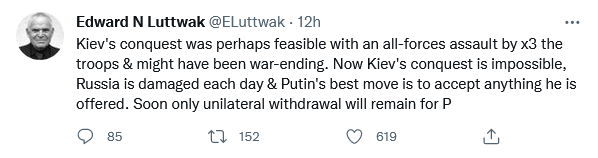 From The Institute For the Study of War:
Russian Offensive Campaign Assessment, March 18
Mason Clark, George Barros, and Kateryna Stepanenko
March 18, 5:30pm ET
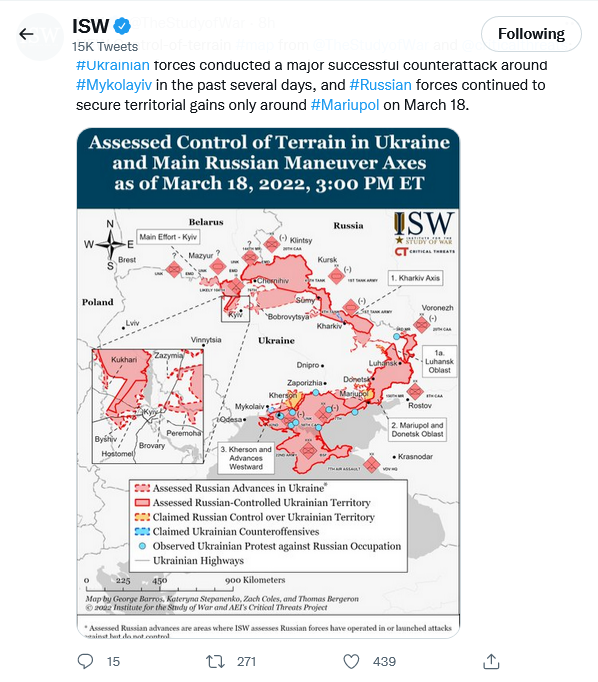
Ukrainian forces conducted a major successful counterattack around Mykolayiv in the past several days, and Russian forces continued to secure territorial gains only around Mariupol on March 18. Russian forces face growing morale and supply problems, including growing reports of self-mutilation among Russian troops to avoid deployment to Ukraine and shortages of key guided munitions. The Ukrainian General Staff continued to report on March 18 that Russia has failed to achieve its strategic objectives in Ukraine, including destroying the Ukrainian Armed Forces, capturing Kyiv, and establishing control over Ukraine to the east bank of the Dnipro River—the first time the Ukrainian General Staff included this territorial conquest as an explicit Russian objective.[1] The Ukrainian General Staff additionally stated that Ukrainian forces “continue step by step to liberate the temporarily occupied territory of Ukraine in all directions” on March 18, the first Ukrainian mention of conducting counterattacks “in all directions.”[2]
Key Takeaways
- The Ukrainian General Staff reported that Russia has “significantly exhausted its human resources” due to battle casualties, cases of self-mutilation to avoid deployment, and psychological factors.
- Ukrainian forces likely conducted a successful counteroffensive against Russian forces around Mykolayiv in the past several days.
- The ability of Ukrainian forces to conduct a successful major counterattack indicates Russian forces attempting to encircle Mykolayiv likely overstretched, and Russian forces are unlikely to have the capability to resume offensive operations toward Odesa in the near term.
- Russian forces did not conduct any offensive operations northwest or northeast of Kyiv on March 18.
- Russian forces continue to make steady progress reducing the Mariupol pocket.
- Ukrainian forces halted a Russian attempt to advance southeast of Kharkiv, through the city of Izyum, in the past 24 hours. Russia is deploying additional reserves to reinforce the Kharkiv axis of advance.
- Russian and proxy forces made minor territorial gains north of the city of Severodonetsk in Luhansk Oblast and will likely assault the city itself in the next 24-48 hours.
- Ukrainian military intelligence created an official website to provide support and guidance to Ukrainian fighters and civilians in Russian-occupied territory.
The Ukrainian General Staff reported Russia has “significantly exhausted its human resources” due to battle casualties, cases of self-mutilation to avoid deployment, and psychological factors.[3] The General Staff stated Russia is having to take “extreme matters in matters of staffing,” including deploying, conscripts, cadets, and mercenaries from Syria.[4] Ukrainian intelligence reported approximately 130 personnel of the 20th Motor Rifle Division (of the 8th Combined Arms Army) refused to deploy to Ukraine and participate in combat operations at an unspecified time.[5] The Ukrainian General Staff additionally reported the Kremlin plans to remove Colonel Vadym Pankov, commander of the 45th Special Brigade due to his ”failure to perform a combat mission at Hostomel airfield”—possibly referring to Russia’s failed airborne landing at Hostomel in the first 72 hours of the war.[6] This is the first confirmed dismissal of a Russian general for their performance in Ukraine. The Ukrainian General Staff stated on March 17 that Russia has already recruited 1,000 personnel from Syria, with the main requirement to have experience in urban combat.[7] The Ukrainian General Staff also reported the Kremlin shifted Russia’s military-industrial complex involved in producing Kalibr and MLRS “Tornado” ammunition to “around-the-clock” production due to the “consumption of almost all missile ammunition” as of March 18.[8]
Russian forces are escalating repressive measures in areas of occupied Ukraine in response to mounting Ukrainian attacks behind Russian lines. The Ukrainian General Staff reported that Russian forces are attempting to establish a “strict administrative and police regime” in several areas while also attempting to “create a positive image” by distributing food to the civilian population.[9] The General Staff additionally stated Russian forces are actively searching for and detaining “pro-Ukrainian activists, civil servants, members of the [Ukrainian military] and members of their families, as well as other citizens who may organize resistance to the occupation.”[10]
The Ukrainian Military Intelligence Directorate (GUR) announced the creation of an official website for the “Center for National Resistance” on March 18.[11] The GUR said the center will “support and coordinate all those who want to fight for the liberation of Ukraine from the Russian invaders” and will be run by Ukrainian Special Operations forces. The website includes guidance on urban warfare and other information for Ukrainian fighters and civilians in occupied territory. The head of President Zelensky’s office, Oleksiy Arestovych, additionally called on civilians to destroy railways in the occupied territories to stage a “rail war” on March 17.[12]
Go here to read the rest. From Strategy Page:
One of the great mysteries of the Russian military failure in Ukraine was revealed in 2021 when Russian state-controlled media gave details of the experience Russian pilots and ground forces officers gained in Syria. Russia believed time spent in the Syrian combat zone would prove to be invaluable in any future war as 90 percent of Russian military pilots now have combat experience. Since 2015 many pilots have flown over a hundred combat sorties in Syria and a few of them over 400. This would account for so many Russian aircraft types showing up in Syria, sometimes in small numbers for short periods. Russia had earlier revealed that they combat tested a lot of new equipment and weapons in Syria, enabling the new gear to use a sales inducement of “combat tested”.
Russian aircraft flew over 40,000 sorties in Syria so far, so there was plenty of work for Russian pilots to get some combat experience. There was one catch, most of the sorties did not involve engaging the enemy. In Syria that meant lots of reconnaissance sorties and combat sorties where there was no combat, as in nothing to bomb or weather that prevented such attacks. The combat experience of the pilots wasn’t all that dangerous because there were no enemy aircraft while the Islamic terrorists and irregulars below only had short range anti-aircraft weapons like heavy machine-guns and some portable heat-seeking surface-to-air missiles that were out of date compared to the missile defenses in Russian helicopters and fixed wing aircraft. Many of the targets in Syria were rebels Russia was trying to force out of Syria. Most of the combat experience came in the form of finding designated targets and bombing them, often with unguided bombs that had to be dropped from low altitudes.
As of late 2021, nearly 70,000 Russian troops had served in Syria, many more than once. Both pilots and ground troops served in Syria for short periods, like three to six months at a time. Since Russia had been in Syria for six years, a growing number of Russian pilots and ground forces officers have served more than one tour.
Russia also confirmed that promising ground forces officers were also sent to Syria for some combat experience and currently most of the commanders and chiefs of staff of units from battalion size up to the divisions, armies and military districts have had some experience in Syria. For the ground force officers the experience often meant going into action as advisors to Syrian officers. This was often in the form of Russian officers leading by example because most Syrian officers had become reluctant to lead their troops into combat due to heavy casualties the Syrian army has suffered since 2011. Russia special operations officers got the most combat experience because they led Russia spetsnaz commandos on combat missions and took a few casualties.
By late 2021 Russia had over 100,000 troops on the Ukraine border and in Crimea with more units arriving every week. Ukrainian intelligence analysts estimated there would be 150,000 Russian troops in position to attack Ukraine in late February or early March.
Ukrainian intel officials were already explaining why and how Russia was serious about completing their takeover of Ukraine. The initial 2014 effort was partially successful but has been stalled since late 2014 in Donbas. Ukrainians have long warned that the Russians were not giving up on their plans to reincorporate Ukraine into Russia and rebuild the Russian empire that communist misrule destroyed in 1991. Russia spins their rebuilding of the Russian empire as necessary for peace in the region because the current official Russian version of the collapse of the Soviet Union in 1991 was that this event was a tragedy that must be fixed.
As the Ukrainians saw it the new Russia offensive would use a collection of older tactics to create a plan, and a force currently gathered on the Ukrainian borders, to destroy Ukrainian independence. The offensive, if it happened, would take place in early 2022. Ukraine deduced from Russian media and past experience that Russia believed it has persuaded enough NATO, especially German, politicians that Ukraine was not worth going to war over, and that the Americans would not be reliable allies in any efforts to prevent or assist Ukraine against a Russian invasion.
The key to the Russian strategy was demoralization and multiple armed incursions that would overwhelm Ukrainian ability to handle the situation and further demoralize Ukrainians. Russia currently had enough troops deployed on the Ukraine borders to form and carry out fifty or more simultaneous attacks using their BTGs (Battalion Task Groups), advancing into Ukraine from different locations along the northern border as well as from the larger garrison now stationed in Russian occupied Crimea. Each BTG had about 800 troops and the ones advancing into Ukraine were composed of volunteer troops. Most of the 170 Russian BTGs in the Russian ground forces have some conscripts, which by law there are not allowed to be used in a combat zone except in defense of Russia.
Reformers in the Russian military had proposed the use of BTGs as far back as World War II and experimented with the concept frequently since then. This included implementing a form of the BTG to lead an advance of their forces into western Europe. The Cold War version was called a ROD or Route Opening Detachment and could be as large as a battalion. The ROD was used during training but never in action.
BTGs were used with some success in Afghanistan during the 1980s, especially if the BTG contained a lot of veteran or elite (airborne or special operations) troops. Some BTGs were used during the 2008 Russian invasion of Georgia in the Caucasus. The BTGs proved more effective than larger units and a series of reforms for the Russian military after 2008 included forming many BTGs. Russia did not use many regular combat units to take over Crimea and Donbas in 2014. Despite that, dozens of BTGs were available in case they were needed. Russia expanded their available BTGs from 96 in 2014 to 125 by 2018 and 170 by 2021. By late 2021 Ukraine estimated that there were 56 BTGs on their borders, all of them “combat ready”, meaning no conscripts and led by officers with experience in Syria.
The mass use of BTGs in Ukraine failed, and not just because the Ukrainians were well aware of BTGs, but because the Russians had not taken into account Ukrainian preparations to deal with an offensive composed of those. Ukraine reported that 15 days after the invasion (March 10th) they had destroyed or rendered useless for combat 31 BTGs. The remaining BTGs were outnumbered by Ukrainian defenders using tactics designed to destroy or neutralize BTGs.
Captured Russian plans indicated the Russian expected the war to be over after 15 days with Kyiv captured and a new, Russian controlled government installed. That plan was based on the assumption that most Ukrainians would not actively oppose the Russians and that many would welcome the Russians as liberators. This was a major failure of Russian military intelligence, especially the FSB (successor to the KGB) which had an active network of informants and operatives inside Ukraine even before 2014. This was reported on by the Ukrainians, usually when announcing the arrest and identification of another Russian agent. Such matters were denied by Russia but the FSB was encouraged by Russian leaders to put a positive spin on what was going on inside Ukraine between 2014 and 2022. By early March the reality of the situation was obvious and two senior FSB officials were put under house arrest while their degree of guilt was determined. The guilt probably belongs to senior officials who received the FSB intel and made adjustments to make sure Putin saw what he expected.
The Russians also underestimated the NATO response to the invasion. NATO nations sent in thousands of highly effective ant-tank and anti-aircraft weapons that played a major role in neutralizing or destroying most of the BTGs used for the invasion and crippling Russian efforts to keep their BTGs supplied. Russia knew about the American Javelin ATGM (anti-tank guided missiles) which had been regularly destroying the most modern Russian armored vehicles for over a decade, especially in Syria and Iraq. The Russians apparently assumed that the American Stinger portable anti-aircraft missile had not changed much since it was first used to cripple Russian helicopter operations in Afghanistan during the 1980s. By 2022 Russian helicopters and transport aircraft were equipped to defeat the 1980s Stinger, but not the 2022 version which, because of many upgrades, was able to destroy Russian helicopters and aircraft used in Ukraine. Russia had about 500 attack and transport helicopters available for the Ukraine invasion but, when Ukrainian forces began taking down these helicopters, Russia used them much less. So far about 20 percent of these 500 Russian helicopters have been destroyed and small teams of Ukrainians using Javelins and Stingers are operating closer to the Russian border to halt resupply operations. Russia has now reverted to more traditional methods and ordered their troops to forage (loot) to survive and kill any Ukrainian civilians who resist. The war is no longer considered a liberation but a conquest of hostile territory.
The original Russian plan depended on demoralization of Ukrainian forces and economic collapse from a Russian blockade of the coastline and most of the land borders. NATO aid was not expected to be a major factor and, when that turned out to be wrong the Putin’s response was a threat of nuclear war. This caused Putin to lose a lot more support within his own military and security services, as well as the general public. Ukrainians believe that the Russian obsession with preventing Ukraine from joining NATO has been the root cause of all this aggression against an independent Ukraine. Russia wants to make it clear that Ukrainians would be safer from this violence if they were part of Russia, and not an annoying neighbor.
This Ukrainian intel assessment proved far more accurate than the Russian one when it came to describing capabilities of troops and weapons. It was no secret that Ukraine had reorganized its ground forces since 2014 and by 2021 had 250,000 troops on active duty with most (80 percent) in the ground forces. Conscription was halted in 2013, but revived in 2014 because of the continued Russian invasion threat. Ukraine has several hundred thousand men with military experience who can be called up, armed, and organized into units to deal with a major emergency. The ground forces also include about 10,000 special operations and airborne/airmobile troops. Russia has many agents inside Ukraine, knew of the growing reserve and paramilitary forces and the enthusiasm of Ukrainians to obtain military training to defend their independence. Russia has a lot of reluctant conscripts which means a large portion of their ground forces are untrained or poorly trained for offensive or special operations. Russia is putting most of its few effective units into the new Ukrainian offensive.
President Putin later made matters worse by reinterpreting the agreements that dissolved the Soviet Union in 1991 and the use of Western assistance to deal with Soviet nuclear weapons outside of Russia. Putin now insists these new nations owe Russia large debts because Russia paid off all the Soviet foreign debts when the Soviet Union dissolved and that was part of the deal to avoid civil war, where it was assumed NATO and others would back many of the potential Russian Civil War factions. This has always been the justification for Russian claims on Ukraine but now are being applied to the Baltic States, three small nations that got free of the Soviet Union and joined NATO. Putin is threatening NATO members, who have a mutual defense agreement. If Russia attacks a NATO member, all NATO members are obliged to join a defensive effort. Putin has always wanted to rebuild the “Russian Empire”, which the monarchy (czars) had created and completed during the 1800s.
Putin refused to face the fact that when the Soviet Union broke up in 1991, it was because half the population willingly went to the 14 new countries and most of those people were quite enthusiastic about ending the Soviet Union and their domination by that empire. The Soviet Union was basically the Russian Empire cobbled together by the old czarist monarchy over more than two centuries of conquest and expansion. Thus, half the Soviet Union population felt like conquered people, not part of any union. The Soviet Union dissolved quickly in 1990-91 because over half the population really wanted it to happen and had wanted it for a long time.
Go here to read the rest. A short description of this War that I have heard is that going into the War most people thought that the Russians had the second most capable military in the world. Now it is becoming apparent that the Russians, certainly as to their ground troops, have the second most capable military in Ukraine.

