
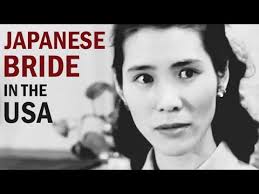
Fascinating film made by the Army in 1952 looking at a Japanese war bride. Some 50,000 Japanese women married American servicemen and returned with them to the States in the years following World War II. I recall a couple in Paris, Illinois when I was growing up. Despite what must have been a large culture shock they seemed to blend in well with the local community. Some 300,000 war brides, and their children, from Allied and former Axis countries, would arrive in the US by 1948.


My maternal grandmother was a war bride. She met my grandfather when he was stationed near Bristol, corresponded with him while he was in Europe, became engaged and married when he returned to Britain, and came to the U.S. on the Queen Mary.
I remember a Japanese war bride in my central lower Michigan county when I was growing up. She and her husband were nice folks. Later on, when it sunk in, I could only marvel at their love and her courage.
We also had a Wehrmacht radioman and his wife, along with the survivor of a Polish cavalry company which was decimated in 1939–and his wife, whom he met in a Ukrainian prison camp run by the Nazis. All within a 10 mile radius of the center of the Mitten.
And that’s before I mention the steady stream of Mexican former migrant workers who liked the area and decided to settle in, increasingly marrying up with the locals.
And they say rural life isn’t diverse.
The good thing about rural life is that if you are married to a local you are normally rapidly accepted. Other newcomers, it can take a while longer.
True. Hard to play “us vs. them” when them are us, to use bad grammar.
As I was growing up in California, I had a friend whose dad had been drafted into the Wehrmacht as a teenager. He was wounded by a British machine gun and somehow ended up stationed in Norway. He had scars on his face and scalp from those wounds. He married a Norwegian woman. Needless to say, they couldn’t stay in Norway after the war and moved to Iceland. From there they emigrated to the US. They were a devout Catholic family. The father worked as a Volkswagen mechanic. He was very kind and abhorred the idea of war after what he saw of it. So I suppose he had a war bride he brought to the US as well.
A fair number of German POWs settled in the US after the War, liking the country from what they saw of it in captivity. I knew one who was with a scouting unit that saw the spires of the Kremlin in 1941. He told me he would prefer to be a bum in the US to being a king in Europe.
I recently watched a great food documentary about Thai women who married US Servicemen who were stationed in Vietnam during the Vietnam War. A large community settled in Las Vegas. It’s a long way from home for them to go from a country which is hot and tropical with a close-knit family community, to a city that is very sparse and dry and where they could not identify faces that were similar to theirs which they could relate to. Not to mention the homesickness they would have felt not being able to find ingredients for food that they grew up with. Would not have been easy. The husbands, I gathered were good men and the marriages lasted.