
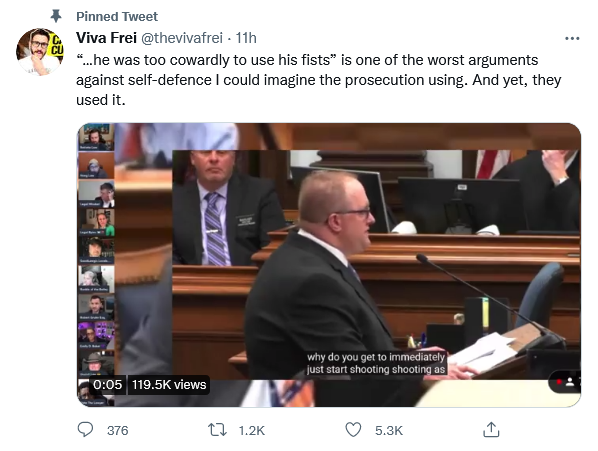
Today the Rittenhouse jury will begin deliberations. How juries function is pretty much left up to them. Usually all the statutes say is that they will elect a foreman or forewoman. That person will take care of any communications that are done with the bailiff usually stationed close to the closed door room in which the deliberations occur. They bring with them, in most states, their notes they have made during the trial, a copy of the jury instructions and they can view any trial exhibits admitted into evidence they wish, including videos Any questions they have are communicated to the bailiff, and then to the Judge, who will round up counsel and the Defendant, and decide how to answer any questions with input from the counsel. Often the Judge’s response will be for them simply to continue their deliberations. If a jury says it is deadlocked, the court can declare a mistrial or instruct the jury to continue their deliberations. Judges hate declaring mistrials and having to do the same thing all over again at a later date.
Juries conduct their deliberations as they see fit, usually with discussions followed by votes. Sometimes members of juries will declare their minds made up and refuse to engage in the discussions. That is their right. Jurors can be disqualified even after a jury begins to deliberate. For example, if a juror says that he or she has violated the court’s instructions about not viewing news accounts of the trial. If that occurs, the Judge will decide what to do after questioning the juror in the presence of counsel. If it is a serious violation of the court’s instructions, the Judge can dismiss that juror and order an alternate juror to take the dismissed juror’s place.
After the jury announces that they have reached a verdict, the Judge summons counsel and the Defendant. The jury is brought into court. The Judge reads silently the written verdict forms the jurors have completed. Then he asks the jury foreman or forewoman if the jury has reached a verdict. Then, going one by one through the applicable charges, the Judge asks what the verdict on each charge is. Either side may ask the Judge to poll the jury. The Judge then asks each juror in turn if the verdict reflects their individual determination.
In a criminal case a quick verdict will usually be thought good for the prosecution. In this case I think a swift verdict will be good for the defense.
Yesterday the instructions were read. They came across as confusing as read, and were some seventy pages in length. It has been my personal belief that jurors pay little heed to the instructions, viewing most of them as so much legal gobbledygook and I think this trial will be firmly in that category. Attorneys and judges often have difficulty construing really elaborate instructions and expecting non-legally trained jurors to do so is a triumph of legal theory over reality. I think most juries rely upon their experiences in life and common sense in reaching their decisions and, overall, that is probably as it should be.
In a blow to the prosecutors the Judge dismissed the gun charge, since the statute clearly did not prevent a 17 year old in Wisconsin from carrying a rifle.
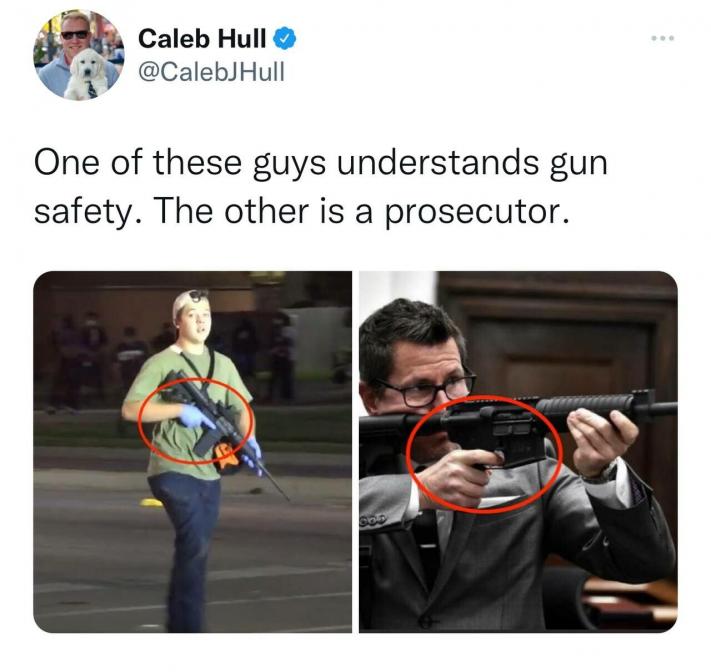
The closing arguments were a disaster for the prosecution and a triumph for the defense. Prosecutor Binger lied his way through the first portion of the State’s argument, blatantly misstating both evidence and the law and doing little to hide the type of attorney arrogance that most jurors find repulsive. His entire argument took on a surreal quality, especially when he pointed the AR-15 of Rittenhouse, with his finger on the trigger, at the jury. Go here for a review of a few, just a few, of the lowlights in Binger’s argument.
I have been highly critical of lead defense counsel Mark Richards, but he rose magnificently to the occasion in the defense closing argument. He began his closing by calling Binger a liar, a completely accurate statement. Binger objected and the Judge shrugged his shoulders and said it was argument. Richards then gave a devastating review of the evidence in the case, ridiculing throughout the prosecution’s contention that this was not a clear case of self defense. At one juncture Richards used a tape measure to demonstrate to the jury how short a distance Rosenbaum was from Rittenhouse when he lunged for the rifle held by Rittenhouse. Richards was greatly helped by how one sided the evidence in the case is, but he went through it with the jury with passion, accuracy and an appeal to their collective common sense.
Assistant prosecutor Kraus gave the closing for the State. I have seen many bad performances in court in my 39 years, but nothing to compare to the jaw-droppingly bad performance of Mr. Kraus. He seemed to be mad at the jurors, correctly, no doubt, concluding that the prosecution’s case had been destroyed in their eyes, and his disjointed and emotional arguments made little sense. His comment that Sometimes you just have to take a beating, was only a good argument if he was attempting to make, satirically, an argument for self defense. An abysmal example of how not to make a closing argument.
We shall soon see if the jurors shared my evaluation of the closing arguments.
Go here for a live feed of the proceedings today, although there will be little to see until the jurors complete their deliberations although, no doubt, there should be a fair amount of attorney commentary to fill in the time.
A recap of what happened yesterday:
Update:
No verdict today. Rumors are floating that the jury is divided 10-2. Jury deliberations will resume at 9:00 AM tomorrow.


Drew Hernandez was on Tim Pool last night talking about the trial and his testimony.
https://youtu.be/RWid0uENPM0
“Sometimes you just have to take a beating.”
And, if there’s any justice (and common sense), the prosecution is about to find that out firsthand…
“Sometimes you just have to take a beating.”
This was implicit in the arguments of George Zimmerman’s detractors (made explicit by one of them, career conservative Daniel Flynn). Implicit also in the arguments of his portside detractors was the notion that Trayvon Martin had a franchise to beat up people who annoyed him. The notional that antifa owns the streets was implicit in Binger’s points.