
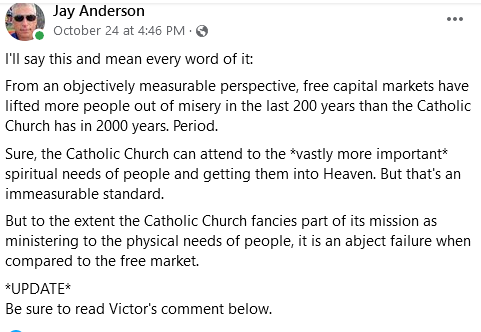
I think CST is conceptually flawed on economics because churchmen think in moral terms, not economic terms. But … (1) economics is the science of commodity relationships, which are definitionally among strangers who do not love each another.* The Church, by its nature, conceives of all human relationships as guided by love and measured accordingly; (2) the Church itself, even in the economic realm, runs on love (i.e., donations), which among other things means economic incentives and profit are a foreign language to churchmen; and (3) the Church’s rejection of consequentialism makes churchmen blind to such paradoxes as the virtue of self-interest.
Or as Adam Smith put it (this addresses all three points, but most directly (3) ) … “it is not from the benevolence of the butcher, the brewer, or the baker that we expect our dinner, but from their regard to their own self-interest. We address ourselves not to their humanity but to their self-love, and never talk to them of our own necessities, but of their advantages.”
When I read Aquinas devote a whole question in the Summa to “Whether it is wrong to sell a thing for more than it is worth?” I kept saying, “but … but … but…” and I couldn’t take anything he said on the topic seriously. I was unknowingly working from the Austrian premise that a thing’s worth is the equilibrium between the seller’s and purchaser’s desires, meaning things have no “value” and the very notion of a “just price” is conceptually and facially absurd.
Pope Leo XIII (and then obv. Pope St. John Paul II) condemned communism and socialism per se (which also condemning the excesses and flaws of capitalism, which obv. exist), but that was not because those ideologies were economically inefficient or unproductive, but because of their view of human nature and their inevitable oppressive politics. It also helps one see the difference between communism/socialism and capitalism that the communists and socialists of their times and places forthrightly hated the Church.
* This isn’t to say that friends don’t engage in commodity relationships. They obviously do (splitting the tab at a bar, for example). But those relationships are still guided first by the love in the overall relationship (in this example, it’s rude to carry things to the last penny and people frequently cover one another, just because.)
Victor John Morton
Free markets make for less physical poverty in this Vale of Tears. Made an end in themselves they do nothing to alleviate the spiritual poverty common in this Vale of Tears. Adam Smith teaches me how the economic world works; the Church teaches me how to go to Heaven. Stick to your own knitting is very trite and very true.


Christians, engaged in Capitalism, should change the world!
The problem with CST as manifest in Rerum Novarum and Quadragesimo Anno is that it assumes a set of social relationships that are relict where they exist at all. If you were Mr. Lapham of Johnny Tremaine and had your daughter-in-law, your granddaughters, and a trio of bonded apprentices living in your home and eating at your table (one of whom you were fixing to marry off to one of those granddaughters), some of the discussion of employer-employee relationships might make some sense. The closest you get to that in most occidental countries in the last four generations would be live-in domestic servants. Nowadays, you only see that in eldercare situations.
So it’s a work in progress. (Francis, I’m sure, has no clue how to generate even a work in progress).
Not sure why Jay Anderson is fixated on capital markets. Improvements in material comfort arise from technological innovation and improvements in the organization of work. I’d put a four-figure sum on the proposition that the financial sector is shot-through with principal-agent problems and rent-seeking. The late Lester Thurow used to say the economy was suffering from human resources being diverted from the shop floor to the counting house, and I suspect he was right.
I apologize in advance.
The Seat of St. Peter is infallible in matters of faith and morals, not agriculture, banking, climate, economics, finances.
Certainly [it’s historical fact], free markets are good for economic development, growth and prosperity. The Catholic Church was good for eternal salvation.
However, “free capital markets” are a quaint history from the 19th century. Since 1913 when the Fed and IRS sprang full-armed from Wall Street’s and progressives’ collective numb skull [Classical reference], the markets incrementally have been functions of bureaucrats, central bankers/planners, and politicians, with insider ‘capitalists’ massively profiting from the big rigs.
And, they didn’t [as advertised] abolish the business cycle, they subverted markets to spread the wealth among all of the above.
Again, I apologize.
Part of what bugs me is that communism is still allowed to frame the debate. Among socialists and communists, their view is a totality one – when their economic system is put in place it will solve ALL problems. (It may even stop hair loss in men.)
The classical conservative idea is that capitalism is good for a very narrow area. It can feed and clothe you, but it can’t give you meaning, it can’t save your soul. So often the debate gets dragged into the weeds with capitalism being accused and condemned for not accomplishing things which conservatives don’t even believe it should try to accomplish.
Sometimes I really can’t tell if you’re doing a bit or honestly not getting it.
Cura animarum has vanished from most episcopal radars.
It really is a spiritual hospice for most of them these days. Just keep the sheep comfortable.
Sometimes I really can’t tell if you’re doing a bit or honestly not getting it.
What am I ‘not getting’?
Nate-
the very term “capitalism” is communism framing the debate.
The word was created as a straw-man, exactly because there wasn’t a word for “not communism.”
Of course “everything that isn’t a flavor of communism” is going to have a wide range of results!
“… the very term “capitalism” is communism framing the debate.”
Great point, Foxfier.
I think Victor’s got it. Capitalist relationships are just, but they don’t have to be loving. God is capable of perfect justice and perfect love, but that’s something beyond our comprehension. I think we’re supposed to treat the requirements of justice as an OT or natural minimum, and then love beyond that. Communism fancies itself to be short-term unjust but long-term loving.
However, “free capital markets” are a quaint history from the 19th century. Since 1913 when the Fed and IRS sprang full-armed from Wall Street’s and progressives’ collective numb skull [Classical reference], the markets incrementally have been functions of bureaucrats, central bankers/planners, and politicians, with insider ‘capitalists’ massively profiting from the big rigs.
There is no central planning of capital allocation and a gold standard is begging for disaster.
Art,
I love you, man.
Can you imagine a worse disaster than the one into which we are hurtling?
[…] Novena to St. Martin de Porres for Healing, Race Relations, & More. . . – Scott Smith, J.D. Free Markets Have Raised More People Out of Poverty Than The Church – The American Catholic This St. Joseph Children’s Book Should Be on Every Kid’s Shelf […]
Jay is using of the term “free capital markets” as a stand-in for “free exchange of goods and services” economy, not the financial sector. You’re the only one bringing up banks and wall street out of nowhere when nobody else was talking about it.
Yes but now that communism (curses be upon it) exists, it is necessary to distinguish not-communism. While I would more prefer “command-markets” vs “free-markets” I’m not in charge of language so capitalism will have to suffice.
The flaw is ever that the government CANNOT love you. The church can, but not the government.
Yes but now that communism (curses be upon it) exists, it is necessary to distinguish not-communism. While I would more prefer “command-markets” vs “free-markets” I’m not in charge of language so capitalism will have to suffice.
Depending on the realm of a conversation, it can be useful to describe what communism actually is— say, “financial totalitarianism” and when people start punching at “capitalism” point out that “not financial* totalitarianism” is a very wide range of options, just as there’s no one word for any other system meaning “everything but totalitarianism.”
It’s not useful all the time, but keeping it in mind and having the arrow in your quiver to knock someone out of their equivocating patter is useful.
Not bad, foxfier, I’ll try to remember some of them. Though somedays when you hate yourself you’ll have to poke around on breadtube or its twitter accounts to see just how insane modern communists can get.
:thumbs up:
I think I’ll stick to things less frustrating.
Like getting math through to the Highly Dramatic pre-teens in my life…..
Jay is using of the term “free capital markets” as a stand-in for “free exchange of goods and services” economy, not the financial sector.
That’s an idiosyncratic usage of the term ‘capital markets’
I’d wish you luck but I’m sure you are in more need of divine intervention. I wonder if getting money involved would help them learn it… [insert one of my favorite Goof Troop episodes here]
Not really, it’s in pretty common internet usage. But even if you want to be pedantic about it, it’s pretty clear from the CONTEXT of the rest of his comment (where he later uses the term “free market”) as well as Victor’s comment (which Jay endorsed) what the intent of the term was even if sloppy thinking or a mischievous autocorrect resulted in something slightly different.