
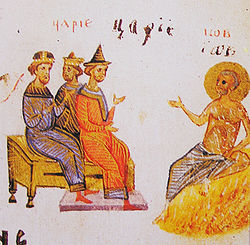
The third friend of Job now speaks, Sophar. He repeats the earlier arguments that Job is being punished for his sins. He emphasizes the omnipotence of God and that Job in his blindness might not recognize the gravity of his sins:
Because he thought there was some hidden secret in God’s wisdom which had not yet been revealed to Job, he strengthens this opinion in what follows trying to make it so sure that Job cannot deny it saying, “You will not perhaps understand the footprints of God.” Footprints are signs of someone walking on a road. So the works of God are called his road and the production of creatures by God is understood as a kind of procession of God in his creatures inasmuch as the divine good derived from him in whom it exists simply and in the highest sense proceeds from him by degrees to effects when higher creatures are understood to be better than lower creatures. Therefore, the footprints of God are certain signs found in creatures by which God can be known in a certain sense through his creatures. But since the human mind cannot totally and perfectly understand creatures in themselves, much less can it have perfect knowledge about the Creator himself. Therefore, he then asks, “and will you discover the truth even about the perfect Omnipotence of God?” as if to say: If you cannot know creatures perfectly, much less can you know the Creator. He says plainly “will you discover” because reason proceeds by a certain process of investigation from effects to cause and as soon as reason knows the causes through the effects we are said to discover it.
One should also not be surprised if the Creator is not known if creatures are not perfectly understood, because even if creatures were perfectly known, the Creator would still not be. For a cause can only be perfectly known through it effects when the effects equal in power to the cause. This cannot be attributed to God. So he continues, “He is higher than the heaven and what will you do? He is deeper than hell and from what will you know him? He is longer than the earth in measure and wider than the sea.” He says these things metaphorically. For he does not mean that God, who is incorporeal, is divided into corporeal dimensions, but he describes the greatness of his power using the metaphor of the great size of a body. This is because no matter how great the quantities of bodies seem to be in height, depth, length or breadth, they are still deficient if compared to the greatness of the power of God who can make greater things. So he plainly attributed “omnipotence” to God before (v.7). From this he shows that God cannot be discovered perfectly in his creatures, because even given the fact that all creatures were perfectly known, one cannot know the power equal to that of God adequately from them. Can one take a measure to know the power of God which exceeds every creature? He clarifies this difficulty when he says, “what will you do?” and “from what can you know him?”
Divine power not only exceeds every being in producing them, but also in preserving them in being. For the preservation of a creature is only from God and there is no power in the creature which could resist the divine will if he does not will to preserve the creature itself any more. So he continues, “If he wills to sweep them all away,” by reducing them to nothing, i.e. by taking away their being, “or draw them together into mass,” by confusing them when he takes away the order which distinguishes things, “who will contradict him?” i.e. what power of the creature will be able to so contrary to his will. To preclude someone from arguing that although nothing could be preserved in being except through him as if he is duty-bound, he next rejects this argument saying, “Or who can say to him: Why did you do this?” as though he were trying to require an explanation by him about some duty which he overlooked.
Go here to read the rest. The gulf between God and Man is so great that it can only be bridged by God’s love.


“The gulf between God and Man is so great that it can only be bridged by love.” Too true, and very well said. That is why the infinite God became man and gave everything he had to corrupt, finite, undeserving man. He did it out of love. It shows us finite beings, like nothing else could, the effects of the infinite. Our God is amazing. Thanks for this post, Don. May you have a blessed Lent.
A blessed Lent to you too F7. I recall at the funeral of my son when I was sunk in a black depression, I suddenly felt a sense of joy and peace I have never known before or sense. I know it was God allowing Larry to grant me a minute fraction of what he was experiencing in Heaven. God’s love for us is something we so often forget.