Donald R. McClarey
Cradle Catholic. Active in the pro-life movement since 1973. Father of three, one in Heaven, and happily married for 43 years. Small town lawyer and amateur historian. Former president of the board of directors of the local crisis pregnancy center for a decade.
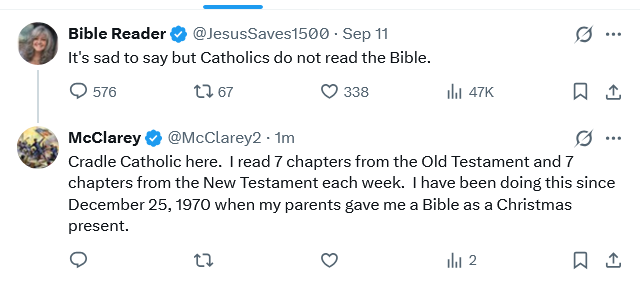


Catholics do not read Protestants’ interpretation of the Bible
Protestants only read 66/73rds of the bible
Some pages in the Protestant Bible apparently get stuck together. They can’t seem to find John 6 or Matthew 16.
One could certainly just drop the ever useful “Quod gratis asseritur, gratis negatur.”
At any rate, I grew up in evangelical churches that placed, as any Christian should, a high premium on the Bible, for which I am truly grateful, as a love of Scripture was instilled in me from a very early age.
But at least in my experience, there is almost a “tiered” system that ends up occurring which, to be fair, is probably more indicative of natural human sloth than anything else.
In most of my experiences in evangelical churches, the corporate reading of scripture was not, as far as I can recall, something commonly done. That is, there generally weren’t places within the “liturgy” (such as it was) for scripture readings. Instead, any scripture being read tended to occur within the sermon, which might be based on one passage and reference other passages, but which were more at the service of the exposition rather than an intentional “reading.” More like a massive bible study. The only corporate “readings” I can remember were at the weeks of Advent, maybe at Christmas and Easter.
Those who were more serious about the Bible would then get involved in Bible studies which would vary widely in quality depending on the group. Sometimes you’d get in-depth study, but more often in my experience it was food and chat time.
The there was the higher lay-person level where you had your daily devotional (reminiscent in some ways to a very low-grade Divine Office) in which one would read a passage or two and some commentary on it, and then, if you go even further, personal Bible-study time on a more structured or time-intensive basis.
I think if you went to your average evangelical, you’d find most of them just as ignorant of the Bible as most nominal Catholics. But once you start engaging people who are more serious and devout, you will likely find proportional levels of knowledge on either side.
That is one thing I came to find I loved about the Catholic Church in that the Scriptures were actually proclaimed at Mass. I also fell in love with the Divine Office and all its hours (even Matins, which can be a struggle at 5am!), and particularly came to savor and relish the Psalms. The natural rhythm of reading the Scriptures every day is something transformative, at least for me.
And yet while Scripture is certainly important (and I think reading for 30 minutes has an indulgence attached to it), it is not itself the source and summit of the faith, which at least liturgically distinguishes Catholics and evangelicals. On the other hand, as St. Jerome says, ignorance of Scripture is ignorance of Christ. I think that since we are all generally literate, it is important for us to at least read the Scriptures on a somewhat regular basis and have a basic understanding of them, as our state in life allows. For as our Lord says, to whom much is given, much will be required.
Jason:
The last I heard the time limit for indulgences for reading Holy Scripture was 15 minutes.
The Catholic Church guided by the Holy Spirit interprets Holy Scripture for all.
Pray for grace and clarity.
Bible Reader must believe in the Chick tract version of Catholicism.