Donald R. McClarey
Cradle Catholic. Active in the pro-life movement since 1973. Father of three, one in Heaven, and happily married for 43 years. Small town lawyer and amateur historian. Former president of the board of directors of the local crisis pregnancy center for a decade.
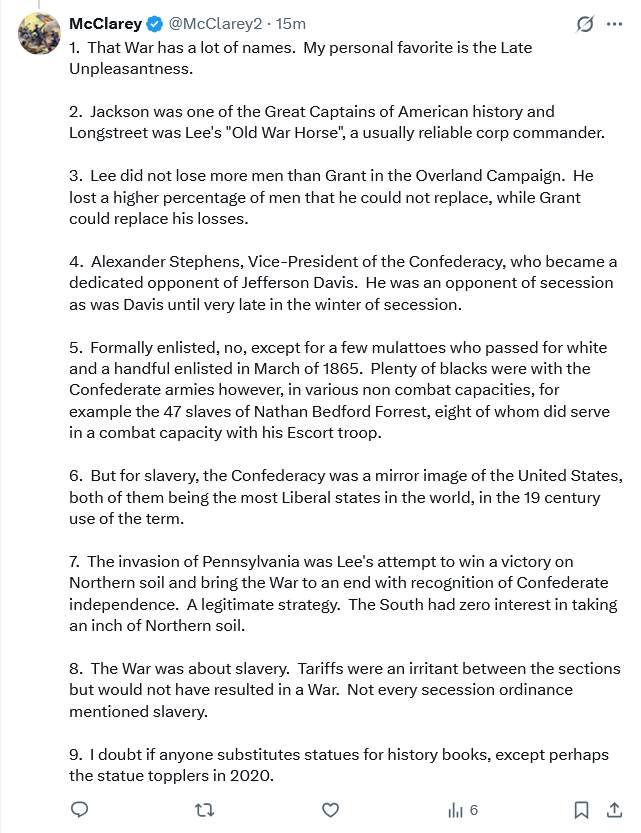
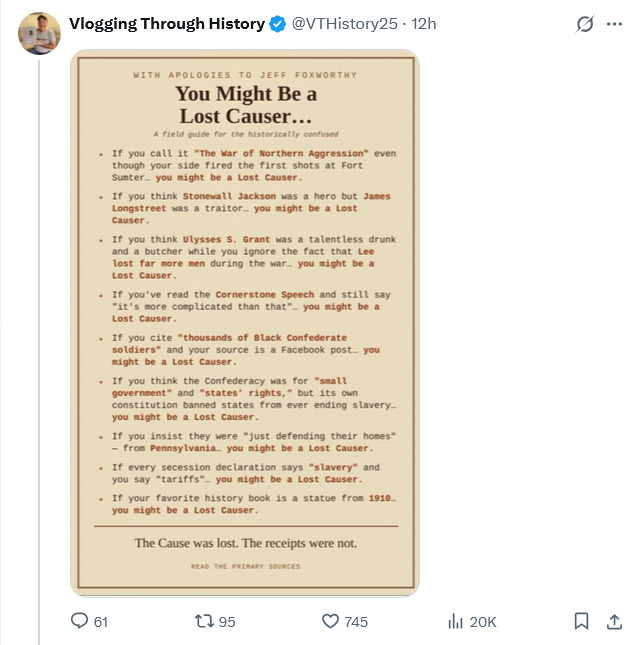



Excellent post, particularly in its recognition of the centrality of slavery as a basic issue of the Civil War. Summary: Grant won, Lee lost, at a terrible cost.
I’ve seen people refuse to watch The Outlaw Josey Wales because Josey fights for the confederacy in the opening acts. The belief is that each and every confederate was irredeemably evil.
Similarly I’ve seen Das Boot dismissed as something that only exists to make the Nazis look like the good guys.
Modern discourse has put all views into solely good and solely bad, making historical discourse impossible.
Lincoln dealt with such prejudice in his speech about slavery on October 16, 1854 in Peoria:
Before proceeding, let me say I think I have no prejudice against the Southern people. They are just what we would be in their situation. If slavery did not now exist amongst them, they would not introduce it. If it did now exist amongst us, we should not instantly give it up. This I believe of the masses north and south. Doubtless there are individuals, on both sides, who would not hold slaves under any circumstances; and others who would gladly introduce slavery anew, if it were out of existence. We know that some southern men do free their slaves, go north, and become tip-top abolitionists; while some northern ones go south, and become most cruel slave-masters.
Lincoln could always put himself in the other man’s shoes, and that capacity for empathy is one of the beginnings of wisdom, as well as a useful trait for any trial attorney.
If the war was about slavery, why didn’t Lincoln free the slaves in the North? Why did Lincoln support the Corwin Amendment to the U.S. Constitution, which would have protected slavery?
Why did Lincoln state:
“My paramount object in this struggle, is to save the Union, and is not either to save or to destroy slavery. If I could save the Union without freeing any slave I would do it..” ( Lincoln wrote these words in an August 22, 1862, letter to Horace Greeley to explain that preserving the Union was his top priority in the war)
There weren’t any slaves in the North, all Northern states having abolished slavery prior to the War. There were slaves in the border states of Missouri, Kentucky, Maryland and Delaware and Lincoln was not going to give the Confederacy a gift by inflaming sentiment in those states against the Union in 1862. Slavery was duly abolished in those states by the Thirteenth Amendment which Lincoln shepherded through Congress in early 1865 and which became part of the Constitution after his death on December 18, 1865.
Lincoln unenthusiastically endorsed the Corwin Amendment which passed Congress on March 2, 1861, under the outgoing Buchanan administration, as a sop to the South in order to attempt to avoid civil war. With the coming of the War little more was heard of what has been called the phantom thirteenth amendment.
Lincoln wrote as he did because he viewed his paramount duty to be the preservation of the Union. At the time he wrote to Greeley he had the Emancipation Proclamation in his desk, just waiting big Union victory to announce it, which he did after the battle of Antietam. The whole letter to Greeley on slavery is as follows:
Executive Mansion,
Washington, August 22, 1862.
Hon. Horace Greeley:
Dear Sir.
I have just read yours of the 19th. addressed to myself through the New-York Tribune. If there be in it any statements, or assumptions of fact, which I may know to be erroneous, I do not, now and here, controvert them. If there be in it any inferences which I may believe to be falsely drawn, I do not now and here, argue against them. If there be perceptable in it an impatient and dictatorial tone, I waive it in deference to an old friend, whose heart I have always supposed to be right.
As to the policy I “seem to be pursuing” as you say, I have not meant to leave any one in doubt.
I would save the Union. I would save it the shortest way under the Constitution. The sooner the national authority can be restored; the nearer the Union will be “the Union as it was.” If there be those who would not save the Union, unless they could at the same time save slavery, I do not agree with them. If there be those who would not save the Union unless they could at the same time destroy slavery, I do not agree with them. My paramount object in this struggle is to save the Union, and is not either to save or to destroy slavery. If I could save the Union without freeing any slave I would do it, and if I could save it by freeing all the slaves I would do it; and if I could save it by freeing some and leaving others alone I would also do that. What I do about slavery, and the colored race, I do because I believe it helps to save the Union; and what I forbear, I forbear because I do not believe it would help to save the Union. I shall do less whenever I shall believe what I am doing hurts the cause, and I shall do more whenever I shall believe doing more will help the cause. I shall try to correct errors when shown to be errors; and I shall adopt new views so fast as they shall appear to be true views.
I have here stated my purpose according to my view of official duty; and I intend no modification of my oft-expressed personal wish that all men every where could be free.
Yours,
A. Lincoln.
I can’t find the reply button, but I wanted to point out that Donald is wrong about Lincoln. Lincoln was the president of the United States, which at the time still included slave-holding states like Maryland, Kentucky, Delaware, Missouri, and West Virginia. He was fully recognized as their president. As the quote Donald used aptly demonstrates, Lincoln cared first and foremost about saving the Union, not the plight of Black people. Honestly, I’m glad Donald wasn’t around when the 13 colonies seceded from England—he probably would have fought for the British just to preserve the union!
As the quote Donald used aptly demonstrates, Lincoln cared first and foremost about saving the Union, not the plight of Black people.
As opposed to those keeping them as slaves? Sure. (sarc off.) As President, Lincoln saw his primary duty as preserving the Union, which was always the foremost war aim of the people of the United States of America. Confederate sympathizers would have loved for Lincoln to order the abolition of slavery in the border states and force them into the arms of the Confederacy. Lincoln did not oblige them. Additionally, Lincoln had no power to abolish slavery in the border states, but only within the bounds of the rebel states under his war powers, which, after the War, courts might have found he did not have the power to do. Lincoln understood that, which is why he successfully pushed for the Thirteenth Amendment abolishing slavery.
https://www.youtube.com/watch?v=SFcMRXVfWOQ