Did lack of material possessions by contemporary standards mean we were unhappy? Rather the reverse. The attempt to rewrite the past in order to serve current political agendas is always a red flag for those who knew the past personally.
Donald R. McClarey
Cradle Catholic. Active in the pro-life movement since 1973. Father of three, one in Heaven, and happily married for 43 years. Small town lawyer and amateur historian. Former president of the board of directors of the local crisis pregnancy center for a decade.
didn’t have an x-box or PlayStation but i had a hockey stick for street hockey, a basketball, a chess board and a ten-speed bike -what more could a young man want-
we’re so impoverished today. you can drive through entire neighborhoods and see no children outside.
Lead kindly light
Sunday, August 9, AD 2026 5:40am
One of my first bosses told me when I was asking for a raise, “You don’t own things; they own you.” At the time I thought he was just trying to avoid giving me a raise which he actually did give, but the older I’ve gotten and the more things I have, the more I think that’s true. There’s a peaceful simplicity about not owning things. Matt 6:33.
back during the depression 1930’s our family used to eat out once a week even though money was hard to come by…that was before fast food.
Art Deco
Sunday, August 9, AD 2026 6:52am
Not sure with whom you’re arguing.
==
There’s a paleo-right strand who fancy that national income accounting is some sort of scam and that standards of living were at their peak around 1975. The leftoid equivalent contend that all the gains in production and consumption have been enjoyed only by those living above the median. That would entail income distribution figures rather different than those we actually have.
==
The decay you see over time is social, psychological, aesthetic, and moral. The improvements are technological. I’m favorable to a couple which have arisen in the last fifty years: (1) automobiles are a great deal more reliable and durable and (2) cancer treatments are notably more effective. I’m also pleased police forces have technological tools which have appeared in recent decades as well, though some of them are creepy.
Art Deco
Sunday, August 9, AD 2026 7:02am
My family ca. 1970 ate out sparingly, less due to cost and more due to it being a habit my mother never acquired in her youth. She did not acquire it in part due to the general standard of living of the era (manifested before and after the Depression), in part due to the Depression, in part due to wartime rationing, and in part because her mother actually enjoyed cooking. Living alone in her 60s, she could have afforded to eat out, but ate at home; companionship was to be had by inviting some of her gal pals over for dinner.
Philip Nachazel
Sunday, August 9, AD 2026 7:13am
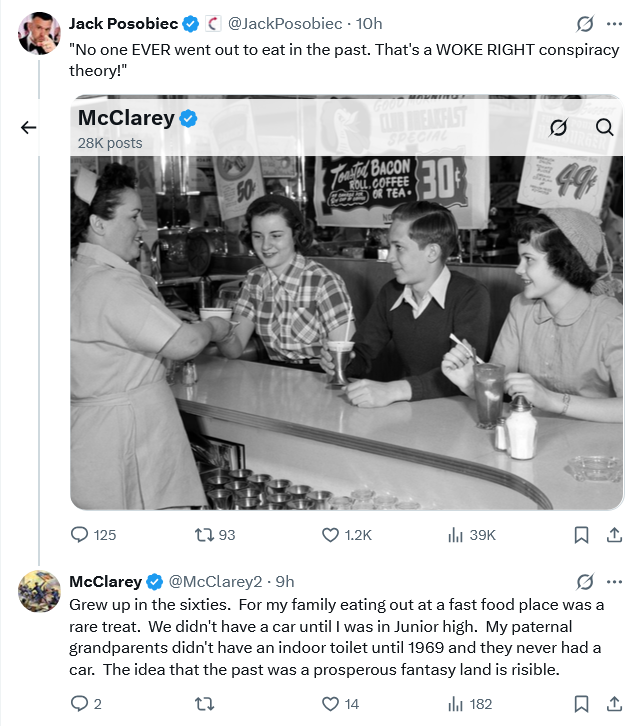
“No one EVER went out to eat in the past.”
Bill Knapp’s ~ A&W Rootbeer ~ International House of Pancakes ~ Elias Brothers Big Boy.
What are you saying?
Did these businesses just spring up like weeds and became self supporting without selling one piece of pie?
My parents raised five boys.
A huge treat was a coneydog and a mug of root beer at A&W. Gee. Others were there too, enjoying their night out.
Josh
Sunday, August 9, AD 2026 8:25am
I re-read the post and comments about five times and I’m with Art – not sure where this is directed at, but alas…
I find we have gotten a twin scourge of nostalgia and sentimentalism growing within certain sectors. The biggest effect seems to be this sanitizing of the past, which is what I *think* Don is reacting to in Poso’s tweet.
Both of those things (nostalgia and sentimentalism) work in small doses and as medicine. It seems that too many have decided those things ought to be *sustenance* rather than medicinal. I also find it interesting it comes from people like Poso, who is younger than I am and never lived through the times he wishes to return (Francoist Spain, apparently).
The post is aimed at pretend conservatives like Posobiec who claim that in some mythical past in the US in the 1950s and 1960s that life was easy economically for all, and that nefarious forces have taken this away from the current under thirties. The thesis is utter and complete crap. I trust that my position is plain enough now?
Josh
Sunday, August 9, AD 2026 10:25am
Don,
That’s completely fair (and clarifying!). I was more sympathetic to Poso in the past, but his recent nutterings about how great Francoist Spain was and what you rightly point out about some mythological golden age has made me stop following his crap on social media. No one has time for that.
Tom Byrne
Sunday, August 9, AD 2026 11:46am
Might be confusing comparative and absolute status. I’m sure that to many adults at the time the 50s looked “golden”, compared with what they dealt with during the Depression and WWII (like the Irish farm-boy who joined the army and couldn’t believe he got to sleep in so late). My late working-class father and other adults constantly reminded us as kids in the 60s about how “these are the best years of your lives” and “you never had it so good”, etc. Yet old photos show our house as pretty sparsely furnished, certainly compared to my grandparents’ in San Francisco and Washington, who had a whole extra generation or more to accumulate staff.
Also, every age has its crosses and roses. Maybe houses cost more compared to salaries right now, but today’s kids have health care for conditions that killed and crippled their grandparents’ classmates, AC everywhere, and instant communication with anyplace they choose.
Last edited 1 month ago by Tom Byrne
Art Deco
Sunday, August 9, AD 2026 12:20pm
I’m not sure why Mr. Posobiec qualifies as a ‘pretend conservative’. I can see taking exception to various things he might say. (I’d also be inclined to defend Franco and Salazar – up to a point). DJT managed to pull the masks off a string of opinion journalists – David French, George Will, Wm. Kristol, and Mona Charen to name a few. You also get people who seem to be suffering some sort of early stage dementia (Tucker Carlson and Ron Unz come to mind). Unless Posobiec has gotten quite peculiar of late, I’m not seeing him in either category.
I wasn’t aware this was some conservative conspiracy theory. I remember by the late 60s and 70s, my parents’ fortunes had definitely improved, as had most in the family and those we knew. While I’m sure the poor have always been with us and always will, I’ve been under the impression for my entire life that the economic boon for the US in the post-war years was more the rule than the exception, and wasn’t a figment of the Depression Era’s imagination. True, we didn’t eat out that much, but it was because of family culture. We just preferred home cooked meals as a matter of course. By the 60s and 70s, the ability to eat out all the time if we wanted was there, we simply chose not to. But I can’t imagine anything helping the post-capitalist cause more than suggesting there never was such a nationwide economic boon. Given where corporations are today, the one card conservatives can play is to point to the benefits the market brought society in the past, in the hope of capturing that again.
Art Deco
Sunday, August 9, AD 2026 12:40pm
The Bureau of Economic Analysis has some data on nominal personal consumption expenditures and ‘food service and accommodations’ expenditures (whcih I assume includes the sum of diner / restaurant checks and hotel bills). The % of personal consumption accounted for by this line item was as follows:
==
1930: 4.7%
==
1962: 6.2%
==
2002: 5.9%
==
2025: 7.1%
Art Deco
Sunday, August 9, AD 2026 12:46pm
I seem to recall John Derbyshire of all people recalling his youth and suggesting that people’s subjective sense of material well being is influenced more by the pace of improvements than by static conditions. The period running from 1949 to 1973 was a period of abnormally rapid economic growth for reasons that I’m not sure have been adequately explained.
Tom Byrne
Sunday, August 9, AD 2026 1:52pm
Art:
I would suggest:
Pent-up demand after 15 years of Depression and war among adults who remembered the prosperity of the 20s.
Rapid growth of population (for family life was one pent-up demand)
A very open field for US manufactures at home and abroad, with the only industry and infrastructure undamaged by the war.
An administration determined that millions of returning service men be productively engaged.
An optimism (sometimes euphoric) borne of winning a great fight, then returning to intact homes and streets (see number 3), a thing the British and other victorious allies did not get to savor.
CAG
Sunday, August 9, AD 2026 1:56pm
Well, I don’t have statistics or studies to back me up, but my conservative nature leads me to think our society was far healthier when families ate home-cooked meals together. I’d even be willing to suggest a causal relationship between the two.
I’d even be willing to conjecture that the ubiquity of screens has contributed to the present sickness of our society … and the common thread is family.
Art Deco
Sunday, August 9, AD 2026 2:10pm
Pent-up demand after 15 years of Depression and war among adults who remembered the prosperity of the 20s.
==
An economist named Casey Mulligan had a blog for a while called “Supply and Demand, in that order”. ‘Pent up demand” might explain the pacing of an economic recovery which takes place over a year or two. It’s not going to explain variations in the pace of economic growth over a generation.
== Rapid growth of population (for family life was one pent-up demand) ==
The population growth rate during the period running from 1950-70 was slower than it was during the period running from 1900 to 1920.
== A very open field for US manufactures at home and abroad, with the only industry and infrastructure undamaged by the war.
==
Wartime reconstruction was complete by 1959.
== An administration determined that millions of returning service men be productively engaged. ==
The employment-to-population ratio was higher after 1973 than it was prior to that. == An optimism (sometimes euphoric) borne of winning a great fight, then returning to intact homes and streets (see number 3), a thing the British and other victorious allies did not get to savor
==
Dunno. Andrew Greeley clamed there was widespread anxiety after the was that the Depression would return, and anxiety which did not dissipate until about 1955. My mother would have told you that around about 1965 public life and mass entertainments began to take on an increasingly disconcerting cast.
“some mythological golden age” is an escape from reality
Rudolph Harrier
Sunday, August 9, AD 2026 10:18pm
This whole debate is bad rhetoric.
If someone says “I used to be able to afford to eat out and now I can’t” saying “in the past there were plenty of people who couldn’t afford to eat out” may be true, but isn’t going to win anyone over to your side. Especially not if you’re running on a platform of national prosperity.
Horn and Hardart, automat, soda fountains, Woolworth lunch counters,
Stewart’s, train car diners. Hotels had fancy restaurants. Streets had food trucks. One guy I know put two sons through college selling hot dogs to truckers.
It all depends on what eating out means.
SouthCoast
Monday, August 10, AD 2026 4:28pm
I remember days of shopping with my Mom and Great-Aunt, happily interrupted by a visit to a “coffee shop”. Not Starbucks. Not fast food. Just a comfortable place where one got a good light meal and a good cup of coffee. Franchised out of existence by progress.



didn’t have an x-box or PlayStation but i had a hockey stick for street hockey, a basketball, a chess board and a ten-speed bike -what more could a young man want-
we’re so impoverished today. you can drive through entire neighborhoods and see no children outside.
One of my first bosses told me when I was asking for a raise, “You don’t own things; they own you.” At the time I thought he was just trying to avoid giving me a raise which he actually did give, but the older I’ve gotten and the more things I have, the more I think that’s true. There’s a peaceful simplicity about not owning things. Matt 6:33.
back during the depression 1930’s our family used to eat out once a week even though money was hard to come by…that was before fast food.
Not sure with whom you’re arguing.
==
There’s a paleo-right strand who fancy that national income accounting is some sort of scam and that standards of living were at their peak around 1975. The leftoid equivalent contend that all the gains in production and consumption have been enjoyed only by those living above the median. That would entail income distribution figures rather different than those we actually have.
==
The decay you see over time is social, psychological, aesthetic, and moral. The improvements are technological. I’m favorable to a couple which have arisen in the last fifty years: (1) automobiles are a great deal more reliable and durable and (2) cancer treatments are notably more effective. I’m also pleased police forces have technological tools which have appeared in recent decades as well, though some of them are creepy.
My family ca. 1970 ate out sparingly, less due to cost and more due to it being a habit my mother never acquired in her youth. She did not acquire it in part due to the general standard of living of the era (manifested before and after the Depression), in part due to the Depression, in part due to wartime rationing, and in part because her mother actually enjoyed cooking. Living alone in her 60s, she could have afforded to eat out, but ate at home; companionship was to be had by inviting some of her gal pals over for dinner.
“No one EVER went out to eat in the past.”
Bill Knapp’s ~ A&W Rootbeer ~ International House of Pancakes ~ Elias Brothers Big Boy.
What are you saying?
Did these businesses just spring up like weeds and became self supporting without selling one piece of pie?
My parents raised five boys.
A huge treat was a coneydog and a mug of root beer at A&W. Gee. Others were there too, enjoying their night out.
I re-read the post and comments about five times and I’m with Art – not sure where this is directed at, but alas…
I find we have gotten a twin scourge of nostalgia and sentimentalism growing within certain sectors. The biggest effect seems to be this sanitizing of the past, which is what I *think* Don is reacting to in Poso’s tweet.
Both of those things (nostalgia and sentimentalism) work in small doses and as medicine. It seems that too many have decided those things ought to be *sustenance* rather than medicinal. I also find it interesting it comes from people like Poso, who is younger than I am and never lived through the times he wishes to return (Francoist Spain, apparently).
The post is aimed at pretend conservatives like Posobiec who claim that in some mythical past in the US in the 1950s and 1960s that life was easy economically for all, and that nefarious forces have taken this away from the current under thirties. The thesis is utter and complete crap. I trust that my position is plain enough now?
Don,
That’s completely fair (and clarifying!). I was more sympathetic to Poso in the past, but his recent nutterings about how great Francoist Spain was and what you rightly point out about some mythological golden age has made me stop following his crap on social media. No one has time for that.
Might be confusing comparative and absolute status. I’m sure that to many adults at the time the 50s looked “golden”, compared with what they dealt with during the Depression and WWII (like the Irish farm-boy who joined the army and couldn’t believe he got to sleep in so late). My late working-class father and other adults constantly reminded us as kids in the 60s about how “these are the best years of your lives” and “you never had it so good”, etc. Yet old photos show our house as pretty sparsely furnished, certainly compared to my grandparents’ in San Francisco and Washington, who had a whole extra generation or more to accumulate staff.
Also, every age has its crosses and roses. Maybe houses cost more compared to salaries right now, but today’s kids have health care for conditions that killed and crippled their grandparents’ classmates, AC everywhere, and instant communication with anyplace they choose.
I’m not sure why Mr. Posobiec qualifies as a ‘pretend conservative’. I can see taking exception to various things he might say. (I’d also be inclined to defend Franco and Salazar – up to a point). DJT managed to pull the masks off a string of opinion journalists – David French, George Will, Wm. Kristol, and Mona Charen to name a few. You also get people who seem to be suffering some sort of early stage dementia (Tucker Carlson and Ron Unz come to mind). Unless Posobiec has gotten quite peculiar of late, I’m not seeing him in either category.
I wasn’t aware this was some conservative conspiracy theory. I remember by the late 60s and 70s, my parents’ fortunes had definitely improved, as had most in the family and those we knew. While I’m sure the poor have always been with us and always will, I’ve been under the impression for my entire life that the economic boon for the US in the post-war years was more the rule than the exception, and wasn’t a figment of the Depression Era’s imagination. True, we didn’t eat out that much, but it was because of family culture. We just preferred home cooked meals as a matter of course. By the 60s and 70s, the ability to eat out all the time if we wanted was there, we simply chose not to. But I can’t imagine anything helping the post-capitalist cause more than suggesting there never was such a nationwide economic boon. Given where corporations are today, the one card conservatives can play is to point to the benefits the market brought society in the past, in the hope of capturing that again.
The Bureau of Economic Analysis has some data on nominal personal consumption expenditures and ‘food service and accommodations’ expenditures (whcih I assume includes the sum of diner / restaurant checks and hotel bills). The % of personal consumption accounted for by this line item was as follows:
==
1930: 4.7%
==
1962: 6.2%
==
2002: 5.9%
==
2025: 7.1%
I seem to recall John Derbyshire of all people recalling his youth and suggesting that people’s subjective sense of material well being is influenced more by the pace of improvements than by static conditions. The period running from 1949 to 1973 was a period of abnormally rapid economic growth for reasons that I’m not sure have been adequately explained.
Art:
I would suggest:
Well, I don’t have statistics or studies to back me up, but my conservative nature leads me to think our society was far healthier when families ate home-cooked meals together. I’d even be willing to suggest a causal relationship between the two.
I’d even be willing to conjecture that the ubiquity of screens has contributed to the present sickness of our society … and the common thread is family.
Pent-up demand after 15 years of Depression and war among adults who remembered the prosperity of the 20s.
==
An economist named Casey Mulligan had a blog for a while called “Supply and Demand, in that order”. ‘Pent up demand” might explain the pacing of an economic recovery which takes place over a year or two. It’s not going to explain variations in the pace of economic growth over a generation.
==
Rapid growth of population (for family life was one pent-up demand)
==
The population growth rate during the period running from 1950-70 was slower than it was during the period running from 1900 to 1920.
==
A very open field for US manufactures at home and abroad, with the only industry and infrastructure undamaged by the war.
==
Wartime reconstruction was complete by 1959.
==
An administration determined that millions of returning service men be productively engaged.
==
The employment-to-population ratio was higher after 1973 than it was prior to that.
==
An optimism (sometimes euphoric) borne of winning a great fight, then returning to intact homes and streets (see number 3), a thing the British and other victorious allies did not get to savor
==
Dunno. Andrew Greeley clamed there was widespread anxiety after the was that the Depression would return, and anxiety which did not dissipate until about 1955. My mother would have told you that around about 1965 public life and mass entertainments began to take on an increasingly disconcerting cast.
“some mythological golden age”
is an escape from reality
This whole debate is bad rhetoric.
If someone says “I used to be able to afford to eat out and now I can’t” saying “in the past there were plenty of people who couldn’t afford to eat out” may be true, but isn’t going to win anyone over to your side. Especially not if you’re running on a platform of national prosperity.
Horn and Hardart, automat, soda fountains, Woolworth lunch counters,
Stewart’s, train car diners. Hotels had fancy restaurants. Streets had food trucks. One guy I know put two sons through college selling hot dogs to truckers.
It all depends on what eating out means.
I remember days of shopping with my Mom and Great-Aunt, happily interrupted by a visit to a “coffee shop”. Not Starbucks. Not fast food. Just a comfortable place where one got a good light meal and a good cup of coffee. Franchised out of existence by progress.