
Now, you’ll show up at my place first Monday after schools out at 5:00 a.m. And come with grit teeth, ‘cuz gentlemen, that’s when school really begins.
Wil Andersen (John Wayne) Cowboys (1972) screenplay
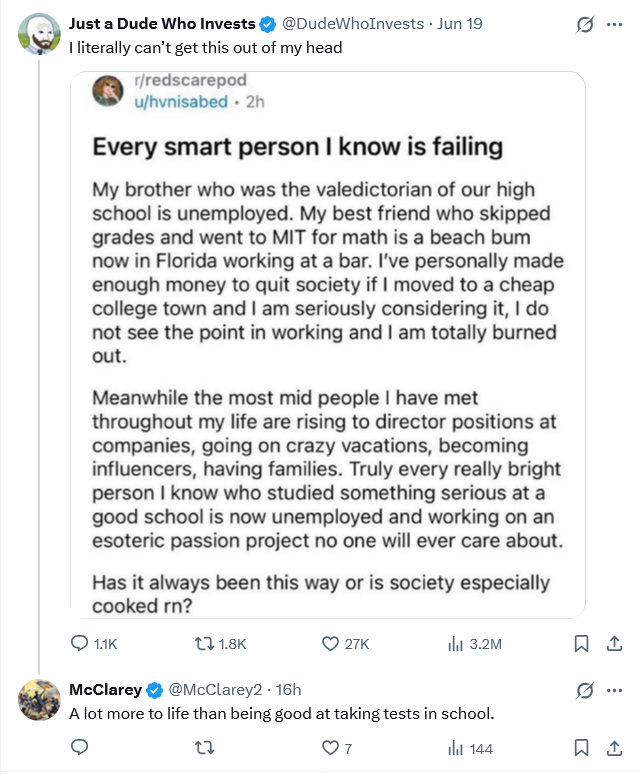
Things like courage, empathy, risk taking, not being a jerk, honesty, original thinking, writing and speaking clearly, grace under pressure and a lot more. When it came to taking tests in school, I was good at memorization and following instructions. After I began practicing law I swiftly learned that both those qualities were of limited utility.


“tests only test what test’s test…”
my father
I loved taking tests and was good at it also. But, life’s tests are much harder and you can fail even with the right answers.
I will take entire class periods with my upperclassmen a few times every year and dispense with the planned topic and just talk about the vicissitudes of life and what is needed for success – and it isn’t merely writing down the correct answers.
I will get the occasional message from a former student (who are now as old as 38-39) telling me how something I said or told them made a difference, and it wasn’t even a theology point. And truth be told, it almost never is.
MIT doesn’t even offer an advanced degree in beachbumology, and yet this math major didn’t let that disadvantage stand in his way! When the cards were stacked against him, he picked himself up by his bootstraps, took the initiative, applied himself and persevered! THAT, my friends, is American exceptionalism!! Bravo!!
I suspect its the luck of the draw in his case, or his memory has cherry picked a few people and forgotten the rest.
==
I can recall a couple of people I grew up with who have had handsome corporate careers. Neither were the smartest kid in the class, but they were just one ratchet down. The smartest kid I knew is an academic physicist who has published scads of papers. I know he’s been on faculties in San Diego and Tampa / St. Petersburg, but cannot locate him. He’s not in service or emeritus anywhere I can see.
==
My mother’s high school published class rankings in its yearbook. My mother was unwilling to discuss it much, beyond saying she’d known the fellow who graduated 2d out of 350 and had no memory of the fellow who’d graduated at the top of the class. Decades later, I remembered his name and searched for it. He’d died in 2020; the obituary provided scant clues as to what he’d done with his life between the ages of 17 and 34 other than the loci where he’d earned degrees done research toward his dissertation and a two year stint in the military. He’d spent 30-odd years as a psychology professor at a state research university, after which he landed some sinecure at one of the lesser professional schools at Harvard. He completed a dissertation at age 33, published a monograph at age 64. Per Google Scholar, he contributed to a scatter of research studies (I’m guessing PsychInfo would locate more than that). He had children, grandchildren, and great grandchildren at the end of his life.
The old teacher says: it’s average vs individual. Take 100 guys with high SATs and another 100 with middling SATs and the average achievements of the first group will undoubtedly top the average of the second, but there’ll be plenty of outliers. That’s why Conant and Chauncey, who championed the tests, never wanted them used to compare individual but only group scores. They wanted a check on the grading schemes of different high schools sending their seniors to the same colleges. So if, on average, kids with the same grades at two schools have comparable SATs, grading polices are comparable. Any difference suggests grade inflation or simply poor standards (and that, my dears, is why the ed establishment hates standardized testing).