
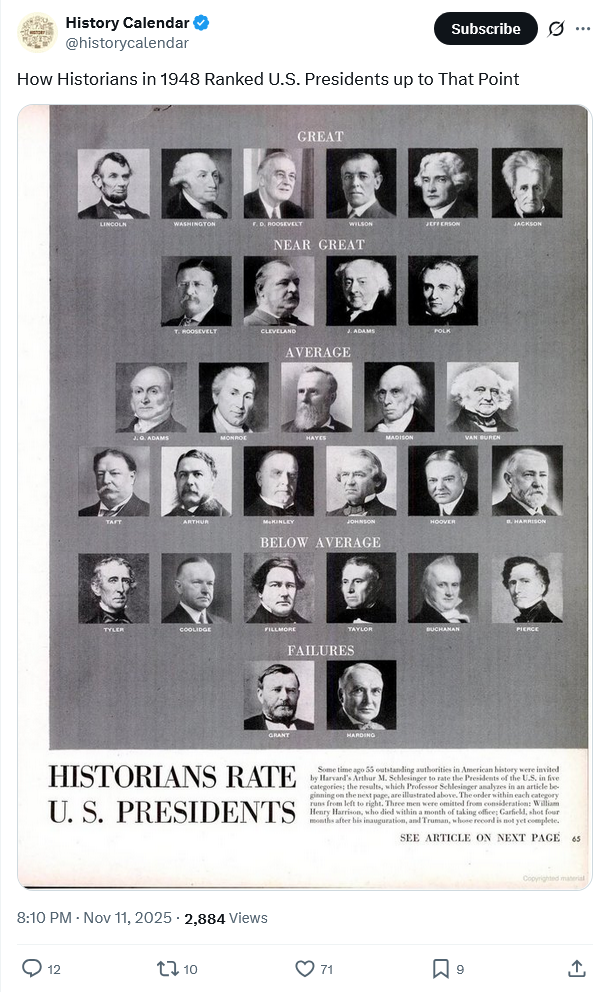
Interesting. How historical reputations have changed over almost eight decades! It should be noted that Arthur Schlesinger, forgotten today, was an ardent Democrat and a so-so historian.
Washington and Lincoln at the top few would quibble with, other than neo-Confederates in reference to Lincoln. Roosevelt would still be, much more controversially, in the top tier. Few presidents are much more hated by the right and the left than Wilson, and he would be lucky not to find himself at the bottom, the same, to a lesser extent, with Jackson. I would put Jackson at near great and Wilson among the average. Jefferson makes the top tier almost entirely due to the Louisiana Purchase. Democrats, until the day before yesterday in historical terms, had Jefferson-Jackson day dinners around the nation, celebrating both men, Jefferson erroneously, and Jackson correctly, as the founders of their party.
I think the near great are all solid choices, although our current Leftist dominated historians would have little good to say about any of them. TR was a force of nature, and his achievements of the Panama Canal, as well as giving the US a world class Navy, have stood the test of time. Cleveland was a fine example of a now extinct species, the conservative Democrat, more conservative than any elected politician today. John Adams demonstrated that power could pass peacefully after the election of 1800, our most divisive presidential election not designated by the year 1860. Polk led the country to victory in the Mexican War, fulfilled all of his campaign promises, retired after his one term, and had the good manners to die almost immediately thereafter.
I also don’t find a lot to quibble with in the Average category. I would put McKinley in the Near Great slot and Johnson among the failures.
Below Average. Tyler set the mold for what happens when a President dies. For that I would boost him to average, along with his bringing Texas into the Union. Coolidge deserves to be Average or Near Great, presiding over perhaps the best economy the country has ever had. Pierce and Buchanan both earned failure slots, as “Dough Faces”, Northern politicians with Southern sympathies, who both helped to bring on the great catastrophe of the Civil War.
Failures: both Grant and Harding deserve higher slots. Corruption in their administrations got them to the lowest rung, but neither were personally corrupt and both men had accomplishments that should not be ignored. I would put them at the top of failures or at the bottom of average. Grant has been getting very good press lately, due to our current racial obsessions and also due to raw ignorance about his two terms.
Go here and here to read my ratings of Presidents back in 2012. Biden, if he can be considered to be a president, I would put near the bottom. Trump would be incomplete at the present.


I see James Garfield is not on the list at all. I supposed because he was assassinated 3 months into his term. I just watched “Death by Lightening” about James Garfield on Netflix which is really very good. I recommend it.
Yeah, the three short termers due to death are omitted. DBL has its points, but the use of contemporary profanity and attitudes is jarring, and any historical value in the series is purely accidental.
Obama and Biden, tied for dead last.
As the voting block dissolves into a pit of uneducated and unreasonable voters, I’m afraid that Biden and Obama may have to share in the ratings come 2032 or beyond. Oh, and if the ACLU gets its way, undocumented and unvetted voters will help deepen that pit where the possibility of The New Socialist State of Amerika slithers into the living rooms of these United States.
[Just look to the east and see the future destroyer of America take his seat as mayor, if support of my opinion needs proof.]
Schlesinger’s disposition was rah-rah for anyone who promoted what he called ‘affirmative government’. I’ll give him points for having no time for the red-haze element in American intellectual life, Noam Chomsky in particular.
==
I suppose I’m indolent, but obsessive rank-ordering strikes me as a waste of effort. In regard to American presidents, you have to assess their objects, assess their contribution as opposed to that of others, assess alternative scenarios. Who has sufficient granular knowledge to do that over a period of nearly two centuries?
==
The Roosevelt administration made a lot of mistakes. One of the ironies of historical memory is that the administration’s detractors outside of academic fora seldom enumerate them and make nonsense utterances (“delayed recovery by eight years:”) or get lost in minutiae (see Amity Schlaes). I suppose I should do the research, but I’ve never seen a speculative piece on the road not taken from March 1933 to December 1941.
Very interesting, Mr. McClarey!
I would argue with you that Harding was not “personally corrupt”. Indeed, he was. He was an unfaithful husband. He was thought to be quite handsome and had a way with the ladies (I don’t see it, myself, but times change). And he actually fathered a daughter out of wedlock while married to his long-suffering wife, Florence, which was confirmed by a DNA test in the daughter’s old age, I believe.
As for Grant, I think the Presidency was something thrust upon him due to his illustrious military career. He was in over his head with the political culture of Washington and the changing political atmosphere surrounding the Reconstruction. Not a bad man but not prepared or with an aptitude for politics.
As for more recent presidents, I think JFK is a bit overrated, possibly due to sentiment and pity for his tragic death. He was not a great president, but I would put him in the Near Great category. He had a lot of challenges – the Cuban Missile Crisis, the Civil Rights movement, Vietnam, and dealing with the lurking anti-Catholicism that infected America. He did his best, I think, but was not always well-advised.
Eisenhower was better than he is given credit for. Like Grant, his incredible military career preceded his political career. He was a good and decent man. In spite of the horrors of WWII, he was generous to the defeated. I think he wanted to always do the decent thing and to protect those in his care. He wasn’t always right all the time, but he, too, did his best. I would put him in the Near Great category as well.
LBJ is also a bit underrated. He was oafish and undiplomatic at times. But it took great moral courage to push through Civil Rights legislation, especially as a Southern born-and-bred politician. He was a disappointment in some ways. But, having been elevated to the Presidency under tragic and unexpected circumstances, he was better prepared than most to assume leadership.
Nixon was a failure. Ford was average. Reagan, definitely Great. GHWB and his son were average (both had great challenges – the Iran War and 9/11 – and led the country well during those times). Clinton and Obama – average (both were good orators and very intelligent, but prone to trusting the wrong people). Trump – TBD. Biden was a failure – surely the Dems could have come up with a better candidate.
Just my two cents. Sorry for the length, but this is such an interesting posting, with very good comments!
I would argue with you that Harding was not “personally corrupt”.
Not in financial matters.
“As for Grant, I think the Presidency was something thrust upon him due to his illustrious military career.”
He tried unsuccessfully to get a third term at the 1880 Republican convention. He was not a reluctant president.
“I think JFK is a bit overrated”
A lot overrated, and from the standpoint of sexual morality probably the worst president we have had.
Eisenhower was better than he is given credit for.
To an extent. His attempt to have the military rely on nukes was mistaken. He was overly reliant on aides, as one would expect from a career military man.
LBJ is also a bit underrated.
Disagree strongly. A big government man who put us on the path to national bankruptcy. Second worst president from the view of sexual morality. Embarked on a war with no plan to win it.
Nixon was a failure. Ford was average. Reagan, definitely Great. GHWB and his son were average
Agreed except as to the shrubs. Shrub the elder and Shrub the younger I would rate as below average.
Clinton and Obama
Agree as to Clinton after the Republicans took Congress in 1994. Obama I would rate as well below average.
At this point, all the consequential officials of the Kennedy, Johnson, and Nixon administrations have died bar Joseph Califano, so we might offer an evaluation.
==
I would give Kennedy kudos for three things. (1) He left Wm Martin in charge of monetary policy who followed a prudent course; fiscal policy was more lax than one might prefer but nowhere near as spendthrift as it was after 1970. (The federal tax code was badly in need of repair). (2) He made the right calls during the Cuban Missile Crisis. (3) He was a fantastic public speaker and his minions adept at public relations. He was a combat veteran, and that counts for a good deal; otherwise, his personal biography is an embarrassment (and his professional biography prior to 1961).
==
Johnson was a very talented man in some circumstances and people close to him seemed to have been fond him in spite of his utter grossness. And people not so close like John Roche and Henry Fairlie were impressed on meeting him. Public sector borrowing was not out of control as it was after 1970. Still, it’s hard to think of an initiative of the administration which wasn’t a failure or in need of restructuring in some major way. The best you can say is that it made graphic was does not work toward any defensible end. NB, the era incorporated catastrophic failures on the part of state and local government as well.
==
Nixon had lots of interesting ideas, few of which came to fruition. He had his share of bad ideas (wage and price controls). He was a crummy administrator as well, something that was true to a degree of all of the presidents who occupied office during the years running from 1961 to 1981. It was during the Nixon years that the country began running large deficits in good years and bad (though Congress bears more of the blame for that). Nixon also put the hopeless Arthur Burns in charge of the Federal Reserve. The administration managed to dismantle LBJ’s ‘Office of Economic Opportunity’, but made little headway at dismantling other Great Society initiatives and is implicated in the advent of the race patronage regime from which we suffer now (which, to be sure, was largely the work of the judiciary). Nixon also made a mess of judicial appointments (see John Dean’s memoir on this point). Nixon also had emotional problems manifest in work situations (evidently not at home). Henry Kissinger, John Dean, William Safire, and Fred Malek have given accounts of what that looked like in real time. Much of the Watergate mess can be attributed to that.
==
One thing to emphasize is that neither Kennedy, Nixon, nor Gerald Ford had ever been in charge of an organization that had a purpose other then to provide service to their person. Johnson had, but his experience was scant and in a situation where operational measures of competence were weak. Jimmy Carter had, but suffered from OCD sufficiently severe that the presidency taxed his administrative skills past the breaking point.