
Of course I did have some good luck. I had a loving, stable family that put my feet on the paths of Faith and knowledge. I was born in the US. I met and married my wonderful Bride and we were blessed with three wonderful kids. No man is an island as John Donne said and the only truly self made man is Christ. The trick is to make the most of what has been given to you, and I hope I have succeeded in that category.
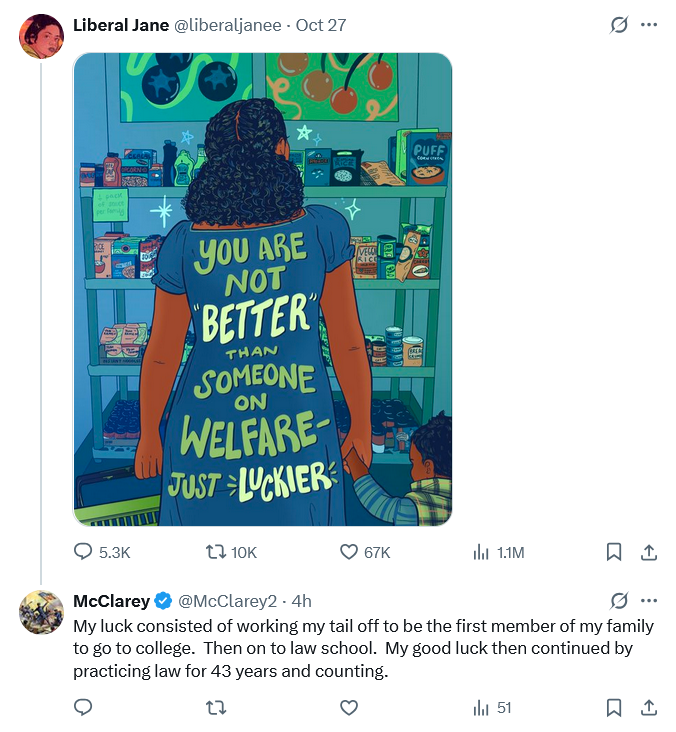


Of course, it would serve us well to keep the phrase “There but by the Grace of God go I” in the forefront of our minds, but the superabundance of Grace must be cooperated with to bear fruit in us. Reducing a failure to cooperate with God’s Grace to “bad luck” is a lame excuse and a copout.
This meme starts out in truth but quickly devolves into envy.
The harder I work, the more luck I have. – Thos. Jefferson
There is no random luck on the way into life, and there are no injustices on the Last Day. I’m not necessarily better or worse than someone else based on our earnings or need for government aid.
The beggar and the donor both need humility.
And as ever, Envy is the emotional driver for those steeped in “progressivism.”
Depends on what you mean by ‘better’. You might say your essential value (inherent in your humanity) is the same no matter who you are. You are ‘better’ if you respect moral norms, ‘better’ if you’re industrious and conscientious, ‘better’ if you control your temper and do not take your upsets out on third parties, ‘better’ if you control your appetites and stay out of debt, ‘better’ if you look for and take advantage of salutary opportunities, ‘better’ if you make sacrifices for others.
==
People’s lives can be wrecked by random chance or by events with a large element of random chance. When the author says ‘luckier’, he’s not referring to an absence of random-strikes from cancer or automobile accidents. They’re referring to who your relatives are and a miscellany of petty events in life. There’s an element of truth in this in ways people like the producer of this cartoon are loath to acknowledge: important and useful traits have a heritable component. There can be an element of truth in it that people have mishaps and are mistreated by others in petty ways. (Please note, though, that the talent of people who have a certain baseline of intelligence to dream up elaborate stories to present the case that the issue of their careless and asinine conduct is the fault of others).
==
The people who babble about ‘welfare’ are pretty vague about to just what they’re referring. At one time it referred to AFDC and general relief. AFDC provided an income to women who (1) got knocked up consequent to their own careless and slovenly behavior and (2) had in so doing spread their legs for men with whom their relationship was unstructured and (with few exceptions) never had any reasonable prospect of being structured. Even in these circumstances, most women coped. They relied on family or they spent a couple of years on AFDC and got back on their feet. Two of the dearest co-workers I’ve had over the years lived that life. Lobbyists for the social work industry and purveyors of feminist blah blah are forever on the look out for opportunities to build patron-client relations, present themselves as experts, scold ordinary people, and extract funds from those who order their lives passably.. Imputing agency to their clients and describing their misconduct in bald terms is a VERY BAD THING and generates much posturing from them. What we discovered after 1996 was something Daniel Patrick Moynihan never anticipated: that you could reduce the welfare rolls by 85% and no social crisis would ensue. Marian Wright Edelman spent decades of her life as a lobbyist for the social work industry and received encomiums all around for doing so; well, she was making the world worse.
==
Appended to this discussion is what Abigail Thernstrom once called the ‘Yale or jail’ mentality. Most people are hourly employees and most people never see the inside of a baccalaureate granting institution. They manage. They have their dissatisfactions in life, but the only social workers who are going to be of any aid to them are those who specialize in career counseling and can tell you what the market looks like in various trades and where you can find training programs.
==
Also appended to this is the idiot babble about ‘privilege’. Privilege means ‘private law’ – i.e. that conventional standards and practices will be set aside to benefit you. People habitually confuse this with having advantages. Some people have many advantages and advantages of consequence and some people do not. The kind of family you grew up in is an advantage which generates other advantages which have a positive effect on productivity. People also confuse privilege with having connections. Connections can generate benefits which do organizations no good. Connections can function like privilege. However, having someone on the inside willing to vouch for you is a salient piece of information in assessing what an organization stands to benefit from hiring you. All markets have imperfect information. Please note that good references have utility for people working in every stratum of the labor market.
If I’m not mistaken, Th. Jefferson had a chronic habit of overspending his income.
Oh yes!
That is your cue Mr. Benet:
Thomas Jefferson,
What do you say
Under the gravestone
Hidden away?
“I was a giver,
I was a molder,
I was a builder
With a strong shoulder.”
Six feet and over,
Large-boned and ruddy,
The eyes grey-hazel
But bright with study.
The big hands clever
With pen and fiddle
And ready, ever,
For any riddle.
From buying empires
To planting ‘taters,
From Declarations
To trick dumb-waiters.
“I liked the people,
The sweat and crowd of them,
Trusted them always
And spoke aloud for them.
“I liked all learning
And wished to share it
Abroad like pollen
For all who merit.
“I liked fine houses
With Greek pilasters,
And built them surely,
My touch a master’s.
“I liked queer gadgets
And secret shelves,
And helping nations
To rule themselves.
“Jealous of others?
Not always candid?
But huge of vision
And open-handed.
“A wild-goose-chaser?
Now and again,
Build Monticello,
You little men!
“Design my plow, sirs,
They use it still,
Or found my college
At Charlottesville.
“And still go questing
New things and thinkers,
And keep as busy
As twenty tinkers.
“While always guarding
The people’s freedom
You need more hands, sir?
I didn’t need ’em.
“They call you rascal?
They called me worse.
You’d do grand things, sir,
But lack the purse?
“I got no riches.
I died a debtor.
I died free-hearted
And that was better.
“For life was freakish
But life was fervent,
And I was always
Life’s willing servant.
“Life, life’s too weighty?
Too long a haul, sir?
I lived past eighty.
I liked it all, sir.”
Cannot think of a more awful place to be in where you have to rely on the State to house and feed you. That should be a motivator to work hard enough to get off that reliance. That and Faith that Our Lord will eventually Bless your efforts towards independence.
Some people enjoy that reliance. Then in that case they have nothing to envy of the next person who doesn’t.
Reasoning with an empty slogan is an exercise in futility. She wears the shirt with the slogan because she cannot support her position in an intellectual manner e.g., she has the wisdom of Jasmine Crockett.
I’ll bet she reads the instructions on a bottle of shampoo.
Mr. McClarey, you were raised as I and my peers were (I am 64). We knew – without being told, because it was in the example of our parents and all those around us – that we would not be given anything. If we wanted to achieve anything in life, we would have to work for it, and work hard,
I have great sympathy for those who are handicapped, disabled, or in unfortunate circumstances beyond their control, especially the physically and mentally disabled.
But for the rest of us, living in the Land of Opportunity, there is always great hope to better ourselves and maintain our dignity by working hard and doing what we can for others not so fortunate, starting with our families and parish families.
When I graduated high school at the age of 17 in 1979, living as I do in NE Ohio, we were on the cusp of the Rust Belt era. The options we had at graduation were to hold down a job while attending university, entering military service (which would hopefully provide university opportunities or a career in the military), or find a job with decent wages in industry. It was a struggle to live as well as our parents did because the well-paying jobs in industry were quickly being outsourced to the South and overseas in an attempt to break the Unions (which were not all bad, and were conversely, not all good). I was fortunate enough to find work at Firestone, which was then still family-owned and the 2nd largest rubber/tire manufacturer in the world. In less than 7 years, I had to scramble to find employment in local government because my job was in danger at Firestone. It hasn’t ever been easy, but our generation for the most part has a great respect for education and a positive work ethic. Most of us did not want to relocate for work – we wanted to remain in our hometowns, near our families, which was another struggle to face. Which explains why I and many of my fellow retirees of the same generation are in demand – we work hard, show up every day, and display loyalty to our employers.
I am sorry to go on so much, but your posting touched me personally. I hope the upcoming generation learns what we learned about the value of hard work and self-respect.
Christopher Lasch once wrote that from reading early 19th century correspondence and literature, he found little discussion of upward mobility (‘freedom to rise’, ‘bettering yourself’) and much concern that every young man find a ‘competence’.
==
Since the era of my great-great grandfathers – three of whom were exemplars of upward mobility – you’ve seen radical evolution in the balance between economic sectors as people moved from agriculture and raw materials processing to town occupations and then from industry to services. You’ve seen a gradual decline in the prevalence of self-employment in town occupations. You’ve seen the rise of formal schooling as a means of sorting the working population. You’ve seen a modest shirt in the ratio of salaried to hourly occupations. You’ve seen a reconstruction of workplace manners as a means of pleasing female employees. However, the arrangement of social strata remain roughly pyramidal, though the contours of the pyramid do change modestly from one era to another. The world of 1955 was more leveled-in than the world of today. There are, however, always, managers, supervisors, and workers.
==
From one generation to the next, you have a bloc of people who ‘rise’ socially, but you also have a bloc of almost equal size who sink socially. It’s not strictly zero sum, as affluent people are less fecund that less-affluent people. Also, you have a secular increase in real incomes, so people who are examples of inter-generational downward mobility may see no decline in their absolute standard of living.
==
The name of the game should be to maintain pathways such that everyone who is able-bodied. of sound mind, and respects rules of proper conduct can build a defensible life for themselves – one where they earn, pay their bills and pay down their debts, raise families, maintain their little corner of the world in satisfactory shape, and aren’t living in squalor as they grow infirm with age. As far as public policy is devoted to fostering that, there’s room for improvement.