
Dear Sir:
I hope you will allow one who, when a boy, laid down his arms at Appomattox and pledged allegiance to the Union, to express his warmest sympathy for you in your suffering. I have watched your movements from the hour you gave me my horse and sword, and told me to ‘go home and assist in making a crop.’ I have been proud to see the nation do you honor, and now, dear General, in the hour of your pain, I weep that so brave, so magnanimous a soul must suffer as you do.
My prayer to God daily is that you may be restored to perfect health, and be assured that I am not the only ex-confederate who sends his prayers daily to the Throne of Grace for the restoration of the grandest, the noblest, the bravest soldier and the purest statesman who ever graced the annals of history. May the God who overlooked you in battle and who has brought you thus far give you grace to meet whatever He has in store for you, and may he restore you to health is the fervent prayer of one who, at fifteen years of age, entered the lists against you and accepted the magnanimous terms you accorded us at Appomattox.”
A. M. Arnold, Rockbridge Baths, Virginia
Letter to Grant, just before his death in 1885.
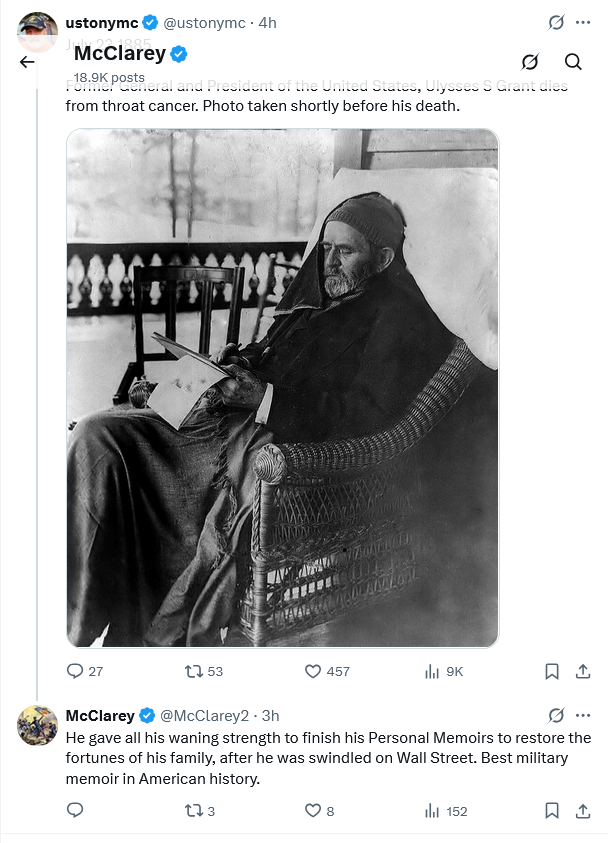
Few men in American history have gone from complete obscurity to being a central figure in the life of the nation faster than Ulysses Simpson Grant. Known as Sam Grant by his West Point friends, his first two initials making Sam an inevitable nickname, Grant had an unerring ability to fail at everything he put his hand to, except for war, his marriage and his last gallant race against the Grim Reaper, as he was dying of cancer, to finish his memoirs and provide financially for his wife and children. Most great figures in our history have known success more than failure. Not so Sam Grant. He would encounter humiliating defeats throughout his life, from beginning to end.
At the beginning of the Civil War, he was a clerk, barely able to support his family. Seemingly a dull plodder, but possessed of iron determination and an uncanny ability to never let the trees obscure the forest; happily married and a firm believer in God, but subject to bouts of depression when he would grasp for the bottle; the shabby little man who, incredibly, ended up winning the greatest war in American history.
His men didn’t hold him in awe as Lee’s men did Lee; Grant was far too common and prosaic a figure for that. However, they did respect him, as this section of Stephen Vincent Benet’s epic poem on the Civil War, John Brown’s Body, indicates:
And, after that, the chunky man from the West,
Stranger to you, not one of the men you loved
As you loved McClellan, a rider with a hard bit,
Takes you and uses you as you could be used,
Wasting you grimly but breaking the hurdle down.
You are never to worship him as you did McClellan,
But at the last you can trust him. He slaughters you
But he sees that you are fed. After sullen Cold Harbor
They call him a butcher and want him out of the saddle,
But you have had other butchers who did not win
And this man wins in the end.
You see him standing,
Reading a map, unperturbed, under heavy fire.
You do not cheer him as the recruits might cheer
But you say “Ulysses doesn’t scare worth a darn.
Ulysses is all right. He can finish the job.”
And at last your long lines go past in the Grand Review
And your legend and his begins and are mixed forever
One private in the Army of the Potomac summed up what Grant meant to them: “At long last, the boss had come.” After Grant died his veterans purchased his excellent Personal Memoirs in droves, making it one of the best sellers of the Nineteenth Century and ensuring the financial security of Grant’s family. His veterans helped their “boss” win his last battle.


That letter from the ex-Confederate soldier brought a tear to my eye.
I finally found my Civil War ancestor this weekend, my paternal 4 times great-grandfather, Stansbury Price, Co. F of the 82nd Ohio Volunteers. He would only fight briefly under Grant at Chattanooga (his regiment came West with the reinforcements after Chickamauga). But I suspect he probably would have shared the sentiments about the man finishing the job.
That letter from the ex-Confederate soldier brought a tear to my eye.
Mine too Dale. Men like him and Grant and Lee, and most veterans North and South, is why our Civil War was not the first of many. The men who went through that terrible furnace wanted to make sure that future generations of Americans would not have to experience what they had experienced. Sad that in our own time too many with loud mouths have forgotten that painful, bloody lesson.
He was a stoic hero, Most of the commentaries on his death are utter scum (speaking as a cancer vicitim).