
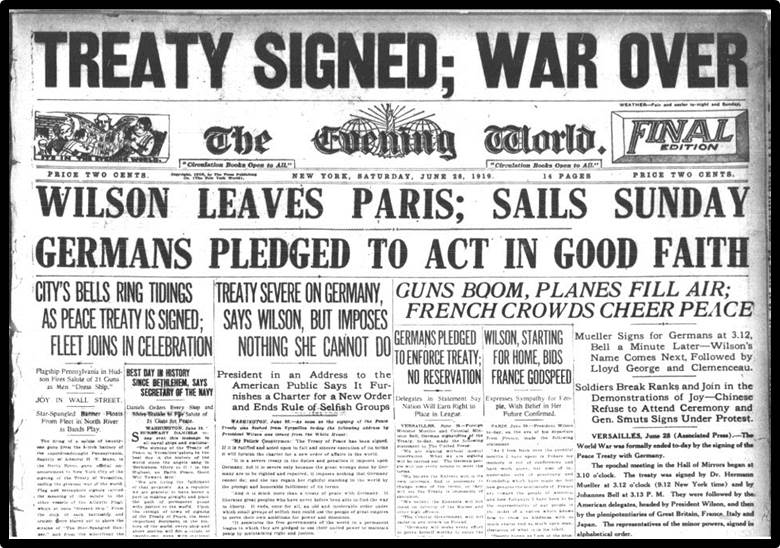
One hundred and six years ago the Treaty of Versailles was signed. It turned out to be a twenty year truce prior to the onset of World War II, but none of the signatories of course knew that at the time. At 198 pages it is a bloated document, never a good sign. It rambles along for 440 articles. Go here to glance at it. Perhaps the man who understood the implications of the Treaty of Versailles best was Marshal Ferdinand Foch, Supreme Commander of the Allied Armies, in 1918 in France and Italy, who thought it was too lenient on Germany. As the treaty was being signed, he remarked: “This is not peace. This is an armistice for twenty years.” Foch died in 1929 at age 77, a decade before he would have learned how much of a prophet he was.


Foch would only count as a ‘prophet’ if the period running from 1919 to 1939 were an integral whole whose political events didn’t incorporate contingency (and if the resultant problems were derived from being too lenient with Germany). It’s not hard to tick-off the unforced errors which discredited the German political elites and provided a conduit for Hitler (who was a nuisance problem prior to 1930).
Foch understood the maxim that the worst thing you can do with a defeated enemy is to hurt him only enough to give him a strong motive for vengeance. Either make a generous peace, or make sure that adversary can never get off the mat again.
Donald:
The “generous peace” idea seemed to work with France in 1815, but the Junkers in Prussia (after their victories in the East) might have interpreted it differently. None of the Allies in 1919 had the belly or resources for a really crushing occupation necessary to destroy the Junkers and Germany’s war-making industries. And given the rise of the USSR, would that last have been good idea anyway?
The difficulty I have with that interpretation is that there wasn’t one body blow to Germany, but four:
They had to sue for peace.
Precise terms of the treaty.
Economic disaster, 1922-23
Economic disaster 1929-33.
The matrix in which these events occurred included deficiencies in the Weimar constitution and that time bomb planted in 1925: the election of the senile and manipulable Paul v. Hindenburg.
N.B. the events of 1922-23 were insufficient to generate a large revanchist vote. The Nazis and other volkisch elements were polling at about 6% of the electorate and the National People’s Party was still run by conservatives at that point. Now posit a counterfactual: a devaluation of the currency in 1930 (as Britain did in Sept. 1931 and as the U.S. did in the spring of 1933). The British economy was recovering in 1932 while the German economy continued to implode. Per capita production in Britain for the calendar year 1932 was 6.5% below that of 1929, while Germany’s was 17% below.
Or, posit the outcome of the wrangling in 1930-33 was a military regime or a more conventional authoritarian regime e.g. that of Pats in Estonia, Svinhufvud in Finland, Horthy in Hungary, or Dollfuss / Schushnigg in Austria.
A similar argument could be made regarding the ‘generous’ peace granted France by the new Empire in 1871; though that armistice lasted twice as long….
Art, you can’t really equate Dolfuss with those dictators you mentioned. Catholic social teaching was his prime inspiration, not militant nationalism. His assassination put an end to his noble experiment.
I’m not ‘equating’ anything. I’m merely listing authoritarian regimes which were circumspect in their objects, especially in the international sphere. The ideology of the regime varied and some of their methods varied, but that’s not salient for this discussion.
When you mention a group of regimes in one sentence in contrast to a different ‘wrangling’ outcome, you have then equated them. Since I ‘m not a wordsmith of your ability, your distinction stll eludes me, but I take your word.
When you mention a group of regimes in one sentence in contrast to a different ‘wrangling’ outcome, you have then equated them.
No, you haven’t. You’ve placed them in a particular taxon. A genus has species. The governments in question were not precisely the same. They had features in common salient to the discussion.
They’re in a particular taxon but not precisely the same…?Does not a ‘particular taxon’ lead one to consider they have some sameness about them? Like I said before, I’ll take your latest byzantine word(s) for it….
Does not a ‘particular taxon’ lead one to consider they have some sameness about them?
Yes, it does, and they did. No clue why you’re trying to dispute that.
Sameness equates….no clue why you’re trying to dispute that.
Similarity is not identity. Don’t understand why you have these confused.
So much ink has been spoiled and arguments waged for this treaty…and opposition to US involvement in the war to begin with.
Ignacy Paderewski, the famous Polish pianist, had Woodrow Wilson’s ear. The reestablishment of the Republic of Poland was one of the Points for Peace. The Germans didn’t like it. The Russians, not a party to this treaty, didn’t like it either.
Germany wanted its empire. It took WWII to beat it out of them.
If we look at the situation in 1919 from the perspective of the time rather than the hindsight of today, we see that there was never any real hope for a lasting peace. French-German hostility dated to Napoleon and unresolved. A soviet Russia would never fit into a European society. In fact, they were Eastern despotism to the core. The slighting of Japan in particular and Asia in general, simply left their unresolved problems to surface at a future time of opportunity for them .The inclination of the US to stay out was probably correct but should have been accompanied by a strong standing military instead of demobilization. The nation should have learned from an unprepared stance when declaring war in 1917 that raising an Army should not be the second step in participating in a war. In fact, one wonders if any of these lessons resonates today. Indications are not encouraging.
Donald, you make great points. Clemenceau wanted the Germans driven under the dirt. The age of empires ruled by royalty had come to an end but the world was not prepared for the next step. Washington’s admonition about European affairs could no longer be in place because the age of wind powered wooden ships had ended.
Germany never had any intention of surrendering the land seized from the Polish Lithuanian Commonwealth in the 1790s but the Poles would have none of it, so the Greater Polish Uprising took place and Germany suffered another humiliation….on top of Versailles, a hardscrabble Polish army and irregulars…cobbled together from units who fought with the Russian and Austrian armies, kicked the Germans out. Germany was deeply humiliated and not just by Versailles. The Russians and Germans had sought to exterminate from history any semblance of Poland and they failed.
It was Ludendorff who helped Lenin get back to Russia to instigate an overthrow of the Czar to get them out of the war. Ludendorff thought he would march into Moscow.
Germany could have chosen another path than Hitler.
Germany never had any intention of surrendering the land seized from the Polish Lithuanian Commonwealth in the 1790s
==
The treaty provided for Germany to cede portions of the Prussian provinces of Posen, West Prussia, and Silesia. The portions had a population of about 4 million in 1910. Silesia had been nicked from the Hapsburgs a generation before the partition of Poland. Somewhat north of 80% of the cession was slated for a revived Poland and the remainder for the Danzig territory. The cession to Poland accounted for about 13% of interwar Poland’s population.
==
Art, i obtained my information from a Polish made video about the Greater Poland uprising. Signed or not, the Germans had to be kicked out and they were. When 1939 came around, the German army hunted down Poles who fought in the Uprising and pretty much murdered them.
If we look at the situation in 1919 from the perspective of the time rather than the hindsight of today, we see that there was never any real hope for a lasting peace.
==
Germany by the end of 1938 had effectively abrogated the Treaty of Versailles. It had not paid much of the reparations bill, It had ignored the arms limitations therein without incident, and it had without firing a shot acquired every piece of Germanophone territory in Europe it was practicable to hold bar Danzig, Memelland, and some border municipalities in South Tyrol. Danzig was a de facto German dependency from 1935 onward, and acquiring the portions of South Tyrol required cutting a deal with Italy, not tangling with the other powers. It also had the most rapid economic recovery of any European country during the period running from 1932 to 1939 and it had the vigorous labor market recovery which Britain (and the United States) had not had, It hadn’t re-acquired its overseas dependencies, but it’s a reasonable wager the dependencies were a net injury to their well-being and they lacked the naval capacity to hold them push comes to shove. (Note that Clemenceau thought France’s overseas dependencies a waste of resources). Keep in mind also that there were political factions in Finland, in Hungary, in Roumania, in Bulgaria, in Yugoslavia, and in Czechoslovakia willing to cut deals with Germany.
==
Problem. The ultimate decisions were not being made by the professional military, or by the smart fraction in the German establishment (e.g. Hjalmar Schacht). They were made by Adolf Hitler, who was a lunatic with a gift for public speaking. There was no satisfactory reason to go to war in 1939 bar that he believed his own hoo-ha about lebensraum and wanted to conquer the Ukraine and slaughter and enslave the intervening Slavic population. William L. Shirer’s account of what he observed in Germany in September 1939 is a piece of evidence toward the thesis that the German public had no enthusiasm for what was coming. The British and French governments had been dithering for years in the face of threats. There was not some immovable set of social forces in favor of war. There was just Hitler and a coterie of others.
Art:
If Hitler was just a lunatic, how did he manage to fool Stalin, or did Stalin have his own plan to trap Hitler that he failed to spring in time? I still can’t believe tales of how the Luftwaffe wiped out so much of the Soviet air force in the first hours of Barbarossa.