Donald R. McClarey
Cradle Catholic. Active in the pro-life movement since 1973. Father of three, one in Heaven, and happily married for 43 years. Small town lawyer and amateur historian. Former president of the board of directors of the local crisis pregnancy center for a decade.



Paul Simon enter’s in;
Slip sliding away, slip sliding away
You know the nearer your destination
The more you’re slip sliding away.
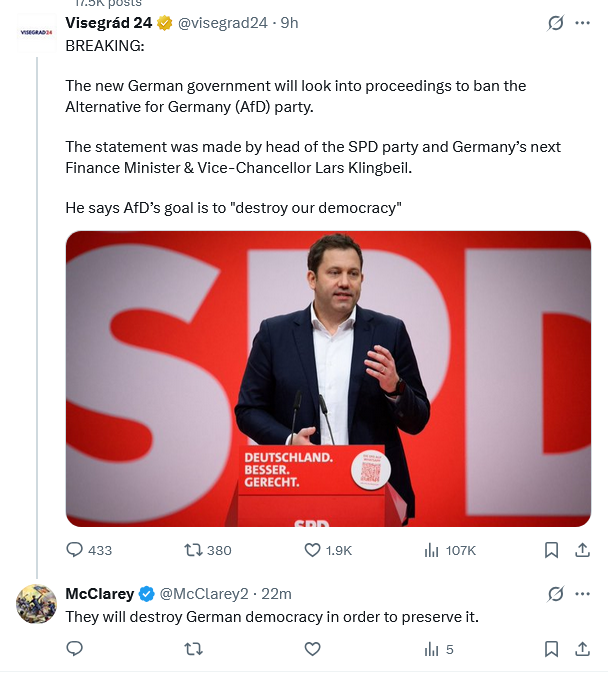
Hey Lars.
Wake Up and smell the Gulag.
No, it’s not the Germans reverting to form. Bar the period running from 1933 to 1945, German political practice was somewhere around the European median. Same deal now. What the German establishment is proposing to do was done by the Belgian establishment years ago contra a political party called the Vlaams Blok. Quite a scrum of European governments (especially Britain’s) have laws and policies in place to punish various sorts of dissenters.
==
What galls about this gaslighting in Germany is that the AfD has a perfectly commonsensical platform and is not hostile to parliamentary institutions at all. They are antagonistic to the regime’s population replacement schemes.
Brings to mind the quote of Tom Wolfe:
“The dark night of fascism is always descending in the United States and yet lands only in Europe.”
Bar the period running from 1933 to 1945, German political practice was somewhere around the European median.
Germany was not friendly to democracy Art, except for the brief period of Weimar Germany. The Second Reich was a concealed autocracy with foreign policy and the military firmly under the control of the monarch, following the Prussian model. Otto von Bismarck as Chancellor of Imperial Germany and Minister President and Foreign Minister of Prussia did as he pleased for 28 years and was a brilliant autocrat, dominating two of the three monarchs he served under. Kaiser Bill forced his resignation in 1890, with Bismarck predicting that Germany would go to hell under the “young puppy”. Kaiser Bill played autocrat and warlord, but he was a very weak man, and the Foreign Service and the Army ruled Germany, paying lip service to the Reichstag. As Frederick the Great of Prussia famously said, My subjects can say what they please, and I do what I please.”
Germany is susceptible, no doubt.. But in the last three decades, all the mechanisms (news-propaganda/color-revolutions/censorship) designed to combat the Soviet Union were turned inwardly to prevent any Populism that might disrupt world order.
When “elites” say: “defend our democracy” or “prevent the destruction of our democracy”, they don’t mean People Voting. What they mean is “defend their Institutions”, i.e. Bureaucracies… from Populism.
(Trump’s populism was their greatest threat and they lost. But they still have Europe, and have retreated to Europe to wait out Trump who they indeed hope is a One-Off.)
Disagree with you entirely. The German monarchy had executive authority that latter day monarchs lack, but that was not abnormal in continental Europe. Not difficult to locate defects in the constitutional order in continental Europe, Latin America, and the United States while we’re at it. As for Weimar, that’s not an ace example of a functioning democracy.
Disagree with you entirely.
More’s the pity for you Art, since German history is precisely as I have stated. Oh, Weimar Germany is not an exemplar of democracy, but it is as close as Germany got before Adenauer. Angela Merkel began the resurgence of authoritarianism which seems the default mode for Germans when things head south in their country.
German history is precisely as I have stated.
==
The salient feature of German history is extreme political fragmentation. That aside, the German states during the post-Napoleonic period went through the same institutional evolution as the rest of continental Europe. The most striking distinction between the Hohenzollern empire after 1870 and the rest of Europe was its decentralization.
The salient feature of German history is extreme political fragmentation.
Correct until Prussia became the dominant power in Germany in the 1860s culminating in the creation of the Second Reich in 1871. After that Bismarck and his successors called the shots on everything that mattered in Germany.
Trying to ban another political party pretty much never works. You can’t act against another party without inherently giving yourself the appearance of autocratic intent. Instead of undermining the other party’s creed, you virtually always end up enhancing it.
Banning a party name or set of symbols won’t help very much. The same ideas will resurface later with somewhat different names or symbols later. One must defeat the principles involved by argument, not by threat of police force.
I don’t know that the appearance of autocratic intent matters. It used to be the received wisdom that you couldn’t prosecute political opponents for the same reason, and look how many people approve of President Trump being convicted for nothing while he was running against Biden. (You may say that the left thinks he was convicted of something, but they do not. They cannot name the specific crime, and indeed even the prosecutor, judge and jury never came to an agreement as to the nature of the crime. He was prosecuted for being the opponent of the leftist machine, and the only difference is that those on the left are happy to see such prosecutions.)
Similarly I would guess that a good chunk of Germans (maybe 30-45%) would not only cheer on the banning of the AfD, but would say that doing so is necessary to “defend democracy.” This is absurd on its face of course, but we’ve lived through decades of people willing to embrace the absurd.