My picks:
1. The Cypresses Believe in God by Gironella
2. A Canticle for Leibowitz by Miller
3. The World, The Flesh and Father Smith by Marshall
4. Saint Francis by Kazantzakis
5. Soldier Ask Not by Dickson
6. Prince of Foxes by Shellabarger
7. Wise Blood by O’Connor
8. The High Crusade by Anderson
10. The Last Crusader by De Wohl
As you can see, my list is top heavy with historical novels, unsurprising, and science fiction, likewise unsurprising. What are some of your choices?
Cypresses Believe in God-I’ve always had a fascination with the history and culture of Spain. This fascination has centered on the Spanish Civil War, 1936-1939, where Spaniards, in a war marked by great atrocities and great heroism, played out all the popular political mistakes of the Twentieth Century: Fascism, Communism, Anarchism, Nationalism and Separatism. The best book on this topic, either fiction or non-fiction, is
Cypresses Believe in God by
Jose Maria Gironella. In the first volume in his trilogy, the lead up to the war is depicted in
Cypresses, the war is set forth unforgettably in
One Million Dead and the aftermath of the war in
Peace After War, Gironella, a veteran of the Nationalist Army, achieves the remarkable feat of creating sympathetic characters in all the warring factions. Many of these characters do terrible things, but Gironella skillfully leads the reader to understand why they did them without condoning their actions. Spain is very much a figure in these novels as the characters act out the various aspects of the Spanish character and fight over what Spain was, is and should be. The whole work is suffused by a deeply Catholic spirit and sensibility as the characters come closer to God or repel themselves away from Him. The finest novels I have ever read.
A Canticle For Leibowitz-The novel is divided into three sections and focuses on the monks at the Monastery of Saint Leibowitz in the American Southwest. Saint Leibowitz was the Jewish Isaac Edward Leibowitz, an electrical engineer working for the US military. Following a nuclear holocaust that kills off most of mankind, Leibowitz converts to Catholicism, and founds an order dedicated to preserving books from pre-Holocaust times. He is eventually martyred by a mob, part of the Simplification movement around the world dedicated to stamping out any learning, blaming such learning for the nuclear death that destroyed their world. Before he is lynched, Leibowitz asks for water and is given a cup of fuel oil instead. He smiles, blesses it and drinks it, some legends saying that the fuel oil was transformed into wine. He is then hung and his body is set aflame. Leibowitz dies, but the Order and the Church live on, preserving fragments of civilization as mankind careens into a Black Age.
The first section occurs in the twenty-sixth century, six centuries after the nuclear war, which in the book is known as the Flame Deluge, and focuses upon a novice at the Abby who uncovers documents belonging to Leibowitz, which eventually lead to the canonization of Leibowitz. Throughout, the book skillfully mixes comedy, “Forgive me Father, I ate a lizard.” and drama. The first book shows the Church as virtually the only source of learning in the world, a fact that the broader world, wallowing in the ignorance of a shattered world, still almost entirely turns its back on.
In the second part of the novel, a Renaissance is starting in 3174, as secular rulers, through their officials who now begin to understand the scientific power contained within many of the books preserved by the Order of Saint Leibowitz, begin to make use of the knowledge contained therein. It is obvious however that Man has learned little from the nuclear destruction wreaked more than eleven centuries before and that old mistakes will likely be made with the rediscovered knowledge.
The final section of the novel in 3781 sees mankind with advanced technology, starships and colonies beyond our solar system. Alas, the wisdom of Man, as usual, lags far behind his technical expertise, and the world goes down in a second nuclear conflagration worse than the first. The Order of Saint Leibowitz sends to the stars a bishop and monks and nuns, assuring the survival of the Church as they bring the Faith to scattered humanity.
This bare bones outline does the novel no justice. While vastly entertaining, the novel is an extremely profound meditation on the Church, the State and History and should be read by all Catholics and all who simply enjoy fine writing and very deep thinking. Mr. Miller’s life was a sad tale overall, but it had this bright gleam of gold in it. May it have been to his benefit when He stood before God for his judgment.
“As Brother Francis readily admitted, his mastery of pre-Deluge English was far from masterful yet. The way nouns could sometimes modify other nouns in that tongue had always been one of his weak points. In Latin, as in most simple dialects of the region, a construction like servus puer meant about the same thing as puer servus, and even in English slave boy meant boy slave. But there the similarity ended. He had finally learned that house cat did not mean cat house, and that a dative of purpose or possession, as in mihi amicus, was somehow conveyed by dog food or sentry box even without inflection. But what of a triple appositive like fallout survival shelter? Brother Francis shook his head. The Warning on Inner Hatch mentioned food, water, and air; and yet surely these were not necessities for the fiends of Hell. At times, the novice found pre-Deluge English more perplexing than either Intermediate Angelology or Saint Leslie’s theological calculus.”
Walter M. Miller, Jr., A Canticle for Leibowitz
The World, The Flesh and Father Smith-Published in 1944 this novel focuses on a Catholic priest in Scotland from 1908 to 1942 when he is killed in a German bombing raid. Profound observations throughout on God and Man.
Saint Francis by Kazantzakis– Very much a hit or miss author for me, the Saint Francis novel was a hit. Brother Leo relates vignettes from the life of Il Poverello in passages than can move a reader to laughter and to tears.
Soldier Ask Not by Dickson-
“Suppose it was even as you think,” he went on, even more gently. “Suppose that all you say was a fact, and that our Elders were but greedy tyrants, ourselves abandoned here by their selfish will and set to fulfill a false and prideful purpose. No.” Jamethon’s voice rose. “Let me attest as if it were only for myself. Suppose that you could give me proof that all our Elders lied, that our very Covenant was false. Suppose that you could prove to me”—his face lifted to mine and his voice drove at me—“that all was perversion and falsehood, and nowhere among the Chosen, not even in the house of my father, was there faith or hope! If you could prove to me that no miracle could save me, that no soul stood with me, and that opposed were all the legions of the universe, still I, I alone, Mr. Olyn, would go forward as I have been commanded, to the end of the universe, to the culmination of eternity. For without my faith I am but common earth. But with my faith, there is no power can stay me!”
Gordon R. Dickson, Soldier Ask Not (1967)
Prince of Foxes by Shellabarger-Set in the court of Cesare Borgia, it is a profound story of spiritual redemption masked in a swashbuckling tale.
Wise Blood by O’Connor-Her first novel, the tale of Hazel Motes who spends his life running away from the grace of God, is Gothic horror mixed with comedic and bizarre characters. Classic O’Connor.
The High Crusade-Anderson’s tale of how a medieval English village founds the Angevin Star Empire is howlingly funny and unexpectedly profound:
“Hearken, Brother Parvus,” said Sir Roger. “I’m weary of this whining about our own ignorance and feebleness. We’re not ignorant of the true Faith, are we? Somewhat more to the point, maybe, while the engines of war may change through the centuries, rivalry and intrigue look no subtler out here than at home. Just because we use a different sort of weapons, we aren’t savages.” The High Crusade, Poul Anderson
Helena by Waugh–
And then Helena said something which seem to have no relevance. ‘Where is the cross, anyway?’
‘What cross, my dear?’ [said Pope Sylvester.]
‘The only one. The real one.’
‘I don’t know. I don’t think anyone knows. I don’t think anyone has ever asked before.’
‘It must be somewhere. Wood doesn’t just melt like snow. It’s not 300 years old. The temples here are full of beams and paneling twice that age. It stands to reason God would take more care of the cross then of them.’
‘Nothing “stands to reason” with God. If He had wanted us to have it, no doubt He would have given it to us. But He hasn’t chosen to. He gives us enough.’
‘But how do you know He doesn’t want to say have it — the cross, I mean. I bet He’s just waiting for one of us to go and find it — Just at this moment when it’s most needed. Just at this moment when everyone is forgetting it and chattering about that hypostatic union, there’s a solid chunk of wood waiting for them to have their silly heads knocked against. I’m going off to find it,’ said Helena.
Helena, Evelyn Waugh
The Last Crusader by De Wohl-De Wohl’s tribute to Don Juan of Austria who smashed the Turkish fleet at Lepanto.






Can I make a shameless plug? The Lance and the Veil. https://www.amazon.com/Lance-Veil-adventure-time-Christ/dp/1502851628/?_encoding=UTF8&pd_rd_w=dMtST&content-id=amzn1.sym.255b3518-6e7f-495c-8611-30a58648072e%3Aamzn1.symc.a68f4ca3-28dc-4388-a2cf-24672c480d8f&pf_rd_p=255b3518-6e7f-495c-8611-30a58648072e&pf_rd_r=8M8AWBVNMKFS159P3PER&pd_rd_wg=R8rDK&pd_rd_r=2f5ba1f7-7497-4780-ada4-d3ceb2f2ace5&ref_=pd_hp_d_atf_ci_mcx_mr_ca_hp_atf_d
I was surprised to see that no books by Robert Hugh Benson were mentioned. I can think of two that are worthy: “Lord of the World,” and “Dawn of All.” The first is a dystopian novel written in the early 1900’s predicting accurately how we live now, and then what Armageddon will be like. The second is an alternative history in which the Reformation fails, England and Europe are theocracies. There is also a fine novel, “Our Lady of the Artilechts.” about AI androids that have been possessed by the Devil, but are saved. I’ve reviewed these on Catholic Stand if anyone is interested in more complete descriptions: Dawn of All; Our Lady of the Artilechts
how do you get on X to add to comment on Anthony Esolen’s post. Pardon the technology ignorance of this 95 year old..I’m a dunce when it comes to social media.
I too would add Fr Hugh Benson.
The Necromancers is particularly chilling. It deals with the Edwardian penchant for spiritualism, which is echoed in our own age.
Passages in Lord of the World dealing with euthanasia ring disturbingly true.
For a lighter read, try Roger Lancelyn Green’s version of Robin Hood. Unlike most versions, it acknowledges that Robin would have been a Catholic.
This video might help bob:
https://www.youtube.com/watch?v=8wOtMBkJQMg
So many wonderful mainly Catholic-themed novels listed here. Great stuff.
Would add 2 other Graham Greene works: “The End of the Affair” (1951), about a nasty rake who keeps trying to entangle a woman in his carefully calculated illicit affair; and “Monsignor Quixote” (1982), which many here know the story (in brief) of a profoundly dedicated priest suspended by his bishop.
I know this excludes non-fiction but two that are in my view life-changing are first, the well-known “The Song of Bernadette (1942),” by Franz Werfel; and “In the Steps of S. Francis (1939),” by Ernest Raymond. Raymond was an established English writer who went through a late conversion, and decided to re-trace S. Francis’ footsteps in Mussolini’s Italy as the war drums are getting louder and the roads are frequently traveled by military units. He has a wonderful descriptive writing style with a penetrating insight.
You can get the latter book and many other out-of-print great books often at ThriftBooks or Abe Books, BTW.
I enjoy reading short stories at night so I have kept my 652 page college text book THEME AND FORM, an introduction to English Literature. In Skepticism and Faith chapter is THE HINT OF AN EXPLANATION, a 5 page story by Graham Greene of two post WWII men who are travelling on an English train. They chat and cover many subjects. The narrator, who identifies as an agnostic, correctly realizes that his fellow traveler is Catholic. The Catholic starts talking about the thig. “The thing?” asks the narrator. The Catholic replies, “The word Satan is so anthropomorphic” and begins to tell him a true story from his own childhood.
Yes, I should reread Monsignor Quixote or listen to the tape err CD again because we now have a connection to an Andalusian family.
Kevin’s The Lance and the Veil should be a good Lenten read.
Thanks for posting lists and the lists in the comments. So many books I remember and new ones to read. I’ve been happy using Abe Books. Also recommend Ott-lite lamps and bulbs for reading and health.
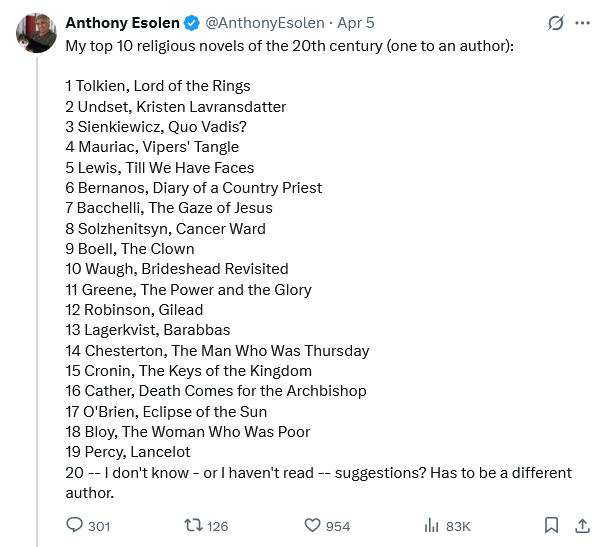
The trouble (and the fun) with lists like this is that it’s hard to distinguish between novels that inspired us or reaffirmed our faith and those that are truly great fiction and deserve to stand shoulder to shoulder with other great literature, while remaining profoundly Catholic.
So, with this defeatist disclaimer in place, I would like to present my choices for your consideration:
I’d have to think to come up with six more. The obvious choices (or those already mentioned by Esolen) are either not explicitly Catholic or not great literature (Bernanos and Bloy–not to mention Greene–were popular among “progressive” Catholics back in the day, and it’s obvious why nowadays.)
I have read most of the novels on Dr. Esolen’s list and certainly can’t argue with any of his choices. If I had to add #20 to his list (and if it must have been written by a Catholic author not already listed in #1-19) then it would probably be either A Canticle for Leibovitz (1959) by Walter Miller or Wise Blood (1952) by Flannery O’Connor.
In my opinion, several of the greatest Catholic novels were written by non-Catholics. Death Comes for the Archbishop (1927) by Willa Cather is by far my favorite Catholic novel. Her lesser known Shadows on the Rock (1931) is also a brilliant Catholic novel. A strong case can also be made that Mark Twain’s The Personal Recollections of Joan of Arc (1896) and Thornton Wilder’s The Bridge of San Luis Rey (1928) are great Catholic novels.
For contemporary Catholic authors, I think Alice McDermott’s The Ninth Hour (2017) is brilliant, as is Ron Hansen’s Exiles (2009). Another good one, though lesser-known, is Dayspring (1944) by Harry Sylvester.
I particularly liked “Canticle for Leibowitz” and “Eclipse of the Sun” — the latter was published in 1997 but was eerily prescient about a lot of the “conspiracy theories” that have turned out to be at least partly true.
Now he’re one that I hesitate to rate as a “best” or even “good” Catholic novel, but turned out a bit better than I expected: “Virgin and Martyr” by Andrew Greeley. (Yes, THAT Andrew Greeley.) I picked it up for a quarter at a garage sale and found that I couldn’t put it down. It’s the story of a pious Catholic girl from a wealthy but dysfunctional Chicago family, who joined a very strict religious order in the early 1960s, left to become a revolutionary in a fictitious South American country, and was later presumed to have been tortured and executed on orders of the country’s dictator. (Emphasis on “presumed”).
What really surprised me was that Greeley — no traditionalist, to say the least — nevertheless makes it clear in this book that he didn’t have much regard for the trendy “spirit of Vatican II” and “liberation theology” crowd that sprang up in the mid to late 60s, and saw them as poseurs at best and corrupt grifters at worst, who tossed out much of what was good about Catholic tradition without coming up with anything worthwhile to replace it.
That surprises me about Greeley Elaine, but he always was a Daley Democrat so I imagine he had no use for the members of the New Left, the surviving members of whom would now be in their seventies or eighties.