
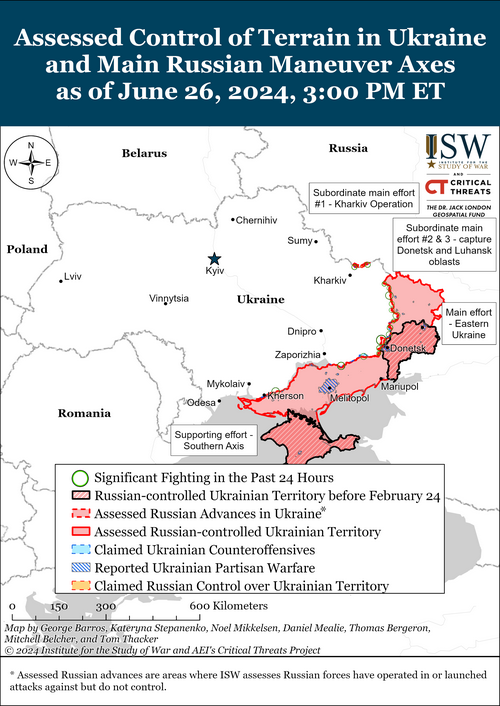
From The Institute for the Study of War:
Russian Offensive Campaign Assessment, June 26, 2024
Riley Bailey, Grace Mappes, Angelica Evans, Karolina Hird, and Frederick W. Kagan
June 26, 2024, 7pm ET
Click here to see ISW’s interactive map of the Russian invasion of Ukraine. This map is updated daily alongside the static maps present in this report.
Click here to see ISW’s 3D control of terrain topographic map of Ukraine. Use of a computer (not a mobile device) is strongly recommended for using this data-heavy tool.
Click here to access ISW’s archive of interactive time-lapse maps of the Russian invasion of Ukraine. These maps complement the static control-of-terrain map that ISW produces daily by showing a dynamic frontline. ISW will update this time-lapse map archive monthly.
Note: The data cut-off for this product was 12:30pm ET on June 26. ISW will cover subsequent reports in the June 27 Russian Offensive Campaign Assessment.
The likely Islamic State (IS) affiliate Wilayat Kavkaz terrorist attacks in the Republic of Dagestan on June 23 have increased fears within the Russian information space about further attacks and instability in the North Caucasus. Russian sources, including prominent Kremlin-affiliated milbloggers and Russian opposition media, amplified reports of two armed men firing on police in Makhachkala on the evening of June 25 and amplified footage of the alleged gunmen and gunfire in the area.[1] Kremlin newswire TASS reported that police deployed to central Makhachkala and cordoned off select areas, but Dagestan’s Ministry of Internal Affairs (MVD) stated that it did not introduce an “interception” plan to apprehend the alleged gunmen.[2] Dagestan’s MVD reported on June 25 that police received reports about an armed man in central Makhachkala but that the reports were false and that there were no violations of public order in the city.[3] Many Russian sources amended their earlier reports to label the shooting as fake and claimed that the footage was from the June 23 terrorist attacks and not the evening of June 25.[4] The apparent widespread misreporting of the shooting and the relatively heavy police response to the false reports suggests heightened fear and expectations in the Russian information space that there will be further terrorist attacks in the North Caucasus.
The Kremlin is attempting to maintain a veneer of stability and normalcy in response to the Dagestan terror attack and posture Russia’s alleged multiethnic and multi-religious unity but is likely so far failing to reassure the public that there will not be further attacks.[5] The March 2024 Crocus City Hall terrorist attack in Moscow and increasingly frequent Russian counterterrorism operations in the North Caucasus have previously prompted tensions within the Russian information space, exacerbated by calls for increased controls on migration to Russia, appeals to Russia’s multiethnic and multi-religious makeup, and outright xenophobia and racism.[6] The Kremlin has struggled to balance its appeals to anti-migrant Russian ultranationalists, its reliance on recruiting migrants for its war effort in Ukraine, and its need for migration to address labor shortages within Russia.[7] Heightened fears about religious extremism will further complicate the Kremlin’s efforts to balance between these competing priorities. A Russian insider source directly commented on this nexus in response to the Dagestan attacks and claimed that Dagestan’s force generation efforts caused practitioners at a government-friendly mosque to turn to a more radical mosque with alleged Wahhabi connections.[8] ISW has previously assessed that Russian force generation efforts and Russian ultranationalist rhetoric are alienating minority and Muslim-majority communities and generating animosities that Salafi-Jihadi groups can exploit in recruitment efforts.[9]
The June 23 terrorist attacks in Dagestan also prompted Chechen Republic Head Ramzan Kadyrov to double down on his image as a ruthless autocratic strongman capable of protecting the North Caucasus from religious extremism. Kadyrov held a meeting with Chechen law enforcement agencies on June 25 in connection with the Dagestan attacks and called on Chechens to be especially vigilant and prevent their relatives from succumbing to religious extremism.[10] Radio Free Europe/Radio Liberty’s North Caucasus service Kavkaz Realii reported that Kadyrov stated in Chechen that Chechen authorities would kill the relatives of those suspected of Wahhabism in a “blood feud.”[11] Kadyrov has routinely threatened the family members of those he deems a threat to his control over Chechnya.[12] Kadyrov appears to be attuned to heightened Russian fears about further attacks and is posturing himself as an attentive and ruthless strongman who can prevent instability in the North Caucasus. Kadyrov invoked the memory of the Chechen wars of the 1990s and 2000s and claimed that his father, Akhmad, and Russian President Vladimir Putin prevented “international” efforts to use Chechnya to destroy Russia.[13] Akhmad Kadyrov supported Russian forces in the Second Chechen War (1999–2002), in which the Russian military brought Chechen separatism to heel through excessive force including the almost complete destruction of Chechnya’s capital, Grozny.[14] Kadyrov has long modeled himself in the image of his father, a strongman loyal to the Kremlin and whom the Kremlin can rely on to ensure stability in the region.[15] Kadyrov consistently appeals to Putin’s favor and is likely aware that further terrorist activity in the North Caucasus may threaten his standing with the Kremlin.[16] Kadyrov also claimed that religious extremism is emanating from Europe and suggested that outside actors aided the Dagestan attackers, supporting Kremlin efforts to tie the attacks to the war in Ukraine while also downplaying the threat of an endogenous religious extremism threat in the North Caucasus.[17]
North Korea will reportedly send military construction and engineering forces to participate in “reconstruction work” in occupied Donetsk Oblast as early as July 2024.[18] South Korean TV network TV Chosun, citing a South Korean government official, reported on June 21 that South Korea expects North Korea to dispatch a large-scale engineering force to occupied Donetsk Oblast as early as July 2024 and that the force will help rebuild infrastructure in occupied Donetsk City.[19] The North Korean military reportedly operates 10 engineering brigades, and TV Chosun estimated that North Korea could earn up to $115 million in unspecified foreign currency each year from Russia if it dispatches three or four engineering brigades to occupied Ukraine.[20] Pentagon Press Secretary Major General Pat Ryder stated on June 25 that the US will “keep an eye” on this development and suggested that North Korea should “question” its decision to send its forces to be “cannon fodder” in Russia’s illegal invasion of Ukraine.[21] Russia and North Korea signed a comprehensive strategic partnership agreement on June 19, but Russian President Vladimir Putin later attempted to downplay the importance of the agreement and the possibility of North Korean troops serving in Ukraine.[22] ISW noted that Russia appears to be pursuing a coalition of friendly states with historically warm ties to the Soviet Union, including North Korea and Vietnam, to form the basis of an alternative world order.[23] ISW has yet to observe reporting that suggests that North Korean military personnel intend to participate in combat operations in Ukraine, but direct North Korean engineering support can free up Russian combat power for operations along the frontline and aid Russian efforts to expand military infrastructure and defensive fortifications in occupied Ukraine.
Russian Foreign Minister Sergei Lavrov reiterated that Russia is not interested in any negotiations that do not result in Ukrainian territorial concessions beyond the parts of Ukraine Russian forces already occupy. Lavrov gave a speech at the “Primakov Readings” international political and economic forum on June 26 and claimed that Russia is open to dialogue with Europe only “based on the recognition of territorial realities enshrined in the [Russian Constitution],” while also dismissing Western calls for the war to end with the restoration of all of Ukraine’s legal sovereign territory.[24] Lavrov is referring to Russian constitutional provisions that consider the administrative boundaries of Kherson, Zaporizhia, Donetsk, and Luhansk oblasts as Russian territory, and Lavrov’s comments emphasize that the Kremlin sees any negotiations on Ukraine’s terms as both unconstitutional and irreconcilable with Russian law. This all-or-nothing approach echoes Russian President Vladimir Putin’s June 14 demands for Ukraine to “completely withdraw” from the entirety of Donetsk, Luhansk, Kherson, and Zaporizhia oblasts before Russia considers any sort of “peace negotiations” — notably including areas of each oblast that Russia does not currently occupy.[25] Both Lavrov and Putin have clearly articulated that the only end-state of the war that the Kremlin envisions is Ukraine’s territorial capitulation, strongly emphasizing the fact that Russia remains uninterested in engaging in negotiations with Ukraine in good faith, and only invokes the concept of “peace plans” and “negotiations” to convince Ukraine’s partners to encourage Ukraine to make preemptive concessions about its people and its internationally-recognized territory even before negotiations begin. Lavrov’s explicit mention of negotiations with “Europe” rather than Ukraine also forwards the Kremlin’s ongoing false narrative that there are no legitimate Ukrainian authorities with whom Russia can negotiate, further undermining Ukraine’s status as a sovereign country with its own borders in the context of territorial concessions.
New Russian Defense Minister Andrei Belousov used his first phone call with US Secretary of Defense Lloyd Austin on June 26 to reiterate standard Russian threats meant to coerce the US out of supporting Ukraine as part of the wider Russian reflexive control campaign targeting Western decision-making.[26] The Russian Ministry of Defense (MoD) claimed that Belousov stressed to Austin the “danger of further escalation” should the US continue to supply weapons to Ukraine, while the US Department of Defense (DoD) noted that Austin emphasized to Belousov the importance of maintaining open communication between the US and Russia.[27] Russian officials have consistently attempted to use vague threats of escalation against the US and Ukraine’s other partners to discourage continued Western military support for Ukraine, and Belousov’s statements to Austin fall in the same category as countless other Russian efforts at informational and diplomatic coercion.[28] Belousov’s predecessor, former Defense Minister Sergei Shoigu, similarly threatened French Defense Minister Sebastien Lecornu during a phone call on April 4, warning that the potential deployment of French troops to Ukraine would “create problems for France itself.”[29] Shoigu notably called several NATO defense ministers in October 2022 to threaten nuclear disaster if NATO members sustained support for Ukraine.[30] Belousov will continue using pseudo-diplomatic engagements with his Western counterparts to further the same narrative in an attempt to influence Western decision-making via the Kremlin’s reflexive control campaign. Russia has notably yet to escalate militarily in response to any US or Western provision of weapons to Ukraine.[31]
Russia and Ukraine exchanged 90 prisoners of war (POWs) each in a one-to-one POW exchange on June 25 amid United Nations (UN) reports of Russia’s continued abuse of POWs. Ukrainian Verkhovna Rada Human Rights Ombudsman Dmytro Lubinets stated on June 25 that 90 Ukrainian POWs returned to Ukraine in the 53rd POW exchange thus far during the war.[32] The Russian Ministry of Defense (MoD) also reported that 90 Russian POWs returned to Russia, and the MoD claimed that the Russian POWs were in “mortal danger” while in Ukrainian custody.[33] The United Arab Emirates (UAE) mediated the exchange. The UN Office of the High Commissioner for Human Rights (OHCHR) Spokesperson Krzysztof Janowski stated on June 26 that the UN OHCHR has interviewed over 600 released Ukrainian civilians and POWs since 2022, all of whom reported experiencing or observing torture, severe beatings, and prolonged exposure to stressful positions, and being mauled by dogs.[34] POWs also reported that Russian guards psychologically tortured them and forced them to sing patriotic Russian songs daily and reported experiencing constant hunger and poor medical care for long periods of time. OHCHR reported also hearing accounts of torture in “transitory” POW camps in occupied Ukraine, but POWs reported that Russian guards did not torture them in “official“ internment camps. ISW has extensively reported on footage and reports of Russian servicemen abusing and executing Ukrainian POWs and noted that the Russian military command appears to be permitting these war crimes in Ukraine.[35]
Russia and Iran signed a memorandum on June 26 regarding the supply of Russian gas to Iran, following reported disagreements between Russia and the People’s Republic of China (PRC) on the Russian supply of gas to the PRC. Russian state-owned energy company Gazprom Head Alexey Miller signed the memorandum with the National Iranian Gas Company in Iran at a ceremony attended by Acting Iranian President Mohammad Mokhber.[36] Miller also met with Iranian Oil Minister Javad Owji about implementing the new memorandum and other areas of energy cooperation. Neither Russia nor Iran provided details about the new memorandum, but Gazprom and the National Iranian Gas Company were negotiating unspecified deals worth about $40 billion as of October 2023.[37] Miller’s visit to Iran and agreement with the National Iranian Gas Company follows a recent Financial Times (FT) report that Russia and the PRC are reportedly in disagreement about economic issues including the Power of Siberia 2 (PS-2) gas pipeline, resulting in Miller not travelling with Russian President Vladimir Putin to Beijing in May 2024 — likely aimed at extracting concessions from Russia given Gazprom’s recent economic struggles and the PRC’s upper hand in the energy sphere.[38] Iran may benefit from this new deal with Russia to reduce its reliance on existing gas swap deals it has with Azerbaijan and Turkmenistan to mitigate summer electricity shortages that could fuel domestic unrest.[39]
Ukraine’s pervasive shortage of critical air defense missiles is inhibiting Ukraine’s ability to protect its critical infrastructure against Russian strikes. Private Ukrainian energy enterprise DTEK Executive Director Dmytro Sakharuk told the Kyiv Post on June 26 that for every one interceptor missile that Ukraine possesses to defend against Russian strikes on the energy grid, Russia has five to six missiles to launch at Ukraine.[40] Sakharuk noted that if Russia were to launch 10 missiles at any target in Ukraine, Ukrainian forces would need to respond with at least 12 air defense missiles to adequately protect against the attack. Sakharuk emphasized that the stark difference in Ukraine’s necessary and actual ratios of Ukrainian air defense to attacking Russian missiles means that the shortage in interceptor missiles is making it impossible to cover energy grid units that Ukraine has repaired or is repairing. Russia’s air strike campaign against the Ukrainian energy grid has already imposed serious constraints on Ukraine’s power generation capacity, and Russian forces have been able to exploit air defense shortages caused by a lack of Western-provided air defense systems to maximize the damage to Ukraine’s energy capacity over the course of 2024.[41]
Key Takeaways:
- The likely Islamic State (IS) affiliate Wilayat Kavkaz terrorist attacks in the Republic of Dagestan on June 23 have increased fears within the Russian information space about further attacks and instability in the North Caucasus.
- The June 23 terrorist attacks in Dagestan also prompted Chechen Republic Head Ramzan Kadyrov to double down on his image as a ruthless autocratic strongman capable of protecting the North Caucasus from religious extremism.
- North Korea will reportedly send military construction and engineering forces to participate in “reconstruction work” in occupied Donetsk Oblast as early as July 2024.
- Russian Foreign Minister Sergei Lavrov reiterated that Russia is not interested in any negotiations that do not result in Ukrainian territorial concessions beyond the parts of Ukraine Russian forces already occupy.
- New Russian Defense Minister Andrei Belousov used his first phone call with US Secretary of Defense Lloyd Austin on June 26 to reiterate standard Russian threats meant to coerce the US out of supporting Ukraine as part of the wider Russian reflexive control campaign targeting Western decision-making.
- Russia and Ukraine exchanged 90 prisoners of war (POWs) each in a one-to-one POW exchange on June 25 amid United Nations (UN) reports of Russia’s continued abuse of POWs.
- Russia and Iran signed a memorandum on June 26 regarding the supply of Russian gas to Iran, following reported disagreements between Russia and the People’s Republic of China (PRC) on the Russian supply of gas to the PRC.
- Ukraine’s pervasive shortage of critical air defense missiles is inhibiting Ukraine’s ability to protect its critical infrastructure against Russian strikes.
- Russian forces recently marginally advanced near Kupyansk.
- Royal United Services Institute (RUSI) published a report on June 26 detailing a significant increase in Russia’s military equipment and weapons production in 2023.
Go here to read the rest. Islamic terrorism is the spectre haunting Russia. A few more attacks and we could see calls from within Russia to shift resources from Ukraine to battle the internal threat.

