

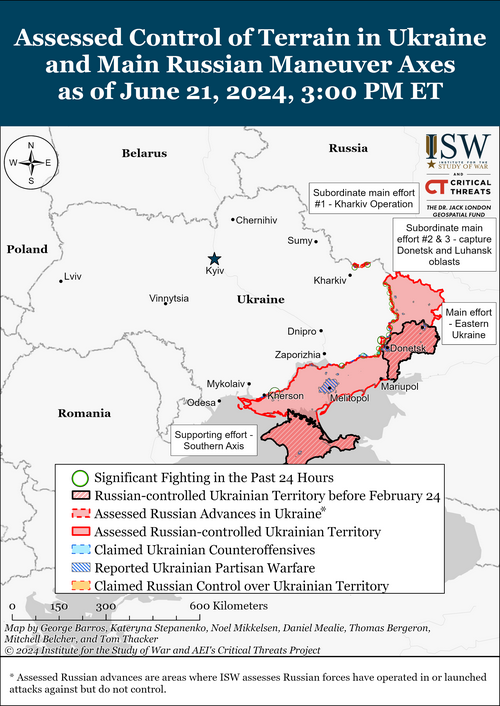
From The Institute for the Study of War:
Russian Offensive Campaign Assessment, June 21, 2024
Angelica Evans, Nicole Wolkov, Christina Harward, Karolina Hird, and George Barros
June 21, 2024, 6:30pm ET
Click here to see ISW’s interactive map of the Russian invasion of Ukraine. This map is updated daily alongside the static maps present in this report.
Click here to see ISW’s 3D control of terrain topographic map of Ukraine. Use of a computer (not a mobile device) is strongly recommended for using this data-heavy tool.
Click here to access ISW’s archive of interactive time-lapse maps of the Russian invasion of Ukraine. These maps complement the static control-of-terrain map that ISW produces daily by showing a dynamic frontline. ISW will update this time-lapse map archive monthly.
Note: The data cut-off for this product was 1:30pm ET on June 21. ISW will cover subsequent reports in the June 22 Russian Offensive Campaign Assessment.
Russian President Vladimir Putin continues to invoke nuclear threats as part of his ongoing information campaign to discourage further Western support for Ukraine and undermine the international community’s efforts to cohere its strategic vision for defeating Russia’s war of conquest against Ukraine. Putin claimed during a speech to graduating Russian officers on June 21 that Russia plans to further develop its nuclear triad as a “guarantee of strategic deterrence” and to maintain the balance of power in the world.[1] Putin noted that Russia is also working to increase its conventional combat capabilities and defense industrial production. Putin claimed during a press conference in Vietnam on June 20 that Russia is considering “lowering the threshold” for nuclear use in Russia’s nuclear doctrine and that a possible future strategic defeat of Russian forces on the battlefield in Ukraine would result in the “end of [Russia’s] statehood.”[2] ISW noted that Putin may have falsely equated a Russian defeat in Ukraine with an existential threat to the Russian state in order to invoke an “exceptional case” in which existing Russian nuclear doctrine would allow for the use of nuclear weapons.[3] Putin’s June 21 statement appears to be the continuation of his recent information operation intended to sabotage the West’s efforts to develop a common strategic objective of decisively defeating Russia’s invasion as the West’s envisioned end state for the war in Ukraine. ISW continues to assess that the threat of nuclear escalation is a core aspect of Russia’s ability to manipulate foreign decision-makers and is highly unlikely to result in actual nuclear escalation due to nuclear and conventional deterrence.[4]
Putin and Russian Foreign Minister Sergei Lavrov continued to emphasize Russia’s initiative to create an alternative “Eurasian security architecture,” likely as part of ongoing efforts to establish a coalition of friendly states to act as an alternative to the West and undermine NATO. Putin reiterated on June 21 his intention to create “equal and indivisible security in Eurasia.”[5] Putin claimed that Russia is ready to discuss Eurasian security issues with the Shanghai Cooperation Organization (SCO), Commonwealth of Independent States (CIS), Eurasian Economic Union (EAEU), and BRICS and claimed that Russia is ready to have discussions with European and NATO countries “when they are ready.” Lavrov similarly emphasized Russia’s effort to form a “Eurasian security architecture to replace… the Euro-Atlantic [security system]” at a June 21 Collective Security Treaty Organization (CSTO) foreign ministers meeting in Almaty, Kazakhstan.[6] Lavrov further promoted the need for joint efforts to create a new Eurasian security architecture and coordination with other unspecified multilateral organizations on the Eurasian continent.[7] Lavrov is likely referencing Russian efforts to increase cooperation with the Association of Southeast Asian Nations (ASEAN), as Putin signaled his interest in developing relations with ASEAN during his state visit to Vietnam on June 20.[8] Putin notably included Vietnam – a country not typically included in political conceptions of Eurasia – in addition to North Korea in his proposed formation of a new Eurasian security system, suggesting that Putin seeks to include Southeast Asia into this alternative Eurasian security structure by leveraging select Southeast Asian countries’ historically friendly ties with the Soviet Union. Putin first laid the informational groundwork for this Eurasian security structure during his visit to the People’s Republic of China (PRC) in May 2024 before proposing it in a speech on June 14, in which he claimed that the “Euro-Atlantic security system” is collapsing and that Western “schemes for security and prosperity in Europe do not work.”[9] ISW continues to assess that Putin and other senior Russian officials will likely continue to amplify Russia’s efforts to create a coalition of countries that Putin could use to posture as an alternative to NATO while also supporting ongoing Kremin information operations to falsely portray Western countries as Ukraine’s only supporters.[10]
The Russian Ministry of Foreign Affairs (MFA) criticized South Korean and Japanese objections to the Russian-North Korean strategic partnership agreement and directly tied the agreement to Russian President Vladimir Putin’s “Eurasian security architecture” initiative. South Korea’s Yonhap News Agency reported on June 21 that South Korean government sources stated that South Korea may send 155mm artillery shells and unspecified air defense systems to Ukraine, after South Korean National Security Director Chang Ho-jin stated on June 20 that South Korea would respond to the Russian-North Korean agreement by reconsidering its policy preventing it from sending aid to Ukraine.[11] The South Korean MFA summoned Russian Ambassador to South Korea Georgiy Zinovyev on June 21 to urge Russia to stop its military cooperation with North Korea.[12] Zinovyev accused South Korea of trying to “threaten and blackmail” Russia and that Russia’s cooperation with North Korea is not directed against any other country and claimed that Russian-North Korean cooperation helps strengthen stability on the Korean peninsula.[13] Director of the Russian MFA’s Third Department for Asia Lyudmila Vorobyova met on June 21 with Director of the Japanese MFA’s Europe Department Masashi Nakagome following the introduction of a new round of Japanese sanctions targeting Russia.[14] The Russian MFA claimed that the Japanese sanctions are the “next step towards the complete destruction” of Russian-Japanese relations, which the Russian MFA claimed are at an all-time low.[15] The Russian MFA claimed that Russia would respond to the sanctions with “tough and painful countermeasures.” The Russian MFA responded to Nakagome’s protests about the Russian-North Korean strategic partnership by outlining Putin’s June 14 initiative for the creation of “a new continent-wide security architecture” in Eurasia.
Ukrainian forces struck oil refineries and military targets in Bryansk and Astrakhan oblasts, Krasnodar Krai, and occupied Crimea on the night of June 20 to 21. The Ukrainian General Staff reported on June 21 that Ukrainian drones targeted the Afipsky, Ilsky, and Krasnodar oil refineries in Krasnodar Krai and the Astrakhan oil refinery in Astrakhan Oblast and conducted strikes on unspecified Russian radar and electronic warfare (EW) stations in Bryansk Oblast and occupied Crimea on the night of June 20 to 21 and that Ukrainian forces are still conducting a battlefield damage assessment.[16] The Ukrainian General Staff reported that Ukrainian forces also struck a Shahed-136/131 storage facility, military training facilities, and several drone communication and control posts in Krasnodar Krai. The Krasnodar Krai Operational Headquarters reported that Ukrainian drones struck unspecified targets in Temryuk and Yeysk Raions and the Ilsky oil refinery in Seversk Raion and that debris from a Ukrainian drone fell near Volna.[17] The Russian Ministry of Defense (MoD) claimed that Russian air defenses destroyed six Ukrainian naval drones in the Black Sea, 70 drones over Crimea, and 43 drones over Krasnodar Krai on the night of June 20 to 21.[18] Russian milbloggers claimed that Ukrainian forces launched the drones in several waves of drone strikes beginning on the evening of June 20 and warned that Ukrainian forces may conduct more large-scale drone strikes in the near future.[19] The Ukrainian General Staff also confirmed that Ukrainian forces and Ukraine’s Security Service (SBU) conducted successful drone strikes against the Tambovnefteprodukt fuel and lubricant warehouse in Tambov Oblast and the Lukoil-Yugnefteprodukt “Enemska” oil depot in Adygea Republic on the night of June 19 to 20, as ISW reported.[20]
Russian milbloggers reported that Ukrainian forces simultaneously used naval and aerial drones during the Krasnodar Krai strike and overwhelmed Russian defenses, causing a Russian air defense system to accidentally shoot down a Russian helicopter in a friendly fire incident. Several Russian milbloggers claimed on June 21 that Russian friendly fire destroyed a Russian Ka-29 helicopter and the helicopter’s crew while defending against Ukrainian drone strikes near Krasnodar Krai.[21] The milbloggers claimed that Russian forces were using helicopters to search for Ukrainian naval drones while Russian air defense systems were simultaneously attempting to shoot down Ukrainian aerial drones and that a Russian Pantsir air defense system accidentally downed a Russian helicopter, reportedly due to a malfunction in the system’s Identification Friend or Foe (IFF) system.[22] The milbloggers claimed that Ukrainian forces have previously used missiles to similarly overload Russian air defenses and criticized the Russian military for not improving its IFF systems to prevent these incidents.
Moscow State University (MGU) announced on June 21 that it has opened enrollment for a master’s program on “strategic communications, information, and hybrid wars” under the guidance of Russian ultranationalist and former State Duma Deputy Zakhar Prilepin and other select Duma deputies.[23] MGU stated that the master’s program has been part of the political science faculty since 2022, but that it is now being offered in an improved and “modernized form,” and that Prilepin’s team and other Duma deputies will participate in developing and presumably teaching the course. Graduates of the two-year program will receive a master’s in “Conflictology” and learn about “national information sovereignty and countering the operations of hybrid, cognitive, and intellectual wars.”[24] MGU admitted its first cohort of students to this program in 2022, but later reportedly ended the program in December 2023 due to financial concerns.[25] MGU’s June 21 announcement, however, suggests that the university has been able to restart the program under the supervision of prominent ultranationalist voices such as Prilepin. ISW previously noted that the MGU master’s program was likely intended to teach and promote Russian objectives for the war in Ukraine, setting multi-generational conditions to strengthen the ideology underpinning Russia’s full-scale invasion of Ukraine.[26]
Key Takeaways:
- Russian President Vladimir Putin continues to invoke nuclear threats as part of his ongoing information campaign to discourage further Western support for Ukraine and undermine the international community’s efforts to cohere its strategic vision for defeating Russia’s war of conquest against Ukraine.
- Putin and Russian Foreign Minister Sergei Lavrov continued to emphasize Russia’s initiative to create an alternative “Eurasian security architecture,” likely as part of ongoing efforts to establish a coalition of friendly states to act as an alternative to the West and undermine NATO.
- The Russian Ministry of Foreign Affairs (MFA) criticized South Korean and Japanese objections to the Russian-North Korean strategic partnership agreement and directly tied the agreement to Russian President Vladimir Putin’s “Eurasian security architecture” initiative.
- Ukrainian forces struck oil refineries and military targets in Bryansk and Astrakhan oblasts, Krasnodar Krai, and occupied Crimea on the night of June 20 to 21.
- Moscow State University (MGU) announced on June 21 that it has opened enrollment for a master’s program on “strategic communications, information, and hybrid wars” under the guidance of Russian ultranationalist and former State Duma Deputy Zakhar Prilepin and other select Duma deputies.
- Russian forces recently advanced southeast of Kupyansk, southwest of Svatove, and west and southwest of Donetsk City.
- The Russian Ministry of Defense (MoD) appears to be taking steps to address known bureaucratic issues as part of its efforts to formalize irregular Russian formations.
- An investigation by Russian opposition outlet Verstka highlights how Russia is importing Russian judges to serve in courts in occupied Ukraine, supporting Russian efforts to control the judiciary while also providing a convenient cover for the resettlement of Russian citizens into occupied Ukraine.
Go here to read the rest. The phony war continues. Not a chance for big ground offensives this year. Stasis.





Putin’s trips to China and North Korea show signs of frustration. Despite the show of friendship, neither country is impressed with Putin’s leadership and see him only as part of a means to their own objective of keeping the West occupied in other matters.
I think China would have been more than happy to see a quick Russian conquest of Ukraine, but this stalemate must worry them. For one, Taiwan, Japan, South Korea and probably Vietnam are taking notes at how a small power (with support and ingenuity) can hold its own against a larger one. Second, the ramping-up of materiel production in at least some countries increases assets that could some day be turned against their expansionism. Next, Muslim restiveness and Russian distraction could lead to ethnic instability that would not recognize borders. While they would be happy with a slightly weaker Russia, they may fear a collapsed Russia. I imagine their message to Putin is: “Swallow your ego and settle.”