
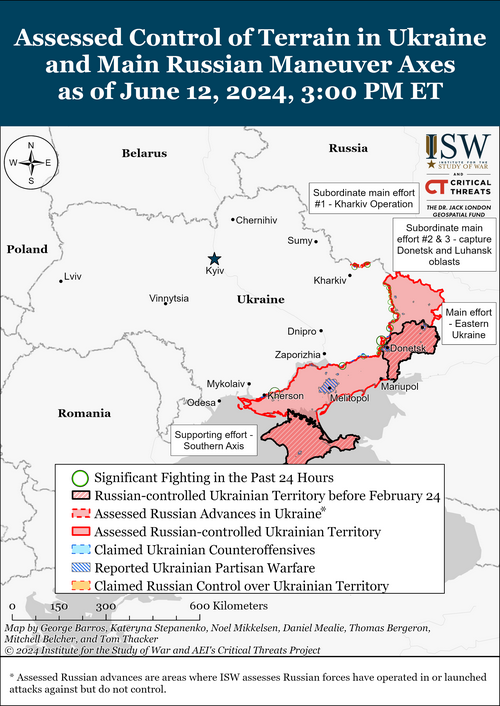
From The Institute for the Study of War:
Russian Offensive Campaign Assessment, June 12, 2024
Grace Mappes, Nicole Wolkov, Christina Harward, Karolina Hird, and George Barros
June 12, 2024, 7:45pm ET
Click here to see ISW’s interactive map of the Russian invasion of Ukraine. This map is updated daily alongside the static maps present in this report.
Click here to see ISW’s 3D control of terrain topographic map of Ukraine. Use of a computer (not a mobile device) is strongly recommended for using this data-heavy tool.
Click here to access ISW’s archive of interactive time-lapse maps of the Russian invasion of Ukraine. These maps complement the static control-of-terrain map that ISW produces daily by showing a dynamic frontline. ISW will update this time-lapse map archive monthly.
Note: The data cut-off for this product was 1:15pm ET on June 12. ISW will cover subsequent reports in the June 13 Russian Offensive Campaign Assessment.
Ukrainian forces may be conducting an effort aimed at degrading Russian air defenses, which, if successful, could enable Ukraine to more effectively leverage manned fixed-wing airpower in the long run. The Ukrainian General Staff reported on June 12 that Ukrainian forces targeted one S-300 air defense battery and two S-400 air defense batteries near occupied Belbek and Sevastopol, Crimea overnight on June 11 to 12.[1] The Ukrainian General Staff reported that the strikes destroyed at least two S-300/S-400 Russian air defense radar systems and caused secondary ammunition detonations, and that the Ukrainian military is clarifying battle damage. Geolocated imagery published on June 12 shows damaged and destroyed Russian S-300 assets north of occupied Yevpatoria and a destroyed Russian S-400 radar system south of occupied Dzhankoy, supporting the Ukrainian General Staff’s June 10 report about strikes against Russian air defense assets in these areas.[2] Some Russian sources speculated that Ukrainian forces used ATACMS in the June 11 to 12 strike, although ISW is unable to confirm which systems Ukrainian forces used.[3] Founder of the Ukrainian Main Military Intelligence Directorate (GUR) “Kraken” Regiment Kostyantyn Nemichev confirmed on June 12 that Ukrainian forces used HIMARS to destroy four Russian S-300 systems in Belgorod Oblast on an unspecified date, and Ukrainian outlet Suspilne referred to Nemichev’s statements as the first official Ukrainian confirmation of strikes against a Russian S-300 battery in Belgorod Oblast on June 1 or 2.[4] Ukrainian forces’ destruction of the Russian air defense systems in Belgorod Oblast reportedly prompted the Russian command to deploy air defense assets from Crimea to Belgorod Oblast in early June 2024, reportedly degrading Russian air defense coverage around Crimea.[5] GUR Spokesperson Andriy Yusov also clarified on June 12 that Ukrainian drone strikes against the Akhtubinsk Airfield in Astrakhan Oblast between June 7 and 8 damaged two Russian Su-57 fighter aircraft instead of just one aircraft as previously reported.[6] S-300/S-400 air defense systems and Su-57 fighters are significant Russian air defense and aviation assets that deny Ukraine the ability to fly aircraft near the front and support Russian offensive operations in Ukraine.
Ukrainian forces may seek to actively degrade Russian air defenses before Ukraine receives a significant number of aircraft in order to set conditions for Ukraine’s future use of manned fixed-wing airpower closer to frontline areas. Ukrainian forces may be attempting to degrade Russian air defenses ahead of anticipated F-16 fighter jet deliveries to Ukraine, which reportedly will begin in small quantities in summer and fall 2024. Ukrainian forces may be able to eventually work towards a concept of operations that combines fixed-wing airpower to support ground operations if the Ukrainian military receives a sufficient number of fighter jets, Western partners train enough trained pilots, and if Ukraine succeeds in degrading Russian air defense capabilities.
Western officials have indicated that Ukraine will continue to face material and training constraints, which will likely prevent Ukraine from leveraging fixed-wing airpower at scale in 2024. Ukrainian and Western officials have previously indicated that it will take significant time to adequately train enough Ukrainian pilots and equip Ukrainian forces with the roughly at least 150 F-16s necessary to gain the air superiority necessary to support ground operations.[7] Ukrainian officials have also identified their envisioned use of F-16s and other fixed-wing aircraft to constrain Russian aviation operations, and Ukrainian Air Force Spokesperson Ilya Yevlash noted that only two F-16 squadrons, roughly 18 aircraft, would be enough to significantly impact the situation in the Ukrainian airspace.[8] These restraints should not fundamentally constrain Ukraine’s ability to leverage airpower at scale in the long run, however, should Ukraine’s Western partners lean into supporting Ukraine’s air domain and deep strike capabilities.
Russian Northern Fleet naval vessels arrived at Havana Harbor, Cuba, on June 12 for their planned five-day-long port call. The Russian Ministry of Defense (MoD) reported that the Northern Fleet detachment — including the Admiral Flota Sovetskogo Soyuza Gorshkov Admiral Gorshkov-class frigate, Kazan nuclear-powered cruise missile submarine, the Academic Pashin replenishment oiler, and the Nikolai Chiker rescue tug — arrived in Havana after the Kazan and Admiral Gorshkov completed planned high-precision missile exercises.[9] Kremlin newswire TASS reported that the Admiral Gorshkov will be open for public viewing until June 15, and the port call will end on June 17.[10] Russian Foreign Minister Sergei Lavrov also notably met with Cuban Foreign Minister Bruno Rodríguez Parrilla in Moscow on June 12 against the backdrop of the port call to discuss Russian-Cuban relations and foreign policy alignment.[11] ISW previously assessed that the Russian port call in Havana is likely part of a larger Russian effort to invoke the historical memory of the Cuban Missile Crisis to encourage US self-deterrence.[12] The presence of the nuclear-capable Kazan submarine so close to US territorial waters in a port that holds fraught historical memory for the US is likely specifically intended to instill fear in the US and the West in order to force self-deterrence and weaken the West’s resistance to Russia. Both US and Cuban officials have emphasized that this port call does not pose a tangible threat to the US.[13]
Armenian Prime Minister Nikol Pashinyan stated that Armenia “will leave” and “will decide when to leave” the Russia-led Collective Security Treaty Organization (CSTO) in a question-and-answer session with the Armenian National Assembly on June 12 amid Armenia’s continued efforts to distance itself from security and political relations with Russia.[14] Armenian Foreign Minister Ararat Mirzoyan clarified that Pashinyan did not state that Armenia is leaving the CSTO but that Armenia “will decide when [Armenia] will leave the CSTO, and [Armenia] will not go back.”[15] Western and Russian media outlets largely portrayed Pashinyan’s statement as confirmation that Armenia will leave the CSTO.[16] Pashinyan also reiterated at the National Assembly’s question-and-answer session that the CSTO failed to fulfill its obligations to Armenia and that CSTO member states “are planning” a war against Armenia with Azerbaijan. Pashinyan indirectly accused Russia and directly accused Belarus in May 2024 of helping Azerbaijan to prepare for the 2020 Nagorno-Karabakh War.[17] Pashinyan acknowledged in February 2024 that Armenia had “essentially” frozen its participation in the CSTO because the CSTO “failed to fulfill its obligations in the field of security” to Armenia, particularly in 2021 and 2022.[18] Armenia has also appeared to be attempting to reduce its bilateral security relations with Russia, and Pashinyan stated in March 2024 that Russian border guards will leave the Yerevan International Airport by August 1, 2024.[19] Armenia’s withdrawal from the CSTO would largely formalize a de facto status quo given that that Armenia has effectively abstained from participation in the CSTO since Pashinyan and Armenian representatives failed to attend several consecutive CSTO events starting mid-to-late 2023.[20] Armenia’s formal withdrawal from the CSTO would be a more significant blow to Russia, as Russia has leveraged the CSTO to undermine former Soviet states’ sovereignty and project power across the former Soviet Union.[21]
Georgian opposition-leaning outlet Mtavari reported that the Georgian government is planning to resume diplomatic relations with Russia. There has been no official confirmation of Mtavari’s report as of this publication. Mtavari reported on June 11 that unspecified sources stated that the ruling Georgian Dream party is preparing to restore diplomatic relations with Russia and that the Georgian and Russian governments are currently selecting employees for the Georgian embassy in Moscow.[22] Mtavari stated that the Georgian Dream party denied this information and called it “groundless.” The Russian Ministry of Foreign Affairs (MFA) also claimed to Kremlin newswire TASS on June 12 that Georgian opposition sources are spreading false information about the matter.[23] ISW continues to assess that Georgian Dream actors likely intend to purposefully derail long-term Georgian efforts for Euro-Atlantic integration, which plays into continued Russian hybrid operations to divide, destabilize, and weaken Georgia.[24]
Key Takeaways:
- Ukrainian forces may be conducting an effort aimed at degrading Russian air defenses, which, if successful, could enable Ukraine to more effectively leverage manned fixed-wing airpower in the long run.
- Russian Northern Fleet naval vessels arrived at Havana Harbor, Cuba, on June 12 for their planned five-day long port call.
- Armenian Prime Minister Nikol Pashinyan stated that Armenia “will leave” and “will decide when to leave” the Russia-led Collective Security Treaty Organization (CSTO) in a question-and-answer session with the Armenian National Assembly on June 12 amid Armenia’s continued efforts to distance itself from security and political relations with Russia.
- Georgian opposition-leaning outlet Mtavari reported that the Georgian government is planning to resume diplomatic relations with Russia.
- Russian forces made confirmed advances near Vovchansk, Siversk, and Avdiivka and in western Zaporizhia Oblast.
- Russian President Vladimir Putin highlighted Russian defense company officials in a list of recent recipients of labor awards during a “Russia Day” speech on June 11, indicating Putin’s continued emphasis on strengthening the Russian defense industrial base (DIB).
Go here to read the rest. Karl Marx once noted that history repeats itself: the first time as tragedy and the second time as farce. Putin’s port call to starving, and increasingly rebellious Cuba, is definitely a farcial attempt by Putin to scare the US with a repetition of the Cuban missile crisis. Submarines equipped with ICBM’s make any concern about land based ICBM’s as relevant as black and white TV.


We have a nuke sub that pulled into Gitmo.
So far Ukraine drones have destroyed 10% of Russian refineries. Biden is now telling Ukraine to go easy on destroying Russian refineries. In WWII we bombed the refineries in Romania so fuel for Nazi tanks, air forces would be scarce. Biden’s stupidity will prolong the Ukraine – Russian war. Obviously Biden doesn’t want gas prices to go up in an election year.