
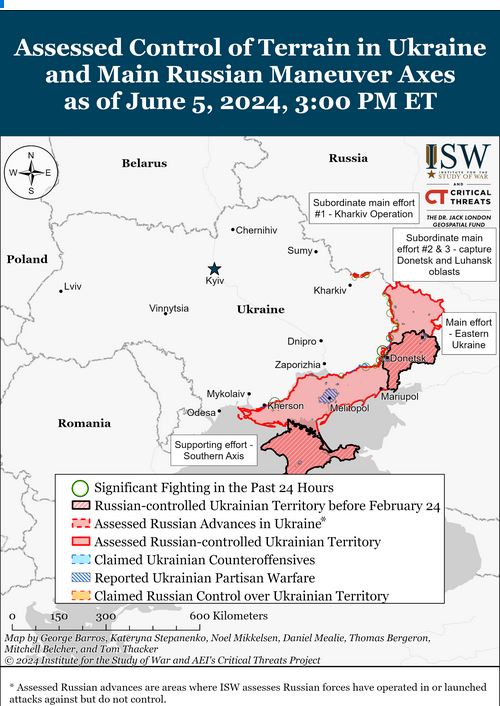
From The Institute for the Study of War:
Russian Offensive Campaign Assessment, June 5, 2024
Nicole Wolkov, Riley Bailey, Kateryna Stepanenko, Karolina Hird, and George Barros
June 5, 2024, 9:45pm ET
Click here to see ISW’s interactive map of the Russian invasion of Ukraine. This map is updated daily alongside the static maps present in this report.
Click here to see ISW’s 3D control of terrain topographic map of Ukraine. Use of a computer (not a mobile device) is strongly recommended for using this data-heavy tool.
Click here to access ISW’s archive of interactive time-lapse maps of the Russian invasion of Ukraine. These maps complement the static control-of-terrain map that ISW produces daily by showing a dynamic frontline. ISW will update this time-lapse map archive monthly.
Note: The data cut-off for this product was 2:15pm ET on June 5. ISW will cover subsequent reports in the June 6 Russian Offensive Campaign Assessment.
US officials continue to attempt to clarify US policy regarding Ukraine’s ability to strike a limited subset of Russian military targets within Russia with US-provided weapons, but public communications about US policy remain unclear. US National Security Spokesperson John Kirby stated during a press conference on June 4 that “there’s never been a restriction on the Ukrainians shooting down hostile aircraft, even if those aircraft are not necessarily in Ukrainian airspace.”[1] Kirby made this statement in response to a question about whether America’s recent partial lifting of restrictions on Ukraine’s ability to strike targets within Russia with US-provided weapons pertains to strikes against Russian aircraft operating in Russian airspace. Kirby suggested that Ukrainian forces can shoot down Russian aircraft within Russian airspace if they “pose an impending threat” to Ukraine and stated that Ukrainian forces already have done so since the beginning of the war. It remains unclear what the official US policy on what Russian aircraft constitute “an impending threat” to Ukraine, and Kirby’s statements did not elucidate how the US administration views this issue. ISW continues to assess that Ukraine’s ability to defend itself against devastating Russian glide bomb strikes is heavily contingent on Ukraine’s ability to target Russian aircraft within Russian airspace using US-provided air defense systems before Russian aircraft can launch strikes at Ukrainian cities, critical infrastructure, and frontline positions.[2] The current lack of clarity in US restrictions on Ukraine’s use of US-provided weapons to strike Russian military assets within Russia has routinely missed the opportunity to force Russia to self-deter against conducting such strikes on Ukrainian territory from Russian airspace.[3] Russian forces continued to conduct intense glide bomb attacks against Ukraine on June 5, likely largely from Russian airspace.[4]|
Kirby also stated during the press conference that the US cannot confirm if Ukraine has already used US-provided weapons in strikes on Russia since the US partially loosened its restrictions on May 30, but the Associated Press (AP) reported on June 5, citing an unnamed US senator and Western official, that Ukraine has used US-provided weapons to strike Russia “in recent days.”[5] ISW has observed geolocated footage from June 1 or 2 that shows a likely Ukrainian HIMARS strike on a Russian S-300/400 air defense system in Belgorod Oblast.[6]
Western-provided artillery ammunition has reportedly started arriving to Ukrainian forces on the frontline, although not at a scale that would allow Ukrainian forces to fully challenge the Russian military’s current artillery shell advantage. Ukrainian soldiers operating near Vovchansk (northeast of Kharkiv City) told the Telegraph in an article published on June 5 that Western-provided ammunition started to reach their sector of the frontline, but that Russian forces in the area still maintain a munitions advantage.[7] One Ukrainian soldier told the Telegraph that Russian forces still maintain a five-to-one artillery advantage. A Ukrainian soldier operating in an unspecified area of the frontline told Estonian outlet ERR that Western-provided ammunition began to “trickle” to the frontline but has not arrived at scale.[8] The Ukrainian soldier stated that Russian forces continue to have a “significant advantage” in munitions. ISW continues to assess that Russian forces are attempting to make tactically and operationally significant gains before US military assistance arrives to Ukrainian forces at the frontline at scale, and that the initial arrival of Western-provided weaponry will take some time to have tactical to operational effect on the frontline.[9]
Russian missile and drone strikes have caused significant long-term damage to Ukraine’s energy grid, and Ukraine will reportedly face even greater energy constraints in summer 2024. The Financial Times (FT) reported on June 5 that Russia has knocked out or captured over half of Ukraine’s power generation capacity, bringing Ukrainian energy production to below 20 gigawatts (likely meaning per year) from 55 gigawatts per year before the start of the full-scale invasion in 2022.[10] European Union (EU) Ambassador to Ukraine Katarina Matherovna told FT that Russia has destroyed 9.2 gigawatts of annual Ukrainian generation capacity since resuming large scale missile and drone strikes against Ukrainian energy infrastructure in late March 2024.[11] A Ukrainian official told FT that Russian forces damaged 1.2 gigawatts of annual Ukrainian generation capacity alone during strikes against energy infrastructure on the night of May 31 to June 1.[12] Ukrainian state electricity transmission operator Ukrenergo stated on June 5 that it expects the Ukrainian energy system to face its most difficult period in the middle of summer 2024 as energy consumption increases due to the heat.[13] The Russian military has attempted to exploit degraded Ukrainian air defense capabilities in spring 2024 to collapse Ukraine’s energy grid and constrain Ukraine’s defense industrial capacity.[14] Russia will likely continue periodic large-scale strikes against energy infrastructure to cause significant long-term damage that degrades Ukrainian war fighting capabilities while setting conditions for pronounced humanitarian pressures in winter 2024–2025.
Ukrainian outlet Liga reported on June 4 that a source in Ukraine’s Main Military Intelligence Directorate (GUR) stated that there are roughly 550,000 Russian military and paramilitary personnel concentrated in occupied Ukraine and near the international border.[15] The GUR source reportedly stated that there are about 32,000 Rosgvardia, Russian Federal Security Service (FSB), and other law enforcement personnel operating in occupied Ukraine, in addition to about 520,000 Russian military personnel in and around Ukraine. ISW cannot independently confirm these figures, and the numbers likely encompass combat and other non-combat military personnel who perform support functions and do not represent Russia’s immediate combat power. Ukrainian Ground Forces Commander Lieutenant General Oleksandr Pavlyuk stated that as of May 3 there were roughly 510,000 to 515,000 Russian personnel deployed in Ukraine.[16] Russian President Vladimir Putin claimed in December 2023 that there were 617,000 Russian personnel in the “combat zone,” likely referring to all Russian military personnel in the zone of the “special military operation,” which includes staging areas in border areas within Russia.[17] GUR Spokesperson Andriy Yusov reported in January 2024 that there are 35,000 Rosgvardia personnel in occupied Ukraine and that Russian authorities are considering deploying more Rosgvardia personnel to occupied areas.[18]
Russian President Vladimir Putin stated on June 4 that former Russian Defense Minister and Russian Security Council Secretary Sergei Shoigu will coordinate efforts to increase Russian defense industrial capacity alongside former Tula Oblast Governor and Presidential Aide Alexei Dyumin and Security Council Deputy Chairperson Dmitry Medvedev.[19] Kremlin Spokesperson Dmitri Peskov stated that Shoigu, Dyumin, and Medvedev will each oversee an unspecified aspect of the effort to increase Russian defense industrial capacity.[20] Shoigu’s roughly equivalent position with Dyumin and Medvedev further indicates that the Kremlin has demoted Shoigu following his removal from defense minister and suggests that he is a secondary figure in newly appointed Russian Defense Minister Andrei Belousov’s task to significantly mobilize the Russian economy and DIB for a protracted war in Ukraine.[21] Putin routinely rotates Kremlin officials in and out of his personal favor with the aim of incentivizing them to strive to regain his support, and Putin may have tasked Dyumin and Shoigu with DIB efforts in order to maintain their devotion following Shoigu’s demotion from his prior long-term role as defense minister and rebukes against Dyumin’s possible effort to become defense minister in the aftermath of the Wagner Group’s rebellion in June 2023.[22] Shoigu is currently working with the Presidential Administration’s Military-Industrial Complex Commission and the Federal Service for Cooperation with Foreign Countries, suggesting that Shoigu is likely involved in the Kremlin’s efforts to leverage relationships with Iran, North Korea, Belarus, and the People’s Republic of China (PRC) to help Russia procure the components and materiel it needs for increasing military industrial capacity.[23] Putin recently appointed Dyumin to the board of state-owned defense conglomerate Rostec and specifically tasked Dyumin with assisting Russian efforts to provide the Russian military with necessary weapons and equipment.[24] It remains to be seen how involved Shoigu, Dyumin, and Medvedev will be in efforts to expand Russia’s DIB, however, and their roles may be at most nominal.
The apparent demotion of former First Deputy Speaker of the Federation Council and United Russia Secretary Andrei Turchak on June 4 is likely part of Russian President Vladimir Putin’s ongoing effort to remove from power the political and military figures that violated his trust in 2023. The Russian Federal Council terminated Turchak’s powers on June 5 after Putin appointed Turchak to become the governor of Altai Republic on June 4.[25] Chairperson of the Russian Federation Council Valentina Matviyenko wryly stated in a farewell message that Turchak will turn Altai Republic into a “tourist Mecca.”[26] Russian insider sources and political bloggers widely claimed that Putin most likely removed Turchak from his position in Moscow for his allegedly close relationship with deceased Wagner Group financier Yevgeny Prigozhin and conflict with the Russian Ministry of Defense (MoD) over the control of occupied Ukrainian territories.[27] Some Russian insider sources and political bloggers also claimed that Putin may have also been dissatisfied with Turchak’s execution of a Kremlin effort to have Russian veterans participate in the Russian primaries in his role as the Chairperson of the Russian State Duma “Special Military Operation” Working Group, although some Russian sources pointed out that this failure was unlikely to have warranted Turchak’s exile to one of the most economically depressed regions in Russia over 4,000 kilometers from the Kremlin.[28] Some Russian sources also speculated that Turchak was demoted for his excessive involvement in local St. Petersburg political drama, and many sources cited Turchak’s tendency to intervene in Kremlin intrigues in an effort to improve his own political standing including by partnering up with former Russian Defense Minister Sergei Shoigu.[29]
Putin had likely exiled Turchak from the Kremlin because he perceived Turchak to be disloyal to the regime. ISW previously observed Russian insider reports that Prigozhin used Turchak to directly deliver Wagner Group complaints about the Russian military failures in winter 2023 to Putin in hopes that this information would prompt Putin to reappoint Wagner-affiliated commanders.[30] Turchak reportedly delivered a blunt briefing about Russian military failures in February 2023 but did not convince Putin to initiate military command changes, likely because Putin perceived Turchak’s briefing as an act of disloyalty. ISW continues to assess that Putin values loyalty over competence and had previously interpreted Prigozhin’s complaints about supply shortages and military failures as acts of disloyalty.[31] A former Russian intelligence source notably revealed that Putin began to distance himself from Wagner after Prigozhin scolded him in October 2022.[32] One Russian political commentator connected Turchak’s demotion to the recent arrest of the former commander of the 58th Combined Arms Army (CAA) Major General Ivan Popov.[33] Popov published an audio recording in July 2023 in which he stated that he was fired after raising concerns over the need for troop rotations among Russian forces receiving the summer 2023 Ukrainian counteroffensive.[34] Russian State Duma Deputy and former Deputy Commander of the Southern Military District (SMD) Lieutenant General Andrei Gurulev leaked Popov’s audio message, and Turchak notably implied that Popov was not involved in the leak.[35] ISW assessed that Popov likely deliberately recorded this message to appeal to the Kremlin to trigger a military command change within the Russian General Staff.[36] Popov also equated himself with a rebellion leader less than a month after the Wagner mutiny, and Turchak’s expressed support for Popov may have further convinced Putin of Turchak’s disloyalty.[37]
A recent meeting of the Kremlin-appointed Russian Human Rights Council (HRC) on Russia’s migration policy reflects Russia’s competing imperatives of attracting migrants to offset Russian labor shortages while also catering to its ultranationalist anti-migrant constituency. The HRC held a meeting on June 4 on “ensuring the rights of Russian citizens in the implementation of migration policy” and discussed several initiatives to strengthen Russian federal control over migrant communities living within Russia.[38] The HRC discussed making Russian language tests mandatory for all children of migrants hoping to enroll in schools and kindergartens; creating “social adaptation centers” for migrants to learn the Russian language; and recognizing children who do not speak Russian at the legally mandated level as having “special educational needs,” all of which would require federal oversight and funding in order to ease the integration of migrants into the Russian social sphere.[39] Some participants of the HRC meeting proposed much harsher policy changes. For example, Kaluga Oblast Minster of Internal Policy Oleg Kalugin called for a rule prohibiting labor migrants from bringing their families to Russia in the first place, suggesting that the cost of helping integrate the families of migrants into Russian society is not worth the social burden on Russian society.[40] Russian business-focused outlet Kommersant noted that these policies are mainly targeted at migrant communities from Armenia and Central Asia, predominantly Tajikistan, Uzbekistan, and Kyrgyzstan.[41] The meeting’s focus on migrant policy as a means to protect Russian citizens (mostly insinuated to be ethnic Russians or naturalized foreign citizens) rhetorically sets a strong wedge between “Russians” and “migrants” as opposing camps, and specifically identifies Central Asian migrants as potentially threatening the rights of Russian citizens. Russian domestic policy is increasingly trying to balance a heavy reliance on migrant labor, particularly from Central Asia, to maintain its domestic economy as it continues to compensate for economic shortfalls resulting from its war in Ukraine, while also disenfranchising migrant communities to cater to its vocal and influential ultranationalist constituency.[42] The HRC will similarly have to balance fostering a policy that encourages and attracts migrants to move to Russia in the hopes of obtaining economic benefit while also appeasing the cadre of commentators that espouse anti-migrant and xenophobic views that hold that migration policy is a threat to ethnic Russians.
Chechen Republic Rosgvardia Head and Russian State Duma Deputy Adam Delimkhanov accused State Duma Deputy Chairman and New People Party Head Vladislav Davankov of contradicting the Russian Constitution and attempting to divide Russian society, exposing continued tension between Chechen efforts to operate autonomously and the Russian state’s efforts to regulate perceived Islamic extremist threats from migrant and indigenous Muslim communities. Davankov submitted a bill to the State Duma on May 28 that would allow educational institutions and regional authorities to ban religious clothing that “partially or completely hides the face” from municipal and public spaces.[43] Delimkhanov responded to Davankov’s proposal by claiming that the Russian Constitution guarantees religious freedom and noting that the hijab, which he claims is a religious obligation for Muslim women, does not cover the face.[44] Delimkhanov claimed that Chechens are against niqab, which covers the face, however. Delimkhanov further asserted that Davankov’s bill could cause a rift in Russian society since he raised “one of the most sensitive topics” without “proper consideration of the subject.” Delimkhanov also observed that Russian Orthodox Christianity expects women to wear headscarves for piety and humility. Davankov defended himself against Delimkhanov’s criticisms citing Russia’s secular education system and claimed that parents demanded the ban in schools given that migrant children “have difficulty speaking Russian, let alone wearing religious clothing.”[45] Davankov also noted that the Russian Supreme Court upheld a ban against wearing religious garments in schools in the Mordovia Republic in 2015.[46] Delimkhanov’s immediate criticism of Davankov highlights continued tension between the Chechen Republic and the Russian government’s long-term efforts to subjugate Chechnya, likely exacerbated by intensified Kremlin crackdowns against indigenous and migrant Muslim communities following the March 22 Crocus City Hall terrorist attack.[47] The renewed debate on restrictions against Islamic religious clothing will likely continue to foster division along ethnic and religious lines, despite the Kremlin’s efforts to portray Russia as a harmonious and united multiethnic and multi-confessional country.[48]
Russian state-owned gas company Gazprom reportedly assesses that it is unlikely to recover gas sales it lost following the start of Russia’s full-scale invasion of Ukraine, illustrating how Western sanctions are achieving some long-term impacts against Russian revenue streams supporting Russia’s war effort. The Financial Times (FT) reported on June 5 that Gazprom’s leadership commissioned a report at the end of 2023 on the long-term prospects for gas sales, which found that Gazprom’s annual exports to Europe by 2035 will average 50 billion to 75 billion cubic meters — roughly a third of its annual exports to Europe before the full-scale invasion.[49] Gazprom reportedly noted that a new pipeline to the People’s Republic of China (PRC) aims to offset lost export volume to Europe but will only have the capacity to transport 50 billion cubic meters of gas per year.[50] Russia has relied on oil revenues to buoy federal budgets amid increased spending on its war in Ukraine, and long-term constraints on other energy exports will likely limit additional significant sources of funding for the Kremlin.[51] Russia has managed to rely on oil revenues to support a record level of defense spending in 2024 by engaging in a concerted effort to circumvent the G7’s price cap on Russian oil and petroleum products.[52] The West is expanding sanctions to curtail Russian efforts to skirt the G7 price cap, and significant constraints on Russian oil exports could also achieve substantial impacts on Russian state revenue.[53]
Russian investigative outlet the Insider and Moldovan outlet Little Country published an investigation on June 5 detailing how former Moldovan Chief of the General Staff Igor Gorgan operated as an agent on behalf of the Russian General Staff’s Main Directorate (GRU). The Insider and Little Country reported that they obtained access to Telegram correspondence between Gorgan and his GRU handler Colonel Alexei Makarov which shows that Gorgan regularly reported on internal Moldovan matters and the visits of Ukrainian Ministry of Defense (MoD) representatives to Moldova since 2019.[54] The Insider reported that an unspecified military intelligence source stated that GRU’s active contact with Gorgan began when Gorgan served on a NATO mission in 2004.[55] Gorgan served as Moldovan Chief of the General Staff in 2013 and from 2019 to 2021 and reportedly offered GRU information on Moldovan military capabilities and activities, requests from the Ukrainian MoD, and information about internal Moldovan politics.[56] Gorgan reportedly assured the GRU that he still has contacts in the Moldovan MoD who can continue to supply him with information.[57]Gorgan also reportedly routinely told Makarov that Moldova was ready for the arrival of Russian forces and that he would keep “the whole situation in the army under control” and help Russia “deal with [Moldovan] politicians.”[58] The GRU’s response to Gorgan’s offers is currently unclear. The Kremlin is engaged in efforts to destabilize Moldova and prevent Moldova’s European Union accession, and Gorgan’s relationship with the GRU illustrates how Russia is leveraging pro-Russian Moldovan actors in these efforts and how Russia could rely on such actors to conduct future hybrid operations or support conventional military aggression against Moldova.[59]
Key Takeaways:
- US officials continue to attempt to clarify US policy regarding Ukraine’s ability to strike a limited subset of Russian military targets within Russia with US-provided weapons, but public communications about US policy remain unclear.
- Western-provided artillery ammunition has reportedly started arriving to Ukrainian forces on the frontline, although not at a scale that would allow Ukrainian forces to fully challenge the Russian military’s current artillery shell advantage.
- Russian missile and drone strikes have caused significant long-term damage to Ukraine’s energy grid, and Ukraine will reportedly face even greater energy constraints in summer 2024.
- Ukrainian outlet Liga reported on June 4 that a source in Ukraine’s Main Military Intelligence Directorate (GUR) stated that there are roughly 550,000 Russian military and paramilitary personnel concentrated in occupied Ukraine and near the international border.
- Russian President Vladimir Putin stated on June 4 that former Russian Defense Minister and Russian Security Council Secretary Sergei Shoigu will coordinate efforts to increase Russian defense industrial capacity alongside former Tula Oblast Governor and Presidential Aide Alexei Dyumin and Security Council Deputy Chairperson Dmitry Medvedev.
- The apparent demotion of former First Deputy Speaker of the Federation Council and United Russia Secretary Andrei Turchak on June 4 is likely part of Russian President Vladimir Putin’s ongoing effort to remove from power the political and military figures that violated his trust in 2023.
- A recent meeting of the Kremlin-appointed Russian Human Rights Council (HRC) on Russia’s migration policy reflects Russia’s competing imperatives of attracting migrants to offset Russian labor shortages while also catering to its ultranationalist anti-migrant constituency.
- Chechen Republic Rosgvardia Head and Russian State Duma Deputy Adam Delimkhanov accused State Duma Deputy Chairman and New People Party Head Vladislav Davankov of contradicting the Russian Constitution and attempting to divide Russian society, exposing continued tension between Chechen efforts to operate autonomously and the Russian state’s efforts to regulate perceived Islamic extremist threats from migrant and indigenous Muslim communities.
- Russian state-owned gas company Gazprom reportedly assesses that it is unlikely to recover gas sales it lost following the start of Russia’s full-scale invasion of Ukraine, illustrating how Western sanctions are achieving some long-term impacts against Russian revenue streams supporting Russia’s war effort.
- Russian investigative outlet the Insider and Moldovan outlet Little Country published an investigation on June 5 detailing how former Moldovan Chief of the General Staff Igor Gorgan operated as an agent on behalf of the Russian General Staff’s Main Directorate (GRU).
- Russian forces recently advanced southeast of Kupyansk, near Chasiv Yar, west of Avdiivka, and southwest of Donetsk City.
- The Kremlin likely authorized the Crimean branch of the Kremlin-created “Defenders of Fatherland” state fund to help grant combatants in Russian private military companies (PMCs) legal veteran statuses, possibly as part of an ongoing state effort to centralize control over irregular formations operating in Ukraine.
Go here to read the rest. If the Russians do have 550k troops in Ukraine, that is at least a million less than they need to conquer Ukraine.

