
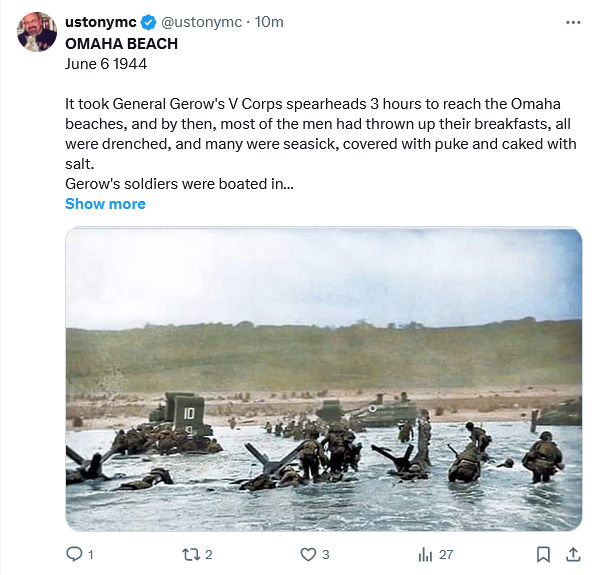
It took General Gerow’s V Corps spearheads 3 hours to reach the Omaha beaches, and by then, most of the men had thrown up their breakfasts, all were drenched, and many were seasick, covered with puke and caked with salt.
Gerow’s soldiers were boated in darkness 12 miles from the beach rather than 7 by the British. Even 7 was quite a distance for troops in LCVP’s to travel, especially in the choppy 10 knot seas off Omaha. But 12 in rough waters was a serious error of judgement.
Omaha Beach gave a dreadful and deadly demonstration of Murphy’s Law; All that can go wrong will go wrong at the wrong time:
* In this sector, American bombers, fearing to hit their own craft and troops had delayed their drop until their bombs crashed uselessly behind the German defenders.
* Here Rommel stationed the 352 Division, one of his finest.
* Here too, the Germans held the strongest natural positions facing the entire Overlord assault; hills and cliffs rising steeply up to 200 ft from the beach and the seawall above it. At Omaha was the greatest concentration of enemy fire on the 60-mile invasion front.
* Gerow loaded down his men with 90 pounds of gear. Even the best conditioned athletes in the world couldn’t go careening around the battlefield for hours so encumbered.
* Attempts to land artillery was a disaster, losing 26 guns.
* 32 tanks were launched in heavy seas 3 1/2 miles out. Five reached the beach, and 27 sank like stones, drowning most of the crews.
* Without tanks to take enemy fortifications under fire, the infantry had to storm the beaches themselves, flesh against fire. When the 5 tanks did arrive, they came behind, not in front of, the 8 spearhead companies–1,450 soldiers in 36 landing craft.
Heavy machine gun and mortar fire greeted these men as they waded ashore, many were wounded before they could reach dry land and had to struggle painfully up the beach heading for the protection of the seawall. A wall of wrecked vehicles built up quickly on the beach, soldiers taking cover from the scything German fire. One of them a soldier with a flamethrower took a direct hit in his fuel tank. The explosion catapulted his dying body into the sea and set the vessel on fire!
A company of 270 specially trained demolition men followed the infantry ashore, planning to blow up the boat obstacles before the tide covered them so that the following wave of 25,000 men and 4,000 vehicles might have an unimpeded path ashore, but German gunfire killed or wounded nearly half of them.
Among the infantry huddled beneath the seawall or strewn among the debris, collapse of command followed quickly upon the destruction of communications HQ, which took a direct hit. Too many of the American Jr officers on Omaha that morning had been paralyzed by that same immobilizing dread that had come over their men.
Offshore aboard the cruiser Augusta, Omar Bradley, had his binoculars trained on the Omaha beach. The First Army commander anxiety deepened upon receipt of fragmentary reports suggesting disaster on Omaha. He was shocked at the loss of 27 tanks and 26 artillery guns lost. When V Corps reported at noon, the situation, “still critical.” Bradley considered diverting follow up forces to other sectors. Bradley realized that all depended on “that thin, wet line of khaki” that had struggled ashore and was so desperately clinging to its precarious hold.
Although the German defenders at Omaha possessed the power to impede or disorganize the American advance, they were neither numerous nor strong enough to halt or destroy it. Throughout the battle they fought a static defensive fight. So, when the Americans gained ground or seized a toehold, they held it. The Germans never attempted to retake it. Like pieces being slowly fitted into a jigsaw puzzle, the Americans steadily expanded their hold. They were also fighting better and with more skill and better judgement.
Now the battle experience of the veteran 1st Infantry Division on the left began to have its effect. Small groups of soldiers from the “Bid Red One” had begun to advance up the narrow valleys mounting local attacks against the Germans in their pillboxes and communication trenches. They fought their way onto high ground and began to hammer the Germans on their flanks. By their valor and rising momentum, they gave encouragement to the inexperienced and all but paralyzed 29th Infantry Division on their right.
When General Norman (Dutch) Cota arrived on Omaha with his 29th Infantry command group he found chaos and paralysis. Cota moved among his dazed troops, coming upon a group of pinned down Rangers, he asked who they were. “Rangers” came the reply. “Then goddamnit, if you’re Rangers, get up and lead the way!” Stung, they leaped erect and began blasting paths through the German wire with bangalore torpedoes. The road at the top of the cliff was reached, the Americans had gotten behind some of the Germans strongest positions, killing the enemy or taking him prisoner.
When Cota found another group of Rangers apparently pinned down, he deliberately walked ahead of them to show there was no enemy fire. There was, but it didn’t kill Cota, and because the Americans had such men–soldiers who didn’t point the way but cried, “Follow Me!” the near disaster that had been Omaha was reversed.
At 1:30 pm, a vastly relieved Omar Bradley read Gerow’s message, “Troops formally pinned down on beaches Easy Red, Easy Green, Fox Red advancing up heights beyond beaches.”
By nightfall, the Americans controlled an area a mile deep beyond Omaha.
The highest casualties occurred at Omaha Beach where 2,000 Americans were killed, wounded or missing.
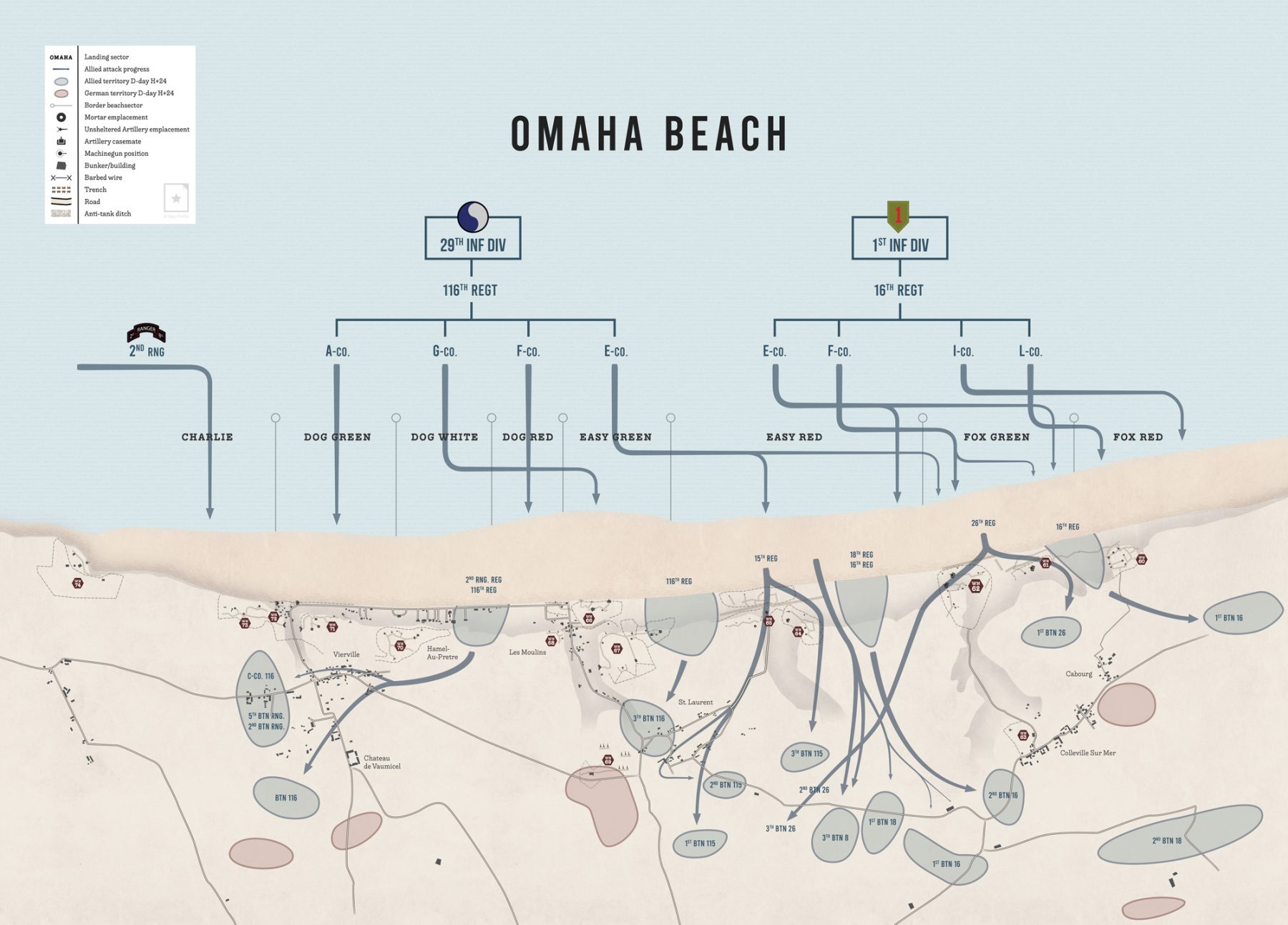


One of my favorite stories of Omaha was when the destroyers moved up to offer direct fire support, blasting artillery and machine guns with their five-inch turrets. Some got so close in-shore that the bottoms of their hulls scraped the sand.
One of the 29th’s veterans said in an interview that seeing gun emplacements vanish in explosions made him a big fan of the Navy that day. Never said a bad word about a swabbie again.
Naval power had quite a day on The Longest Day Dale!