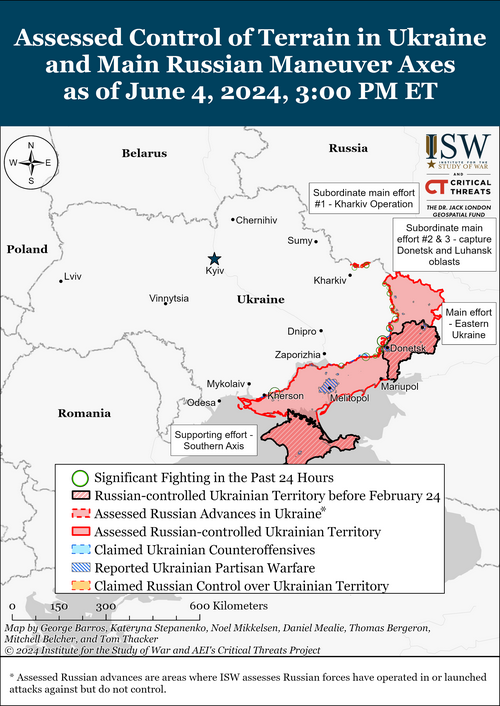
From The Institute for the Study of War:
Russian Offensive Campaign Assessment, June 4, 2024
Riley Bailey, Karolina Hird, Christina Harward, Nicole Wolkov, and George Barros
June 4, 2024, 6:35pm ET
Click here to see ISW’s interactive map of the Russian invasion of Ukraine. This map is updated daily alongside the static maps present in this report.
Click here to see ISW’s 3D control of terrain topographic map of Ukraine. Use of a computer (not a mobile device) is strongly recommended for using this data-heavy tool.
Click here to access ISW’s archive of interactive time-lapse maps of the Russian invasion of Ukraine. These maps complement the static control-of-terrain map that ISW produces daily by showing a dynamic frontline. ISW will update this time-lapse map archive monthly.
Note: The data cut-off for this product was 1:00pm ET on June 4. ISW will cover subsequent reports in the June 5 Russian Offensive Campaign Assessment.
Select Russian military commentators continue to complain about superior Ukrainian drone and electronic warfare (EW) capabilities on the battlefield, continuing to highlight the rapid and constant tactical and technological innovation cycles that are shaping the battlespace in Ukraine. A Russian milblogger who formerly served as a “Storm-Z” unit instructor posted a list of complaints on June 4 detailing the challenges that Russian forces face in repelling Ukrainian drones and claimed that effective and pervasive Ukrainian drone use is now the “leading factor” in Ukraine’s ability to repel Russian offensive actions.[1] The milblogger made six points about the Russian-Ukrainian drone disparity, claiming first and foremost that Ukrainian troops have a large numerical advantage in first person view (FPV) drones and FPV drone operators. The milblogger claimed that Ukrainian assault groups have a 3-4:1 FPV drone advantage over Russian assault units, while Ukrainian mechanized groups have a 6-10:1 FPV drone advantage over comparable Russian units. The milblogger noted that Ukraine also has specialized and centralized drone units within existing Ukrainian ground units, which allows Ukrainian forces to better integrate reconnaissance and attack drone capabilities into basic tactical maneuvers. Russian forces, by contrast, lack the centralized and organized drone-unit system and adequate EW and electronic reconnaissance (ER) capabilities to counter Ukrainian drones.[2] Another milblogger, whose initial post from May 31 spurred the former Storm-Z instructor to weigh in on the issue, noted that specialized Ukrainian drone units have heavily targeted and destroyed unprotected Russian armored equipment in the Avdiivka direction, inhibiting Russian offensive prospects in the area.[3] The milblogger emphasized that the provision of FPV drones and required EW and ER systems to Russian forces is done on an ad hoc volunteer basis, as there is no centralized supply mechanism from the Russian Ministry of Defense (MoD). These remarks on Russia’s need to centralize its drone warfare capabilities echo recent calls made by a cadre of Russian commentators, including former Russian Space Agency (Roscosmos) head Dmitry Rogozin.[4] As Ukrainian forces adapt and better integrate new technologies into their force, Russian forces will likely feel pressured to do the same in order to retain technological and tactical parity on the battlefield. This offense-defense and capability scaling race is central to the development of combat means in a contemporary war.
Ukraine and its partners have reportedly drafted a document for the Global Peace Summit in Switzerland on June 15 that calls for future engagement with Russia on a limited number of issues connected to Russia’s invasion of Ukraine, although the Kremlin remains unlikely to engage in meaningful negotiations on the proposal or any wider settlement to the war in Ukraine. Bloomberg reported on June 4 that the draft document aims to generate consensus among summit participants on nuclear safety, food security, and the return of abducted Ukrainian civilians and children.[5] The document reportedly states that this consensus will serve as a “confidence building measure” for future engagement with Russian officials on these issues.[6] The reported document specifically deems nuclear threats as “inadmissible” and calls for the return of the Zaporizhzhia Nuclear Power Plant (ZNPP) to Ukrainian control, and freedom of navigation in the Black Sea and the Sea of Azov so that Ukrainian agricultural products can reach third parties and the return of all deported and unlawfully displaced Ukrainian children and civilians to Ukraine.[7]
Russian officials have routinely been explicitly hostile to engagement with Ukraine on many of these issues, however. The Kremlin frequently threatens Ukraine and the West with nuclear weapons in order to promote Western self-deterrence. The Kremlin also uses nuclear rhetoric as a common tool of its reflexive control campaign aimed at influencing Western decision-making.[8] Russian officials have repeatedly attempted to use Russia’s physical control over the ZNPP to try to force international organizations to legitimize Russia’s occupation of the ZNPP and by extension Russian occupation of Ukrainian territory.[9] Russia withdrew from the Black Sea Grain Initiative, which facilitated limited agricultural exports from Ukrainian ports, in July 2023 and has since routinely targeted Ukrainian ports and agricultural infrastructure in southern Ukraine in an effort to constrain Ukraine’s ability to provide grain and other agricultural products to its partners.[10] Russian officials have shown very limited openness to the return of Ukrainian children from Russia and occupied Ukraine to Ukraine through mediation with third parties.[11] The Kremlin and Russian occupation officials continue to deport Ukrainian civilians and children from occupied Ukraine, however, and there is no indication that Russia is willing to stop this campaign or return deported and unlawfully displaced Ukrainians back to Ukraine at scale.[12] The Kremlin continues to feign interest in meaningful negotiations with Ukraine in an effort to push the West to make concessions on Ukraine’s sovereignty and territorial integrity and the Kremlin may use engagement on these more limited issues to pursue similar concessions.[13]
Russia is conducting a wide-scale hybrid warfare campaign targeting NATO states in tandem with Russian efforts to augment its conventional military capabilities in preparation for a potential conflict with NATO. Bloomberg reported on June 3 that Norwegian Chief of Defense Eirik Kristoffersen stated that NATO has a window of two to three years to rebuild its forces and stocks before Russia has rebuilt its own ability to conduct a conventional attack, presumably against NATO.[14] Kristoffersen stated that this expedited time frame is due to Russia’s current elevated defense industrial base (DIB) output. Western officials also continue to highlight Russia’s current engagement in hybrid warfare activities across Europe. The Financial Times (FT) reported on June 4 that Western governments are trying to formulate a response to the growing series of Russian-backed sabotage attempts on military bases and civilian infrastructure in Europe.[15] FT reported that an unspecified Western defense advisor stated that Russia has a “highly developed lexicon” for hybrid warfare, including information and psychological operations and sabotage. The defense advisor noted that Russia is learning from and adapting its hybrid warfare operations, stating that Russia is “constantly observing” the West’s reactions to these hybrid warfare operations and “testing to see which of [Russia’s] actions work.” FT reported that Russia has resorted to using proxies, such as operatives from criminal gangs, to conduct the sabotage attacks after European governments expelled hundreds of Russian diplomats and spies. NATO and its member states have repeatedly warned about intensifying Russian hybrid operations on NATO member territory.[16]
A joint investigation by Russian opposition student journal DOXA and open-source outlet Kidmapping highlights the role of the Kremlin-backed Russian Orthodox Church (ROC) in Russifying Ukrainian children whom Russian authorities have deported to Russia.[17] DOXA found that from the early days of Russia’s 2022 full-scale invasion of Ukraine, Russian officials deported children from orphanages and boarding schools in occupied Donetsk Oblast to Russia’s Rostov Oblast, where they were visited by Metropolitan Mercury (Igor Ivanov) of Rostov and Novocherkassk, who spoke to them about the ROC and seemingly enticed them to consider baptism into the ROC.[18] ROC clergy have also called for the baptism of deported Ukrainian children into the ROC and reportedly encouraged them to join various “military-patriotic” youth organizations in Russia.[19] DOXA and Kidmapping also found that deported children from occupied Donetsk and Luhansk oblasts stayed at shelters run by the ROC in Voronezh Oblast, where ROC clergy and affiliated officials hold “military-patriotic” events for the deported children in order to encourage pro-Russian and pro-ROC sentiment and cut the children off from their Ukrainian identities.[20] ISW has previously assessed that the ROC is instrumental in enacting the Kremlin’s occupation plan for Ukraine, and this appears to extend to Russian efforts to Russify deported Ukrainian children living in Russia.[21] Kremlin-appointed Commissioner on Children’s Rights Maria Lvova-Belova, against whom the International Criminal Court has issued an arrest warrant due to her role in facilitating the deportation of Ukrainian children, is notably married to an ROC priest.[22] Lvova-Belova and her husband have themselves adopted a deported Ukrainian child from Mariupol, highlighting the personal involvement of the ROC and other Kremlin officials in the deportation of Ukrainian children.[23] ISW continues to assess that the deportation of Ukrainian children, with the intent to destroy their Ukrainian identities via such Russification projects, amounts to a violation of the Convention on the Prevention and Punishment of the Crime of Genocide, which prohibits “forcibly transferring children of a group to another group” on grounds that it is an act of genocide.[24]
Russian President Vladimir Putin named First Deputy Speaker of the Federation Council and United Russia Secretary Andrei Turchak the acting governor of the Altai Republic on June 4.[25] Turchak chaired the Russian State Duma “Special Military Operation” Working Group dedicated to resolving issues with Russia’s war effort in Ukraine and reported on the working group’s efforts directly to Putin.[26] Former Altai Republic Head Oleg Khorokhordin resigned on June 4 reportedly to transition to a new, unspecified position.[27] Putin met with Turchak via videoconference to discuss Turchak’s new position and stated that the Altai Republic is a “promising but difficult” multinational republic where the Russian government wants to develop the tourism industry.[28] Russian outlet Vedomosti reported on June 3 that three sources close to the Russian presidential administration stated that the Presidential Plenipotentiary Representative in the Ural Federal District Vladimir Yakushev may replace Turchak as United Russia Secretary.[29]
Russian sources speculated on the meaning behind Turchak’s appointment. Russian opposition outlet Meduza stated that sources close to the presidential administration noted that Putin offered Turchak the position during a videoconference, not during a personal meeting as Putin usually does.[30] Meduza’s sources reportedly stated that Turchak’s new position is a demotion, comparing it to an “execution” and “deportation to a colony settlement.” A source reportedly stated that Turchak lost his position in the “power vertical” and that Turchak must have “seriously screwed up.” Meduza reported that a source close to the St. Petersburg government claimed that Putin moved Turchak because Turchak was “too active” in St. Petersburg and St. Petersburg Governor Alexander Beglov complained to Putin — a version with which other Meduza sources reportedly disagreed. A Russian milblogger refuted claims that Turchak’s appointment is “political exile” and claimed that the Altai Republic is geographically important given its position near Central Asia and Xinjiang, China.[31] The milblogger claimed that the West is active in Central Asia and that Russia will need logistics hubs and a strong executive power in the area if there are “serious showdowns” in Central Asia between the West and Russia. A Russian insider source claimed that the Russian government may launch a new association of federal subjects that Turchak will supervise.[32] The insider source claimed that the Russian government may hold a referendum, which Turchak will also oversee, to unify the Altai Republic and neighboring Altai Krai. There are multiple defense industrial enterprises in Altai Krai, and if the insider source’s claim about plans to unify Altai Republic and Altai Krai are true, the Kremlin may have appointed Turchak to oversee Russian defense industrial efforts in the region as part of a wider Kremlin effort to increase Russia’s defense industrial production.[33] Putin may have also moved Turchak in an effort to sideline and demote him without having to make a public show of the demotion, especially if Putin was displeased with Turchak’s advocacy for Russian servicemembers fighting in Ukraine.
Newly appointed Russian Defense Minister Andrei Belousov reportedly invited select Russian war correspondents and milbloggers to meet with him to coopt several Russian information space actors, prompting limited criticism from a prominent Russian milblogger. A Russian insider source claimed on May 26 that Belousov planned to meet with milbloggers and military correspondents to demonstrate that he has “nothing in common with his predecessor [now Russian Security Council Secretary] Sergei Shoigu.”[34] The Russian information space largely celebrated Belousov’s appointment as Defense Minister and expressed hope that his appointment would foster positive changes to the endemic problems that persisted under Shoigu’s MoD, such as the Shoigu MoD’s tendency to lie about Russia’s military performance in Ukraine and failures to adequately supply frontline forces.[35] ISW has previously observed that the Kremlin began efforts to coopt Russian milbloggers critical of the Russian military’s poor performance in the war in Ukraine by offering them state awards and government positions starting in November 2022 in an effort to regain control over the Russian information space.[36] A prominent Russian milblogger, who has previously criticized the Russian MoD and routinely posts complaints on his Telegram channel from Russian servicemen on the frontlines, claimed that Belousov invited a limited number of already-respected military correspondents, whom the Kremlin has coopted and likely deemed to be “safe,” and milbloggers to meet with him.[37] The milblogger further claimed that he would not be surprised if Russian MoD employees from the “old team,” likely referring to Shoigu’s affiliates at the Russian MoD, organized the meeting and expressed doubt that the Russian MoD would listen to milblogger suggestions. Russian milbloggers appear to be experimenting with different ways to express critical opinions of the Russian MoD following Belousov’s appointment, and Belousov may be meeting with military correspondents to constrain this criticism.[38]
Key Takeaways:
- Select Russian military commentators continue to complain about superior Ukrainian drone and electronic warfare (EW) capabilities on the battlefield, continuing to highlight the rapid and constant tactical and technological innovation cycles that are shaping the battlespace in Ukraine.
- Ukraine and its partners have reportedly drafted a document for the Global Peace Summit in Switzerland on June 15 that calls for future engagement with Russia on a limited number of issues connected to Russia’s invasion of Ukraine, although the Kremlin remains unlikely to engage in meaningful negotiations on the proposal or any wider settlement to the war in Ukraine.
- Russia is conducting a wide-scale hybrid warfare campaign targeting NATO states in tandem with Russian efforts to augment its conventional military capabilities in preparation for a potential conflict with NATO
- A joint investigation by Russian opposition student journal DOXA and open-source outlet Kidmapping highlights the role of the Kremlin-backed Russian Orthodox Church (ROC) in Russifying Ukrainian children whom Russian authorities have deported to Russia.
- Russian President Vladimir Putin named First Deputy Speaker of the Federation Council and United Russia Secretary Andrei Turchak the acting governor of the Altai Republic on June 4.
- Newly appointed Russian Defense Minister Andrei Belousov reportedly invited select Russian war correspondents and milbloggers to meet with him to coopt several Russian information space actors, prompting limited criticism from a prominent Russian milblogger.
- Russian forces recently advanced near Vovchansk, Siversk, and Donetsk City.
- The Russian military reportedly continues to forcibly send Russian military personnel, including those with serious medical issues, to fight in Ukraine.
- Russia continues efforts to militarize deported Ukrainian youth and prepare them for future service in the Russian armed forces.
Go here to read the rest. As always, with certain honorable exceptions, the Russian Orthodox Church functions as an arm of the Russian State.