Donald R. McClarey
Cradle Catholic. Active in the pro-life movement since 1973. Father of three, one in Heaven, and happily married for 43 years. Small town lawyer and amateur historian. Former president of the board of directors of the local crisis pregnancy center for a decade.
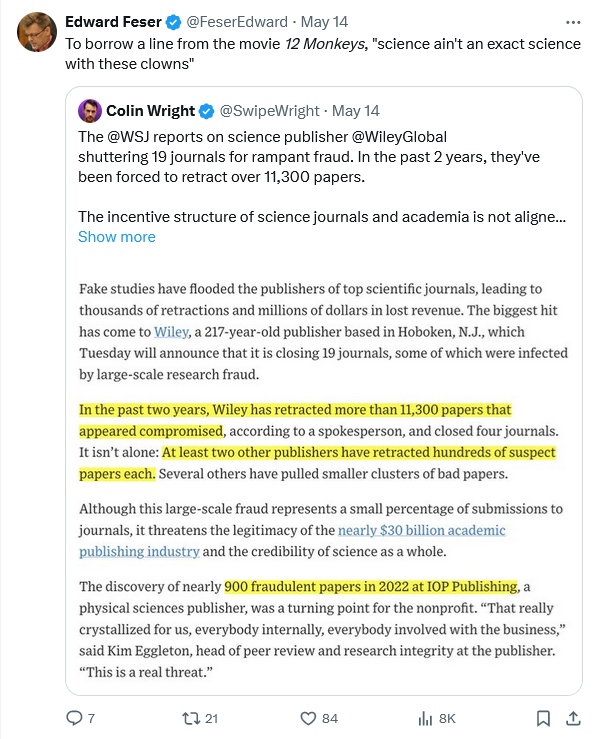



My upcoming highly scientific paper is entitled, “How Common Sense and a Two-Dollar BS Detector Saved Me from Myocarditis.”
Evidently, the referees they employ cannot readily detect fraud.
NB, journals in the natural sciences, medicine, and engineering have a history of publishing a far higher share of submissions than do social research journals and those in social research publish a higher share than humanities journals. Publishing 50% of submissions was once normal for science journals. (About 17% was normal for humanities journals). And some journals publish an avalanche of material. How their ‘editors’ sift through it I cannot imagine. <i>Journal of Biological Chemistry</i> was the champion – over 50 linear inches per year when print publication was the order of the day. <i>Journal of Comparative Neurology</i> (a Wiley title) put out 15 or 20 inches of material a year. The Institute for Scientific Information has the data on how often a particular article is cited. IIRC, the vast majority are never cited or are cited only by their own author.
Think I’ll stick with “The Journal of Irreproducible Results”. They’re the only honest game in town.
These losers lost me in my formative years.
Eggs are bad, eggs are good, just eat the whites, just eat the yolks.
Just shut up.
If it’s “publish or perish” in academia, it is high time they perish.
The trouble is that if you show this to scidoloters, they will just insist that the fact that papers have been retracted proves that the scientific method is “working.” Even though these are the exact same people who would use no retractions as evidence that all the papers are accurate.
There’s a few reasons why peer review doesn’t work to detect this stuff:
-It’s often difficult to find a reviewer who is in the same sub-specialty as the paper uses, in which case the reviewer will be ill-equipped to talk about the plausibility of these specific results even if he understands the area broadly.
-Many authors do not give out their raw data. Even when authors do, reviewers often do not have time to read through it. If you can make up whatever raw data you want then the rest of the paper doesn’t matter. (A while back someone went through social science papers and found that many of them had inconsistent data sets, ex. having a sample size of 10 but a mean for some integer valued quantity of 3.47 even though a mean with a sample size of 10 could only have a digit in the tenths place after the decimal.)
-Adding onto that last point, in many studies even if you did have the raw data, you still couldn’t directly check the results. This could be due to exotic equipment (got a large hadron collider lying around?) or the results obviously being dependent on the population polled (most social science papers fit into this category.)
-Many of the reviewers view the situation as “I’ll scratch your back if you scratch mine.” That is, I’ve got a paper coming up for review soon too and it’s publish or perish. So if I let your paper get through, maybe you’ll let mine get through, ok?
The end result is that reviewers tend to correct more for spelling and grammar than scientific accuracy.
The only way that you can have a working scientific method is if you do two things:
1.) Restrict the notion of “scientist” to people with good moral fiber who are unlikely to lie. Going with this, if someone is found to be even slightly dishonest he has to be run out of the whole business for life.
2.) Stress the importance of reproducibility studies. If we’re talking about a natural law, and science shouldn’t be studying other things, then either it is real and will come up in repeated studies or it’s not it and won’t.
Rudolph:
As a retired science teacher with a master’s degree, your (1) used to be automatic, for anyone cheating at any level in their university education was dismissed and it stuck to their record. Don may correct me, but I think that now it’s harder to give that kind of information out without risk of a lawsuit, unless the dishonesty resulted in a court record. (2) is still true for working scientists, but the problem is the media, which will run with any study that confirms what they want, even if it’s the only one or ten others stand against it. There’s also lots of money from businesses, governments and NGOs to scientists who come up with the “right” conclusions. The real solution is that EVERYBODY needs to be much more skeptical of this stuff than in the recent past.
I wonder whether any of those who are commenting have ever done research or published scientific papers. In general the review process works and makes good stuff come out. In my own case, my best paper (2590 citations and still getting one or two a week) had a grievous error of omission that the referee pointed out. I corrected it and asked the referee to be a co-author. My research director, E.B. Wilson wrote a book on scientific ethics; he told us we should be the ones most critical of our work; this is also what Richard Feynmann has said (I can’t find the quote).
The corruption has come because of money and politics intermixing with the scientific process. Read about the corruption amongst climate scientists (so-called) 10…20 years ago. But it is symptomatic of a general corruption. The social disease is not confined to a particular enterprise.
Bob – he told us we should be the ones most critical of our work
Such a brilliant point. That statement is true of all professions. Are scientists searching for an understanding of the truth of our natural world OR are do they practise the science with the intent to protect their egos. If it’s the latter, they will skew the narrative completely to protect their intellectual image. If it’s the former, then they will know that our understanding changes, the truth does not.
The latest on weather is that hurricane/typhoon season is going to be the worst it has been in many, many years. We’ll see. Maybe the prognosis is an excuse for rising home and car insurance premiums.