
My family of four has four BAs and five advanced degrees, and I think we may be at the end of a historical phase for such achievement. College degrees have become both too expensive and too meaningless. In the age of great educational debt, and college graduates who cannot write a coherent sentence, the current system is manifestly failing. I think the future is a combination of skill credentials, apprenticeships and in house training. For true scholars, something akin to current colleges will still exist, but they will be far fewer as will the students attending them. The current system may well eventually be considered a hot house plant of the twentieth century that expired in the twenty-first century.


I do not have a college degree, just Naval Nuclear Propulsion Training. I have had a very successful 40 plus year in commercial nuclear power as a result. I thank God for giving me that success. I routinely teach degreed engineers in my training classes. I had to mentor such a degreed engineer yesterday who graduated in 2018 and didn’t even know the basics.
PS, the best education is being on a submarine under the North Atlantic chasing Russians, not college.
Higher education is horribly padded and inefficient and extant institutions merit dismantling. You can say much the same about primary and secondary schooling.
Ideally, extant plant and equipment would be operated by real estate firms, some private corporations, some affiliates of the government. The firms would then play host to one or another educational institution.
Tertiary institutions would be variable in their clientele. A model:
You’d have adult education centers which would provide instruction in written and spoken English, arithmetic, elementary algebra; the fundamentals of American history, geography, and civics; and life skills courses like household budgeting.
You’d have 2d chance high schools, which might offer some academic courses but would be oriented toward vocational / technical instruction and largely replace the community college system; students at them would work on certificates in discrete trades and there would be no padding with distribution credits.
You’d have occupational institutes, which would federate schools offering 30, 48, or 60 credit programs in discrete subjects, no padding; you enroll in the accounting program, you take 48 credit-hours of accounting. The certificates could be offered over 1 academic year, 1 calendar year, or 2 academic years. The institutes might have schools of business, teacher training, nursing, technology, sports and recreation, police and security services, [non-business] administration, clinical laboratory sciences, &c.
You’d have preparatory institutes offering academic courses with some leavening of business or technology courses. Certain occupational and professional schools might require a standard certificate of such courses as a prerequisite and these and others might also admit students conditionally, insisting they fill in gaps in their secondary school program.
Then you’d have the universities. The universities might be split between an academic side and a professional side. On the academic side, you’d have a college where students would enroll for 1, 2, or 3 years of study of a discrete subject and you’d have a research center offering research degrees in such subjects. On the professional side, you’d have institutes devoted to engineering &c, medicine and allied, law, professional psychology (now and again), and veterinary medicine (now and again). Each might or might not have an associated research center offering research degrees. Appended to this would be a general research center offering research degrees on occupational subjects outside of engineering, medicine, law &c, e.g. the study of business or public policy.
Beyond that, you might have off center programs: service academies (military, naval, air, maritime, police, fire, civil aviation), diploma programs which combined hands on learning with some classroom instruction (in nursing, clinical laboratory sciences, and work in museums, libraries, and archives), agricultural institutes, arts institutes (music, studio art, theater, dance), stand-alone university components, certificate programs designed by commercial companies, &c.
Posit that perhaps 12% of each cohort receives academic instruction in a university setting and perhaps 4% stays for a full three years, the rest taking a credential and leaving. Posit perhaps 3-5% of each cohort might attend the professional institutes. Posit briefer programs at professional institutes – e.g. a foundational law degree of 50 credit-hours).
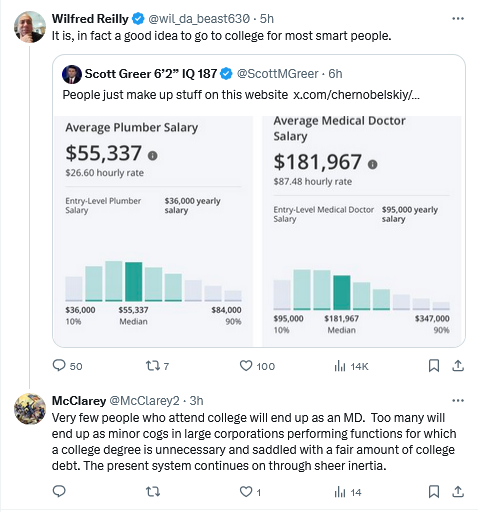
The “balance sheet” shown here lacks balance.
The cost, in lost earnings years and in educational expenses and in required outlays to be in business ( ex malpractice insurance) is ignored.
College is also spiritually perilous, a hotbed of enmity to God. Trading your faith for a great career is a fools bargain.
in VA and SC one could or can “read the law” meaning instead of law school be tutored by a lawyer of the bar. Of course pass the state bar same as a law school grad would have to for working as an attorney.
For engineers many colleges offer co-op programs wherein a student works with a company for a month then attends classes for a month. Not sure what the tuition savings are.
[…] Political News and Punditry:College Degrees Have Become Both Too Expensive and Too Meaningless – D. McClarey, J.D.Mayor Eric Adams Cites ‘TikTok’ for Spate of Women Being Attacked […]
Update: I did my training session yesterday with that engineer at Neutrons ‘R Us – a 20 something feminist graduated from college in a major California city. I did some background research and eventually discovered her Instagram account. Half naked lingerie photos with thongs and the whole nine yards. Not just swimsuit photos at the beach, but Playboy type centerfold pics. And these feminists don’t want to be objectified but prance around like whores before the camera and publish the risque photos in the public forum. And yes, she was completely ignorant in training – knew nothing about either NRC regulations or digital electronic technology. That’s what we in the submarine service called a rooster tease (think of the other word for rooster). Potiphar’s wife – that’s what this thing made me think of. Joseph ran the other way. I don’t want to be around her at all. Yes, I informed my manager. It’s his problem now. And he’s a Southern Baptist, as conservative as I am. Coincidentally, this young lady’s boss withdrew her from the training and assigned her a different work activity once he realize how regulatory driven and complex my area is. I thank God for that. The Lord is ever merciful.
Now yes, you all will say, “LQC, you’re a sex pervert.” Damn straight I am. That’s why I got married. St. Paul said it’s better to marry than to burn. My Filipina wife keeps my libido in check, and if it doesn’t stay in check, then it’ll get cut off. That’s the way things should be. And I damn sure don’t ever want to see half naked photos of girls (or even boys) who are my co-workers whom I have to train.
My son is getting the education of his life right now on a nuclear submarine under the Artic Circle ice cap. I told my boss that I wish I could give that kind of training to every single one of these millennial fruit cake feminists we have to train, and he agreed with me.
You have to pick a job which you like to do and which you’d be good at. There is no point being a plumber if it brings with it lots of money if you hate it and aren’t good with your hands.
I agree that many if the university degrees could come back to more on-the-job training. Eg. In my neck-of-the-woods, “Building” is a university degree. Being the daughter of a builder/carpenter myself I find that laughable and most of these big shots will come out of the degree with an inability to hammer a nail or use a drill. They just want jobs where they boss around the guy hammering the nail and using the drill. And if you know anything about tradiea is that if you tell them what to do and you have no idea how to do it yourself they will eat you for breakfast.
Agree that the subject and content taught in Higher Eduction degrees is filled with a lot of bull. But it needs to be changed, not done away with. And it needs to be changed inline with a job at the end. Because the rapid rate of change of technology at the moment indicates the future will have more thinking jobs than doing jobs. I think we are still hungover the the Covid mess and still finding ourselves struggling with a shortage of workers to fill manual jobs.
By the way, those figures at the top would be very different if you worked for someone who worked for yourself.
If you worked for yourself we have workers comp insurance, payroll tax, company tax, personal tax, bank interest repayments, rent/outgoings or operating expenses, superannuation, sick/leave entitlements, phone/laptop/car/equipment expenses all for businesses and employees. Then your own salary out of the business and re-investing profit (which don’t start kicking in properly until 5-10 years into the business). It’s false to say that the money for a plumber or a doctor running their own operation would be growing on trees. Most don’t make good money until years into the business. More so for the doctor.
If you were a specialist MD- that’s a whole other story and that is dependant how intelligent you are in order to become a specialist. Then, as others mentioned, medical insurance is through the roof.
Do what you love and that you are good at. Work hard at it. And trust in God. That’s the best formula for a successful professional life.
No one with a BA is going to become an MD. It is highly unlikely that anyone with a BA alone will get a high-paying job, unless they have a lot of hustle to go with it. A BS or engineering degree can still get you somewhere.
This is because rationality is being drained from academia, and those subjects without math and experiments to keep them slightly more honest will become meaningless faster.
Although, I would also say that being a doctor has quite a bit of practical technician work to it – a strong kinship with plumbing.
Teaching students how to think.