
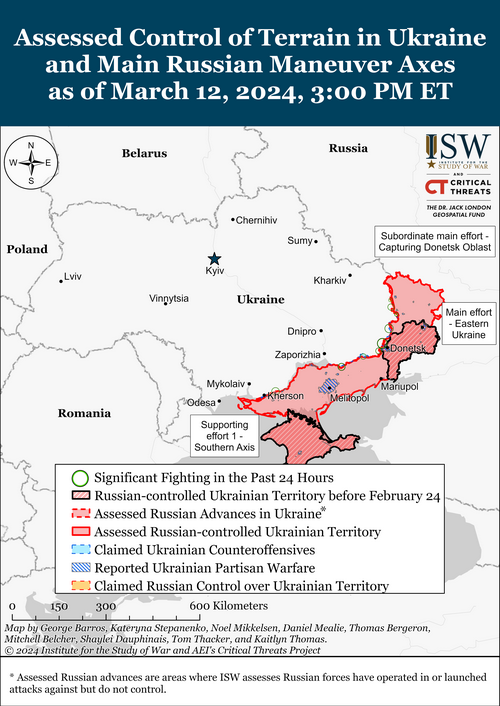
Russian Offensive Campaign Assessment, March 12, 2024
Angelica Evans, Christina Harward, Nicole Wolkov, Kateryna Stepanenko, and Frederick W. Kagan
March 12, 2024, 8pm ET
Click here to see ISW’s interactive map of the Russian invasion of Ukraine. This map is updated daily alongside the static maps present in this report.
Click here to see ISW’s 3D control of terrain topographic map of Ukraine. Use of a computer (not a mobile device) is strongly recommended for using this data-heavy tool.
Click here to access ISW’s archive of interactive time-lapse maps of the Russian invasion of Ukraine. These maps complement the static control-of-terrain map that ISW produces daily by showing a dynamic frontline. ISW will update this time-lapse map archive monthly.
Note: The data cut-off for this product was 8 pm ET on March 12. ISW will cover subsequent reports in the March 13 Russian Offensive Campaign Assessment.
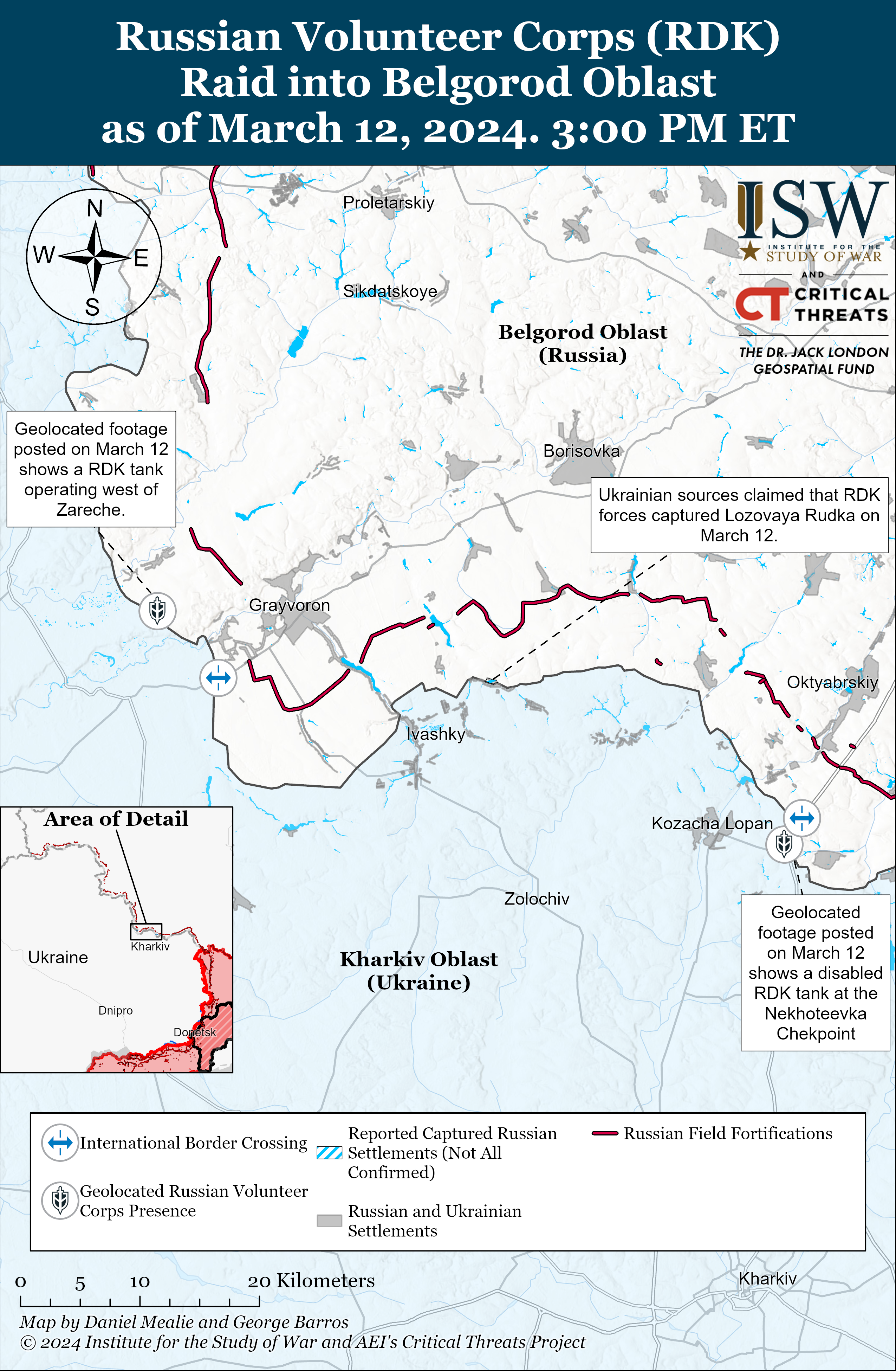
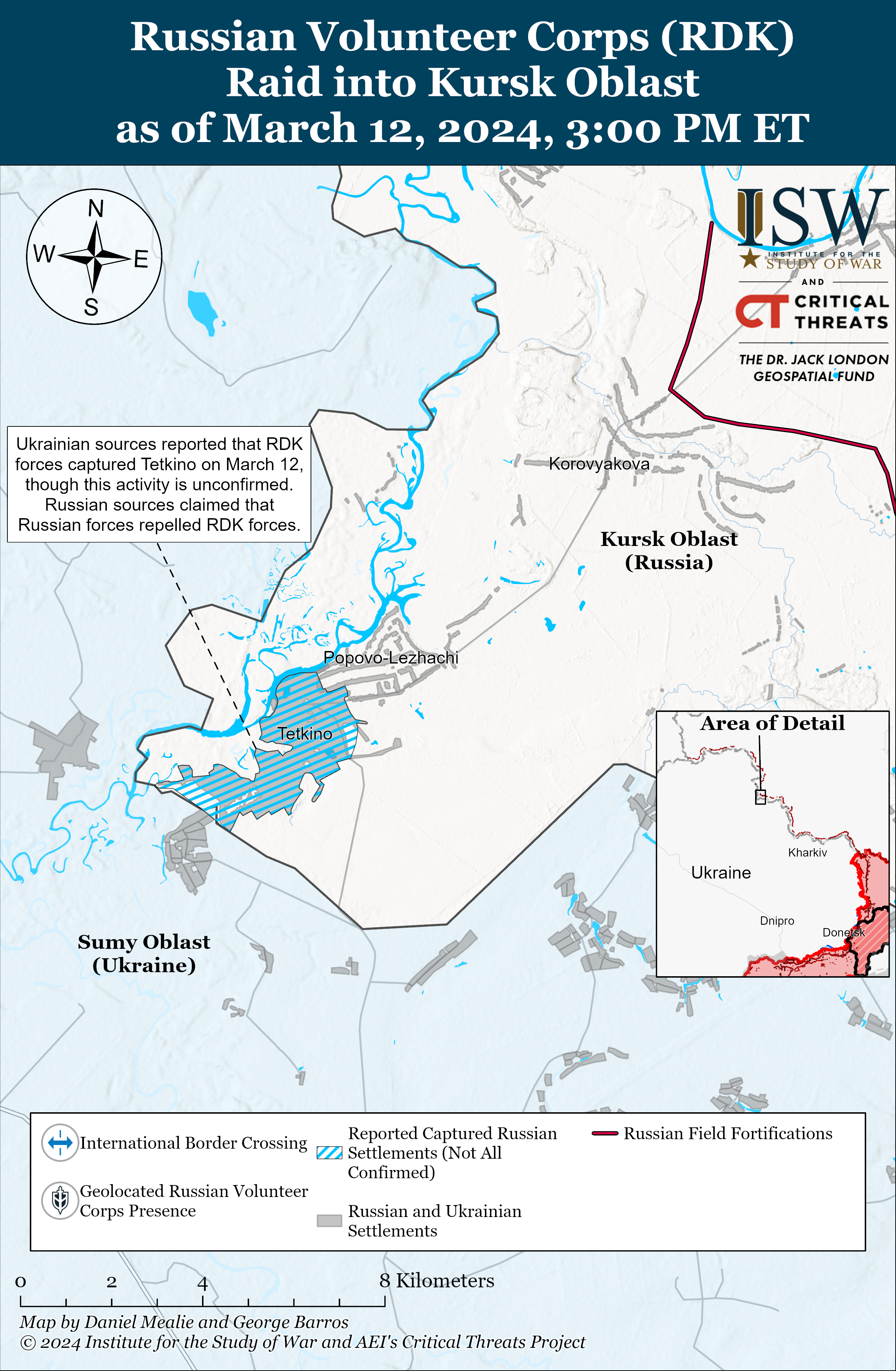
The All-Russian pro-Ukrainian Russian Volunteer Corps (RDK), Freedom of Russia Legion (LSR), and Siberian Battalion conducted a limited cross-border incursion into Belgorod and Kursk oblasts on the morning of March 12. Ukrainian Main Military Intelligence Directorate (GUR) Spokesperson Andriy Yusov stated on March 12 that elements of the RDK, LRS, and the Siberian Battalion were involved in clashes in Belgorod and Kursk oblasts.[1] Russian sources initially denied reports of the incursion but later claimed that Russian forces repelled Russian pro-Ukrainian forces with tank, armored vehicle, and drone support attacking near Odnorobivka, Kharkiv Oblast and Nekhoteevka and Spodaryushino, Belgorod Oblast.[2] Footage published on March 12 shows Russian pro-Ukrainian forces operating near Nekhoteevka and Spodaryushino in Belgorod Oblast and in Tetkino, Kursk Oblast.[3] LSR forces reportedly seized Tetkino, although Russian sources claimed that Russian airborne conscripts repelled all the assaults in Tetkino.[4] ISW has previously observed reports that Russia uses conscripts to defend its border with Ukraine against limited incursions and assessed that this is likely due to Russia’s unwillingness to transfer forces away from the frontline elsewhere in Ukraine.[5] Russian milbloggers noted that the incursion came days before the Russian presidential election on March 17, and several Russian milbloggers warned that there might be additional incursions in the coming days.[6]
The New York Times (NYT) reported that Russian and Ukrainian forces have differential advantages and disadvantages in their electronic warfare (EW) capabilities. NYT reported on March 12 that Russian forces have more EW equipment but that Russian EW capabilities are spread out unevenly along the front and that Russian armored vehicles are vulnerable to Ukrainian drone strikes due to their lack of mounted EW equipment.[7] The NYT stated that Russia’s defense industrial base (DIB) has adopted a “top down” approach to drone production with “heavy military oversight” that has made Russian drones “predictable” and lacking variety. This lack of variation has reportedly made it easier for Russian units to coordinate their drones’ flight paths and jammers so that they can jam Ukrainian drones without jamming their own. ISW has previously reported that the effectiveness of Russian EW systems is inconsistent across the front.[8] Russian milbloggers have routinely complained about Russian forces’ lack of EW systems in the east (left) bank of Kherson Oblast, for example.[9] Russian milbloggers have also recently criticized the Russian military command’s failure to properly equip Russian forces with drones and EW systems after an unsuccessful Russian mechanized assault near Novomykhailivka, Donetsk Oblast.[10]
The NYT noted that Ukraine’s DIB, on the other hand, has allowed non-military companies to fund and supply drones to Ukrainian forces, which has allowed Ukrainian drone units to test different technologies, procurement processes, and combat missions on the battlefield. The NYT reported that a Ukrainian sergeant commanding a drone platoon stated that Ukrainian and Russian forces are engaged in a “constant arms race” in which one side improves its drone technology, forcing the other side to find a new way to combat this improvement.[11] ISW has also previously reported that Ukraine has over 200 companies (most of which are privately owned) producing various drones for the Ukrainian military as of October 2023.[12] Moscow Duma Deputy Andrei Medvedev recently stated that Russia has opted to mass produce drones, leading to the production of large numbers of drones that lack the technological adaptations needed to compete with Ukrainian drones.[13] Medvedev noted that Ukrainian forces are constantly improving their drones. ISW has observed how recent Russian drone and missile strike packages are also characteristic of the constant air domain offense-defense innovation-adaptation race in which Russia and Ukraine are engaged.[14] Ukrainian and Russian capabilities will likely vary across space and over time as one side will be unlikely to gain a decisive advantage across the entire frontline or permanently in one sector of the front. There will likely be opportunities to take advantage of these shifting variations.
US Office of the Director of National Intelligence’s (ODNI) 2024 Annual Threat Assessment reported that Russian President Vladimir Putin “probably believes” that Russian forces have blunted Ukrainian efforts to retake significant territory and that US and Western support to Ukraine is “finite.”[15] The 2024 Annual Threat Assessment reported that Russia “almost certainly” does not want to engage in a direct military conflict with the United States or NATO but “will continue asymmetric activity below what it calculates to be the threshold of military conflict globally.”[16] ISW continues to assess that Russia continues to threaten NATO states and is setting conditions to justify future escalations against NATO states but does not assess that Putin desires direct full-scale war with NATO at this time.[17] US National Intelligence Director Avril Haines noted the importance of US security assistance to Ukraine to help Ukrainian forces maintain their previously liberated territories, especially amid “the sustained surge in Russian ammunition production and purchases from North Korea and Iran.”[18] ISW has previously assessed that the United States remains the only immediate source of necessary quantities of essential military equipment such as M1 Abrams tanks, armored personnel carriers, advanced air defense systems such as Patriots, and long-range strike systems – equipment that previous US aid packages prioritized.[19]
US National Security Advisor Jake Sullivan announced an emergency military aid package valued at $300 million for Ukraine on March 12.[20] Sullivan stated that the aid package is comprised of new funding made available by cost saving measures in unspecified Pentagon weapons contracts.[21] Unnamed US officials told CNN that the new funding is a result of “good negotiations” and “bundling funding across different things” but noted that this is not a sustainable long-term solution to aiding Ukraine, calling the package a “one time shot.”[22] This funding does not appear to be part of the reported $4 billion in presidential drawdown authority fund still available for Ukraine.[23] Sullivan stated that the aid package would provide Ukrainian forces with enough ammunition to last “a couple of weeks” and noted that this package “does not displace and should not delay the critical need” to pass a supplemental aid package for Ukraine.[24]
Lithuanian and French authorities are expected to meet in Paris in the coming days to discuss accelerating support for Ukraine. Lithuanian President Gitanas Nausėda stated on March 12 that he will meet with French President Emmanuel Macron in Paris to discuss ways to accelerate support for Ukraine, to strengthen the security of NATO’s eastern flank, and to increase European defense production.[25] Lithuanian Foreign Minister Gabrielius Landsbergis stated on March 11 that “now is the time to debate” sending Western military personnel to Ukraine and the “red lines that [the West] has imposed on [itself]” in response to recent French discussions about sending Western military personnel to Ukraine.[26] French Foreign Minister Stéphane Séjourné stated on March 9 during a meeting with Baltic and Ukrainian officials that Ukraine could use foreign troops for operations such as demining and that Russia should not be able to tell the West how to aid Ukraine by setting arbitrary “red lines.”[27]
The Kremlin continues to assert its right, contrary to international law, to enforce Russian federal law on officials of NATO members and former Soviet states for actions taken within the territory of their own countries where Russian courts have no jurisdiction, effectively denying the sovereignty of those states. The Russian Ministry of Internal Affairs (MVD) placed the Estonian Minister of Internal Affairs, Lauri Laanemets, on its online Russian wanted list.[28] Kremlin newswire TASS reported on March 12 that Russian law enforcement agencies stated that Laanemets is wanted for the destruction and damage of Soviet war monuments.[29] The Russian MVD previously put other Baltic and Polish officials, including Estonian Prime Minister Kaja Kallas, on the wanted list for the same charges despite Russia’s lack of legal authority to prosecute foreign citizens for allegedly violating Russian laws in foreign states.[30] The Russian Ministry of Foreign Affairs (MFA) also banned 347 citizens from Estonia, Latvia, and Lithuania, including many high-ranking Baltic officials, from entering Russia for allegedly having “hostile” policies towards Russia, interfering in Russian internal affairs, persecuting Russian-speaking populations, demolishing Soviet monuments, “glorifying Nazism,” and supplying Ukraine with weapons.[31] The Russian MFA claimed that it could expand the list “at any time.” Russia has previously used narratives about Russia’s right to protect its “compatriots abroad” (which includes Russian speakers), its alleged fight against neo-Nazism, and its dissatisfaction with the treatment of Soviet monuments in former Soviet states to justify its invasions of Ukraine and aggression against other countries, including NATO member Estonia, in the past.[32] ISW continues to assess that Russia‘s attempted use of pseudo-legal mechanisms against Baltic officials are part of the Russian efforts to set informational conditions justifying possible Russian escalations against NATO states in the future.[33]
The Kremlin recently implemented a series of personnel changes in the Russian Ministry of Defense (MoD), Rosgvardia, and the Russian military command. Russian sources reported that the Russian military command named Lieutenant General Andrei Bulyga Deputy Defense Minister for Logistics.[34] Kremlin newswire TASS reported that Bulyga previously served as Russian Western Military District (WMD) Deputy Commander for Logistics, and a Russian insider source, which has previously provided accurate reports regarding Russian command changes, claimed that Bulyga previously served in the Central Military District under Russian Colonel General Aleksandr Lapin, who is reportedly the current Russian Ground Forces Commander.[35] Russian State Duma Committee on Information Policy Head Alexander Khinshtein stated on March 11 that Russian President Vladimir Putin reappointed Deputy Defense Minister Colonel General Kuzmenkov as Rosgvardia Deputy Director overseeing rear areas and logistics and claimed that Kuzmenkov’s return to Rosgvardia means that Kuzmenkov has “completed his tasks” at the Russian MoD.[36] The Russian insider source claimed that the Russian military command appointed Lieutenant General Alexander Peryazev and Igor Seritsky as deputy commanders of the Moscow Military District and Lieutenant General Esedulla Abechev as Deputy Commander of the Leningrad Military District.[37] Peryazev reportedly previously served as the Commander of the Russian 6th Combined Arms Army (WMD); Seritsky reportedly previously served as the Deputy Commander of the WMD; and Abechev reportedly previously served as the Deputy Command of the 8th Combined Arms Army (Southern Military District).[38]
Armenian President Nikol Pashinyan stated that Armenia would leave the Russia-led Collective Security Treaty Organization (CSTO) if the CSTO fails to meet certain Armenian expectations, as Armenia continues to distance itself from Russian security relations. Pashinyan stated on March 12 that the CSTO must clarify its “zone of responsibility” in Armenia and pledge to defend Armenia against foreign aggression, likely referencing Article 4 of the CSTO Treaty that parallels Article 5 of the North Atlantic Treaty and states that aggression against one CSTO member state is aggression against all member states.[39] Pashinyan stated that Armenia would leave the CSTO at an unspecified date if the CSTO’s answers to Armenia’s questions do not correspond with Armenia’s expectations.[40] Pashinyan expanded on his February 22 statement that Armenia “essentially” froze its CSTO membership and explained that Armenia does not participate in CSTO sessions, does not have a permanent representative in the CSTO, did not appoint a CSTO Deputy Secretary General, and does not express opinions on documents circulating in the CSTO.[41] CSTO Secretary General Imangali Tasmagambetov stated on March 12 that Armenia has not recently participated in that CSTO secretariat, but that Armenia has not made any official statements about its suspension of CSTO membership.[42] Pashinyan also stated on March 12 that Russian border guards will leave Zvartnots International Airport in Yerevan by August 1, 2024, following a March 6 announcement that Armenia officially informed Russia that “only Armenian border guards” should perform duties at the Zvartnots Airport.[43] Kremlin Spokesperson Dmitry Peskov confirmed on March 12 that Russia received Armenia’s notification that it is terminating Russian border guards’ operations at the Zvartnots Airport.[44]
Key Takeaways:
- The All-Russian pro-Ukrainian Russian Volunteer Corps (RDK), Freedom of Russia Legion (LSR), and Siberian Battalion conducted a limited cross-border incursion into Belgorod and Kursk oblasts on the morning of March 12.
- The New York Times (NYT) reported that Russian and Ukrainian forces have differential advantages and disadvantages in their electronic warfare (EW) capabilities.
- US Office of the Director of National Intelligence’s (ODNI) 2024 Annual Threat Assessment reported that Russian President Vladimir Putin “probably believes” that Russian forces have blunted Ukrainian efforts to retake significant territory and that US and Western support to Ukraine is “finite.”
- US National Security Advisor Jake Sullivan announced an emergency military aid package valued at $300 million for Ukraine on March 12.
- Lithuanian and French authorities are expected to meet in Paris in the coming days to discuss accelerating support for Ukraine.
- The Kremlin continues to assert its right, contrary to international law, to enforce Russian federal law on officials of NATO members and former Soviet states for actions taken within the territory of their own countries where Russian courts have no jurisdiction, effectively denying the sovereignty of those states.
- The Kremlin recently implemented a series of personnel changes in the Russian Ministry of Defense (MoD), Rosgvardia, and the Russian military command.
- Armenian President Nikol Pashinyan stated that Armenia would leave the Russia-led Collective Security Treaty Organization (CSTO) if the CSTO fails to meet certain Armenian expectations, as Armenia continues to distance itself from Russian security relations.
- Russian forces recently made confirmed advances near Bakhmut, Avdiivka, and Donetsk City amid continued positional engagements along the entire line of contact on March 12.
- The Kremlin is reportedly considering raising taxes, likely as part of efforts to increase federal budget revenues to fund its war in Ukraine.
- Russian Presidential Administration Deputy Head Sergei Kiriyenko continues to pursue industrial projects in occupied Ukraine.
From here to read the rest. The raids into Belgorod and Kursk by Ukrainian forces are stunts to embarrass Putin on the ever of his reelection.

