
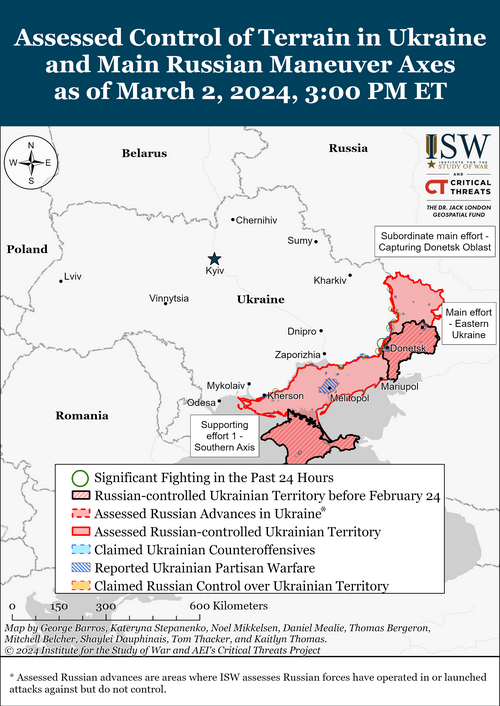
From The Institute for the Study of War:
Russian Offensive Campaign Assessment, March 3, 2024
Angelica Evans, Riley Bailey, Nicole Wolkov, Kateryna Stepanenko, and Frederick W. Kagan
March 3, 2024, 5:15pm ET
Click here to see ISW’s interactive map of the Russian invasion of Ukraine. This map is updated daily alongside the static maps present in this report.
Click here to see ISW’s 3D control of terrain topographic map of Ukraine. Use of a computer (not a mobile device) is strongly recommended for using this data-heavy tool.
Click here to access ISW’s archive of interactive time-lapse maps of the Russian invasion of Ukraine. These maps complement the static control-of-terrain map that ISW produces daily by showing a dynamic frontline. ISW will update this time-lapse map archive monthly.
Note: The data cut-off for this product was 12:30pm ET on March 3. ISW will cover subsequent reports in the March 4 Russian Offensive Campaign Assessment.
China and Turkey continue to pursue their own negotiation platforms for a settlement in Ukraine, which the Kremlin is exploiting to further its own information operations aimed at discouraging continued international support for Ukraine. Russian Deputy Foreign Minister Mikhail Galuzin and Chinese Special Representative for Eurasian Affairs Li Hiu met in Moscow on March 2 to discuss China’s desire to facilitate peace negotiations between Russia and Ukraine.[1] Galuzin and Li noted that it is “impossible” to discuss a settlement in Ukraine without Russia’s participation and without “taking into account [Russia’s] interests in the security sphere.” Galuzin and Li added that Western and Ukrainian “ultimatums” and “dialogue formats” only “harm the prospects for a settlement and cannot serve as [the settlement’s] basis.” Li is expected to visit Ukraine and unspecified EU states following his meetings in Russia.[2] Turkish Foreign Minister Hakan Fidan stated during the Antalya Diplomatic Forum on March 3 that Turkey hopes talks for a ceasefire in Ukraine will “start soon” and that Turkey believes that “both sides have reached the limits” of what they can achieve through military means.[3] Turkish President Recep Tayyip Erdogan recently announced that Turkey is prepared to provide another negotiation platform for Russia and Ukraine, which Russian Foreign Minister Sergei Lavrov publicly rejected on March 1.[4]
Russian officials continue to falsely blame Ukraine and the West for the lack of peace negotiations between Russia and Ukraine, despite numerous public Russian statements suggesting or explicitly stating that Russia is not interested in good faith peace negotiations with Ukraine.[5] Russian Foreign Minister Sergei Lavrov claimed during a panel at the Antalya Diplomatic Forum on March 2 that Ukraine lacks the “goodwill” to negotiate with Russia, insinuating that the lack of substantive negotiations is Ukraine’s fault and not Russia’s fault.[6] Lavrov claimed that people who misunderstand which party is at fault “lack understanding” about the reality of the situation. Russian Permanent Representative to the UN Vasily Nebenzya claimed during an interview with Russian TV channel Rossiya 24 on March 3 that Russia has never refused negotiations, but that Ukraine refuses to talk to Russia.[7] Nebenzya stated that there are currently no negotiation efforts with Ukraine directly or through intermediaries. ISW continues to assess that any Russian statements suggesting that Russia is or always has been interested in peace negotiations are very likely efforts to feign interest to prompt preemptive Western concessions regarding Ukrainian sovereignty and territorial integrity and place the onus for negotiations on Ukraine and the West.[8]
Recent relatively high Russian aviation losses appear to be prompting a significant decrease in Russian aviation activity in eastern Ukraine, although it is unclear how long this decrease in activity will last. Ukrainian Air Force Commander Lieutenant General Mykola Oleshchuk stated on March 2 that Russian aviation activity completely stopped in eastern Ukraine around 19:00 local time following the Ukrainian downing of two Russian Su-34 aircraft.[9] Ukrainian Air Force Spokesperson Colonel Yuriy Ihnat stated that the decrease in Russian aviation activity continued on March 3 and that Russian forces have continued not to fly A-50 long-range radar detection aircraft following the destruction of an A-50 aircraft on February 23.[10] Ukrainian officials reported that Russian forces have lost 15 aircraft since February 17, which is not negligible for the Russian military given that Russia likely has about 300 various Sukhoi fighter aircraft.[11] Previous Russian aircraft losses have prompted Russian forces to temporarily decrease aviation activity throughout Ukraine for significant periods of time, although it remains unclear how long this current period of temporarily decreased Russian aviation activity will last.[12] Russian forces appeared to tolerate an increased rate of aviation losses in recent weeks in order to conduct glide bomb strikes in support of ongoing Russian offensive operations in eastern Ukraine, and the Russian command may decide in the future to assume the risk of continued aviation losses in pursuit of further tactical gains.[13]
Delays in Western security assistance will likely make Ukraine’s energy infrastructure more vulnerable to Russian strikes. The Financial Times published an interview on March 3 with Maksym Timchenko, the executive of Ukraine’s largest private energy company DTEK, in which Timchenko warned that delays in security assistance have weakened Ukraine’s ability to counter Russian attacks on Ukraine’s energy infrastructure.[14] Timchenko stated that Ukraine was initially prepared to protect energy infrastructure at the beginning of Winter 2023-2024 but that in recent weeks more Russian drones and missiles have reached their targets.[15] Timchenko stated that Russian forces have targeted Ukrainian energy infrastructure 160 times in 2024 and that more than one million households and businesses have suffered from blackouts.[16] Russian forces launched several massive strike series against Ukraine in December 2023 and January and February 2024, likely forcing Ukrainian forces to expend a significant number of interceptors.[17] Ukrainian officials have stressed that Ukraine is facing a “critical shortage” of air defense missiles, and US officials have reportedly assessed that this shortage will become increasingly significant through spring and summer 2024 without further security assistance to Ukraine.[18] Timchenko noted that Ukraine’s economy depends on the stability of its energy grid, and major malfunctions in the energy grid would likely significantly disrupt ongoing Ukrainian efforts to expand its defense industrial base (DIB).[19] Limited effective air defense systems, dwindling air defense missile stocks, and continued Russian missile and drone strikes are likely forcing Ukraine to make difficult choices about air defense coverage.[20]
Russian forces operating around Avdiivka appear to be adapting to conducting offensive ground operations with trained and untrained personnel. The Washington Post published interviews on March 2 with seven Ukrainian servicemen from the 3rd Assault Brigade who discussed overwhelming Russian wave attacks in Avdiivka in the lead-up to Russia’s capture of the settlement in mid-February. Several interviewed Ukrainian servicemen described Russian forces involved in later direct assaults on Ukrainian positions as well-prepared. One Ukrainian soldier told the Washington Post that about three-quarters of Russian personnel his unit engaged with near Avdiivka appeared to have “decent” military training and the rest were “just confused.”[21] One Ukrainian serviceman recalled that a group of well-trained Russian soldiers used rocket-propelled grenades to enter their positions, while another serviceman recalled that inexperienced Russian servicemen avoided attacking his position after he was able to shoot eight soldiers in one day. The serviceman stated that the Russian military sent inexperienced personnel who appeared to be 40 to 50 years old to attack in waves each morning, afternoon, and evening without protective vests or helmets near Avdiivka. Another Ukrainian serviceman observed that the Russian skill levels were not “really consistent” and that some servicemen had more advanced equipment than their counterparts who only had basic rifles. The reports about inconsistencies in the nature of Russian attacks and in the quality of attacking personnel indicate that Russian forces may be conducting layered ground attacks alternating between groups of trained forces and untrained forces, likely consisting of mobilized personnel or Russian “Storm” units composed of recruited convicts.[22] Commander of the 2nd Assault Battalion of the 3rd Brigade Mykola Zynkevych similarly recalled in an interview with a Ukrainian publication that Russian forces used 20 to 30 people to attack one position — a lot more than Russian forces used in similar attacks during the effort to seize Bakhmut.[23] Russian forces likely used poorly trained personnel to carry out mass daily attacks on Ukrainian positions and employed trained personnel with better equipment to assault specific positions after exhausting Ukrainian forces. Russian forces are likely attempting to adapt ground attacks to sustain a higher tempo of offensive operations near Avdiivka with personnel of varying levels of training and to prevent rapid attrition of better-trained units and formations.
German officials confirmed that the Kremlin is conducting an information operation aimed at deterring Western states, particularly Germany, from sending additional military aid to Ukraine. German Defense Minister Boris Pistorius stated on March 3 that a leaked recording of German military officers discussing the theoretical provision of Taurus missiles to Ukraine is part of the “information war” that Russian President Vladimir Putin is waging against the West.[24] Pistorius stated that the Kremlin is conducting a “hybrid attack aimed at disinformation, division, [and] undermining [the West’s] resolve [and] unity.” Kremlin newswire TASS and veteran Russian propagandist and RT editor-in-chief Margarita Simonyan amplified the audio recording on March 1, in which German military personnel discuss how much training and preparation the German military would need to provide should Germany decide to supply Ukraine with Taurus missiles, and should Ukraine decide to conduct a complicated long-range precision strike against Russian targets such as the Kerch Strait Bridge.[25] Kremlin officials and Russian milbloggers seized on the audio to accuse Germany of planning a strike on the Kerch Strait Bridge and to accuse NATO of escalatory actions.[26] Russian Security Council Deputy Chairperson Dmitry Medvedev accused Germany of “preparing for war with Russia” and claimed that any effort to present the audio as an innocent “game of rockets and tanks” is “false.”[27] Russian officials have previously intensified their efforts to portray the provision of certain Western systems to Ukraine as significant escalations when those systems are subjects of debate in the West.[28]
The Russian Anti-Terrorism Committee (NAK) announced on March 3 that the Russian Federal Security Service (FSB) conducted a localized counter-terrorism operation in Karabulak, Republic of Ingushetia. Kremlin newswire TASS reported that Russian FSB officers conducted the counter-terrorism operation on four streets in Karabulak and killed six militants who were reportedly members of the Islamic State, were on the Russian federal wanted list, and had committed previous crimes.[29] Russian law enforcement has routinely attributed terrorist operations in the north Caucasus to the Islamic State when militants may be affiliated with the Islamic State or a different terrorist organization.[30] Russian milbloggers claimed that the militants wounded several Russian law enforcement personnel, while a Russian outlet reported that a man walking by was killed in a shootout.[31]
Key Takeaways:
- China and Turkey continue to pursue their own negotiation platforms for a settlement in Ukraine, which the Kremlin is exploiting to further its own information operations aimed at discouraging continued international support for Ukraine.
- Recent relatively high Russian aviation losses appear to be prompting a significant decrease in Russian aviation activity in eastern Ukraine, although it is unclear how long this decrease in activity will last.
- Delays in Western security assistance will likely make Ukraine’s energy infrastructure more vulnerable to Russian strikes.
- Russian forces operating around Avdiivka appear to be adapting to conducting offensive ground operations with trained and untrained personnel.
- German officials confirmed that the Kremlin is conducting an information operation aimed at deterring Western states, particularly Germany, from sending additional military aid to Ukraine.
- The Russian Anti-Terrorism Committee (NAK) announced on March 3 that the Russian Federal Security Service (FSB) conducted a localized counter-terrorism operation in Karabulak, Republic of Ingushetia.
- Positional engagements continued throughout the theater on March 3.
- Russian regional administrations continue efforts to expand the aperture of ongoing crypto-mobilization efforts.
Go here to read the rest. The Russians have not solved the problem of using their manned planes without encountering severe losses from Ukrainian air defense.

